

Restrictive practice includes physical restraint or the use of devices, medication or seclusion and must always be legally and ethically justified.
This means it must only ever be used when it is absolutely necessary to prevent serious harm and it must be the least restrictive option.
In some settings or situations you may need to provide care and support that involves some form or restrictive practice. If restrictive practice is used inappropriately, it will almost certainly be a breach of the individual’s human rights.

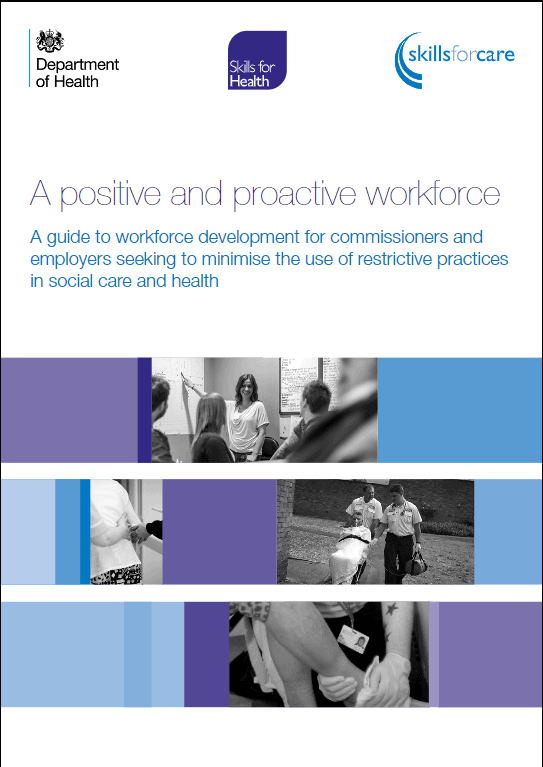
Skills for Care and Skills for Health have co-produced guidance for those who may need to carry out restrictive practices or interventions as part of positive support for people with social care needs who can display or are at risk of displaying behaviour that challenges or are resisting essential care.
A positive and proactive workforce
You can click HERE to find out more from Skills for Care’s website about Restrictive Practice and to access a copy of their guide to “A positive and proactive workforce” which looks at restrictive interventions and deprivations of liberty.
Restrictive practice can be obvious or subtle, it could be planned in advance or used as a response to an emergency.
Examples of restrictive practice:
- Restrictions that arise because of habit or blanket rules, like everyone having to be up by a certain time, rules on whether people can have their phones or doors being routinely locked. These are sometimes called “de facto” restrictions.
- For safety: these could be restrictions such as locking a room to keep household cleaning products or medicine out of someone’s reach or allowing someone a planned portion of jam each day. This could also mean responding to violence or aggression towards the individual themselves, or to the words of others.
- For treatment or care: restrictive practices may be used in a planned or unplanned way in order to provide essential care, support or medical treatment. This could be in an emergency. Some prescribed medication which is not designed to restrict, such as sleeping tablets, can have restrictive side effects.
- Restrictions may also be used with people who are displaying or are at risk of displaying behaviour that challenges, including self-injurious behaviour.
.svg)



