
14.1 Hello from Berlin!

In every Lesson from 7 - 15 there is going to be a featured German-Speaking city, which
will be the theme of the lesson. For 7 - 8 it is Berlin. There will be famous locations in
Berlin, for this lesson it's Kurfürstendamm and KaDeWe, the shopping area of Berlin. Also
in each lesson there will be facts, so if you ever travel to a German-Speaking country, it'll
be like you are a native!
14.1.1 Facts
It's Time to Change Time
Berlin's time is GMT+1. That means that they are 6 hours ahead of E.S.T. If it's 2:00pm
in New York City, it's 8:00pm (or 20:00) locally. Please note that Germany changes to
and from daylight-saving time a few weeks before the U.S., so time differences still vary in
March and October.
Tip, Tip, and More Tip
In contrast to many other countries where waiters sometime 'live on the tips' in Germanspeaking countries service personnel always receive a regular wage (usually per hour) and
the tip is always an extra for good service. Not to give a tip will probably give the waiter
the impression that either service or product were not that good and you are too polite to
admit this, but not tipping is not considered 'rude'. If you tip you usually round up, up to
50 Cents for coffee or up to the next 5 euros for lunch, e.g. 2,70 € becomes 3,00 € and 21 €
become 25 €.
Also, tipping is only expected when you get served, i.e. when the service
personnel bring something to your table, so if you pay at a counter – like at McDonald's
or StarBucks – you don't tip at all. Only when having a large party, like celebrating your
birthday in a restaurant, you do extra tipping. For a night you should pay 30 EUR to
80 EUR per waiter and give it separately to the manager (“für die Bedienung”). In many
restaurants it is normal the tip is shared with the kitchen personnel. Paying with credit
card or debit card makes tipping difficult, because there is no line on the bill to fill in the
tip. Always tip when paying, don't leave money on the table.
Shopping Locations
There are two major shopping locations. The Kurfürstendamm in the old west is lined
with boutiques and department stores. It continues eastwards for about three hundred yards
where you can visit KaDeWe, the biggest department store in Europe. On the newly developed Friedrichstraße in the old east, the famous French store Galleries Lafayette
is to be found together with a maze of underground shopping malls. Shops are generally
open 9am-8pm Monday through Saturday. In the outskirts most shops close at 4pm on
Saturdays.
14.2 Dialogue

Sarah Morgen, Lisa.
Lisa Morgen. Wie geht's dir?
Sarah Gut, danke! Ich gehe zum Kurfürstendamm, möchtest du
mitkommen?
Lisa Ja, gerne. Ich hole vorher noch Geld.
Sarah Ich sehe dich dann am Kurfürstendamm.
am Kurfürstendamm
Sarah Hallo Lisa!
Lisa Hallo!
Sarah Wohin gehen wir zuerst?
Lisa Lass uns zu dieser Boutique gehen.
Sarah O.K.
in der Boutique
Angestellter Thomas Hallo meine Damen!
Sarah und Lisa Guten Tag!
Angestellter
Thomas
Darf ich Ihnen helfen?
Lisa Ja, können Sie mir helfen, diesen Rock in meiner Größe zu
finden?
Angestellter
Thomas
Natürlich.
Angestellter
Thomas
Hier ist der Rock in Ihrer Größe.
Lisa Danke. Wo ist die Umkleidekabine?
Angestellter
Thomas
Dort drüben.
14.3 Shopping

There is a lot to say about shopping, places to shop at, money and items to buy. In this
lesson we will cover most of it. There are two big shopping locations in Berlin. They are
Kurfürstendamm and KaDeWe.
English /German
Babyweardie Babyartikel (plural)
Children's Wear die Kinderbekleidung
(Children) department die (Kinder-)Abteilung
Clearance Sale der Räumungsverkauf
Closed geschlossen
Clothing die Kleidung
Computer Section die Computerabteilung
Cosmetics die Kosmetik (singular) die Kosmetika (plural)
Customer der Kunde
Customer Service der Kundendienst
Electrical Appliance das Elektrogerät
English German
Escalator die Rolltreppe
Fashion die Mode
Furniture das Möbelstück (singular), die Möbel (plural)
Gift der Geschenkartikel
Good Value (Adj.) preiswert
Groceries die Lebensmittel (plural)
Jewellery der Schmuck (no plural)
Lady's Shoes die Damenschuhe (plural)
Leather Goods die Lederwaren (plural)
Open geöffnet
Opening Hours die Öffnungszeiten (plural)
Present das Geschenk
Reduced reduziert
price cut die Preissenkung
Sales Receipt der Kassenbon, der Kassenzettel, die Quittung
Souvenir das Andenken
Special Offer das Sonderangebot
Sporting Goods die Sportartikel (plural)
Stationery die Schreibwaren (plural)
Summer Sale der Sommerschlussverkauf (abbr. SSV)
Video Store die Videothek
Winter Sale der Winterschlussverkauf (abbr. WSV)
14.3.1 Kurfürstendamm
• Kurfürstendamm
Tauentzienstraße
Fasanenstraße
The Kurfürstendamm has many boutiques, department stores, etc., which are on
Tauentzienstraße and Fasanenstraße, two streets in Kurfürstendamm. Tauentzienstraße
has a lot of the department stores, including KaDeWe, which we will get into greater detail
later. Fasanenstraße has a lot of the boutiques.
English German
Department Store das Kaufhaus (old fashioned "das Warenhaus")
Retail Store das Einzelhandelsgeschäft
The Mall das Einkaufszentrum
Boutique die Boutique
Store das Geschäft
And some of the things you might say or ask while in a clothing store...
• Können Sie mir helfen, meine Größe zu finden (für dieses ____)?
Can you help me find my size (for this ____)?
80
Shopping
• Wo ist die Umkleidekabine?
Where is the dressing room?
English German
Managerder Manager
Employee der/die Angestellte
Sales Clerk der Verkäufer
Cashier der Kassierer
Dressing Room die Umkleidekabine
Men's Section die Männerabteilung
Women's Section die Frauenabteilung
14.3.2 KaDeWe
Another shopping location is das KaDeWe, an upscale department store in Germany. It has
six floors, and Is also called "The department store of the west" (Kaufhaus des Westens)
because it is the largest and most magnificent department store on continental Europe.
English German
First Floor Erstes Stockwerk
Menswear Männerkleidung
Second Floor Zweiter
Stock
Womenswear Frauenkleidung
Third Floor Dritter Stock
Kids Section Kinderabteilung
Fourth Floor Vierter Stock
Electronics Elektronik
Kitchenware Küchenbedarf
Fifth Floor Fünfter Stock
Lighting Beleuchtung
Bedding Bettwäsche
Toys Spielwaren
Sixth Floor Sechster Stock
Food Lebensmittel
Since we already have most of the general shopping phrases and vocabulary down, we are
going to get into more detail in the next few sections.
Section Problems2>>
1 http://en.wikibooks.org/wiki/%2FProblems%23Kurf.C3.BCrstendamm
2 http://en.wikibooks.org/wiki/%2FProblems%23KaDeWe
Electronics

First is electronics: it might seem a little sparse, but electronics and much other stuff will
be featured in Lesson 12.
English German
Electronics
die Elektronik
Television das Fernsehen/der Fernseher, die Fernseher (plural)
Digital Camera die Digitalkamera, die Digitalkameras
Telephone das Telefon, die Telefone
Cell phone das Mobiltelefon/das Handy (pronounced "Hendee"), die Mobiltelefone/Handys
Computer der Computer/der Rechner, die Computer/Rechner
Speaker, Speakers der Lautsprecher, die Lautsprecher
DVDs die DVDs (singular: die DVD)
CDs die CDs (singular: die CD)
DVD Player der DVD-Player
CD Player der CD-Player
Spielt der DVD-Player auch CDs?
Does the DVD player also play CDs?
Hat das Mobiltelefon/das Handy eine Digitalkamera?
Does the cell phone have a digital camera?
If you look at the word order of this sentence, you will see that you've already learned everything you need to make these sentences, and you, yourself can customize these sentences
if you want.
Bedding
The bedding section is also quite bare, but that is because it will be discussed further in
Lesson 12.
English German
Bedding die Bettwäsche
Blanket die Decke, die Decken
Pillow das Kopfkissen/das/der Polster (Austrian German), die
Kopfkissen/Polster
Pillow Case der Kopfkissenbezug, die Kopfkissenbezüge
Sheet das Betttuch, die Betttücher
Bed Skirt der Bett-Rock
And like always here are some of the things you might say that are related to bedding.
3 http://en.wikibooks.org/wiki/%2FProblems%23Electronics
82
Money
• Passen die Kopfkissenbezüge auf das Kopfkissen?
Does the pillow case fit the pillow?
And with that question there are other variations of it you can ask, like...
•
Passt die Decke auf das Bett?
Does the blanket fit the bed?
14.4 Money
Germany, Austria, Luxemburg, Belgium and Südtirol – in other words: all German speaking
regions except Switzerland and Liechtenstein– have given up their former currencies and
adopted the Euro as of 1999. Because they are not members of the European Union,
Switzerland and Liechtenstein have kept the Swiss Francs. Currently 1 EUR is 1.34 USD.
Now if you were at a shopping center in German like Kurfürstendamm, and you were
shopping at a boutique here is some vocabulary you might want to know.
• Was macht das?
Was kostet das?
How much does it cost?
• Das Hemd kostet 120 Euro.
The shirt costs 120 euros.
• Das kostet 690 Euro.
That costs 690 euros (all together).
English German
Price der Preis
Note der Schein
Coin die Münze
1 Euro coin das Eurostück, das Ein-Euro-Stück
2 Euro coin das Zweieurostück
5 Euro note der Fünfeuroschein
10 Euro note der Zehneuroschein
100 Euro note der Hunderteuroschein
Note: The word coin (Münze) mostly turns to Stück when a word or number is put together
with it.
Even though in the vocabulary we list the 1, 2, 5, 10, 100 Euro there are more Euro notes.
The twenty, fifty, two hundred, and five hundred Euro notes are the ones we didn't list, also
there are cent coins.
English German
1 Cent Coin
das Centstück
2 Cent Coin das Zweicentstück
5 Cent Coin das Fünfcentstück
10 Cent Coin das Zehncentstück
20 Cent Coin das Zwanzigcentstück
50 Cent Coin das Fünfzigcentstück
14.4.1 German Math
In written German, a comma is used (e. g. in prices) where we would put a decimal point in
English. Thus € 5,49 (or 5,49 €) means five euros and forty-nine cents. When a price ends
in a round number of euros, it is most commonly written as € 5,- etc. The reverse is also
true. Where as English uses a comma to split up large numbers, German uses a dot. So "€
6.945" means sechs tausend neunhundertfünfundvierzig (six thousand nine hundred
and forty-five) euros - not six point nine four five euros.
14.5 Clothing

English German
Skirt der Rock, die Röcke (plural)
Pullover der Pullover, die Pullover
Sweatshirt das Sweatshirt, die Sweatshirts
Scarf der Schal, die Schale/Schals
Jacket die Jacke, die Jacken
Coat der Mantel, die Mäntel
Shirt das Hemd, die Hemden
T-shirt das T-Shirt, die T-Shirts
Sweater der Sweater, die Sweater
(Neck)tie die Krawatte, die Krawatten
Bowtie die Fliege, die Fliegen
Suit der Anzug, die Anzüge
Pants die Hose, die Hosen (note: "die Hose IST"="the (pair of) pants
ARE")
Underpants die Unterhose, die Unterhosen
Boxershorts die Boxershorts (plural)
Top das Top
Bra der Büstenhalter/der Busenhalter (abbr. BH), die Büstenhalter/Busenhalter
Swimming costume der Badeanzug, die Badeanzüge
Trunks die Badehose, die Badehosen
Hat der Hut, die Hüte
Clothing
English German
Shoe der Schuh, die Schuhe
Sock die Socke, die Socken
Stocking der Strumpf, die Strümpfe
Tights/Pantyhose die Strumpfhose, die Strumpfhosen
Glove der Handschuh, die Handschuhe
Blouse die Bluse, die blusen
Cap die Mütze, die Mützen
Woollen hat die Wollmütze, die Wollmützen
English German
Size die Größe, die Größen
Color die Farbe, die Farben
Cotton die Baumwolle
Leather das Leder
Rayon die Kunstseide
English German
Small klein (abbr. S)
Medium mittel (abbr. M)
Large groß (abbr. L)
Extra-Large extragroß (abbr. XL)
14.5.1 Describing Clothes
Here are some of the words you can use when you are describing clothes:
English German
Cheap günstig, billig
Expensive teuer
Pretty schön
Ugly hässlich
Soft weich
New neu
Broad breit
Wide weit
Tight eng
Comfortable bequem
Uncomfortable unbequem
To say I like something or not, for clothing, it's...
I like it!
Er/Sie/Es gefällt mir!
I don't like it!
Er/Sie/Es gefällt mir nicht!
Now if you try something on or you're looking for a soft shirt with a tight fit, you find it,
feel it, try it on, but it's fairly expensive you might say this...
In English: The shirt looks great! The shirt feels soft, fits tight. The shirt is very
comfortable. How much does it cost? Oh no! The shirt is expensive! 55 euros is a little too
much for me.
In German: Das Hemd sieht prima aus! Das Hemd fühlt sich weich an, es sitzt eng. Das
Hemd ist sehr bequem. Wieviel kostet es? Oh nein! Das Hemd ist teuer! 55 Euro sind mir
ein bisschen zuviel.
The phrases to describe the shirt were...
The shirt looks great.
Das Hemd siehtprima aus.
The shirt feels soft.
Das Hemd fühltsich weich an.
The shirt fits tight.
Das Hemd sitzteng.
Now, the bold words are verbs that are one part in describing how the shirt is. The other
half of describing it is the adjectives like soft, tight, great, etc. And as you can see the verb
"looks" is separable, but we will get into that later.
14.5.2 Clothing-Related Verbs
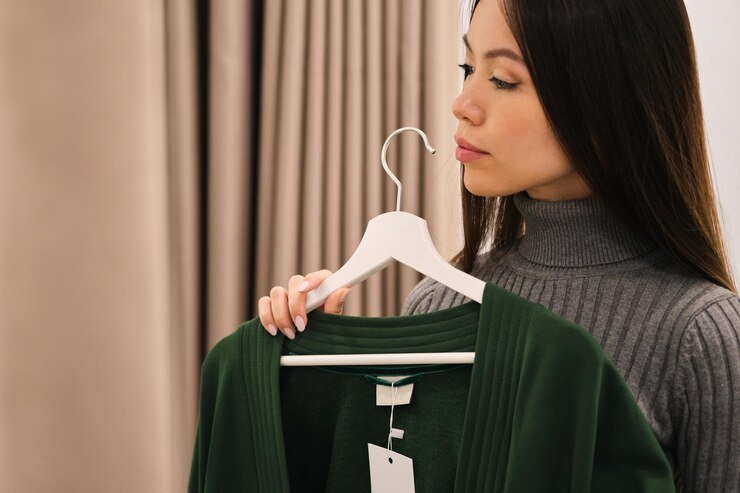
And now getting into verbs - here are some of the verbs, and also some of these are SeparablePrefix Verbs, like aussehen, anprobieren, and anhaben. But we will study those in more
detail later. Also we will be learning about "tragen".
English German
To look aussehen
He looks Er sieht aus
To try on anprobieren
He tries on Er probiert an
to put on anziehen
He puts on Er zieht an
To take nehmen
To buy kaufen
To have on/wear anhaben, tragen
He has on/wears Er hat an
14.6 Separable Prefix Verbs
Many German verbs change their meaning by adding prefixs, which are often preposition
such as ab-, an-, auf-, aus-, bei-, ein-, mit-, vor-, or zu-.The verbs anhaben (to wear)
and aussehen (to look) are both verbs with separable (trennbar) prefixes. That is, when
used next to the subject pronoun, the prefix is separated from the verb and put at the end
of the sentence or clause. Or, better put, In the present tense and imperative, the prefix is
separated from the infinitive stem.
Examples:
"Ich habe einen Mantel an." ("I'm wearing a coat." Or, more literally translated, "I have a
coat on.")
"Was hast du an?" ("What are you wearing?" or "What do you have on?")
However, when the separable-prefix verb is put at the end of the sentence, such as when
used with a modal verb, the verb in question and its prefix are not separated.
Examples:
"Du willst einen Mantel anhaben." ("You want to wear a coat.")
"Willst du eine Bluse anhaben?" ("Do you want to wear a blouse?")
14.7 Tragen
Instead of "anhaben" the verb "tragen" is often used. The sentences from above would then
be:
"Ich trage einen Mantel." ("I'm wearing a coat." )
"Was trägst du?" ("What are you wearing?")
"Du willst einen Mantel tragen." ("You want to wear a coat.")
"Willst du eine Bluse tragen?" ("Do you want to wear a blouse?")
The verb "tragen" has two meanings: "to wear" and "to carry". So if someone says "Ich
trage Schuhe" only the context will tell you whether the person is carrying the shoes in his
hands or actually wearing them. Tragen is a different kind of irregular verb -- one that not
only changes at the end of the word, but also changes internally. Notice that the vowel
in tragen's second and third-person forms changes from an a into an ä. Other verbs with
similar conjugation patterns include fahren, graben, schaffen, and waschen.
Person Singular Plural 1st ich trage wir tragen 2nd du trägst ihr tragt 3rd er/sie/es trägt sie tragen
14.8 Colors
Color are also another great way to describe clothes like Das rote Hemd passt gut.which
means The red shirt fits well.
Read the following paragraph, try to find the words described to have a color.
Wir fahren in den Schwarzwald. Ich habe ein grünes Hemd getragen. Die Reise war lang.
Es begann kälter zu werden und abzukühlen. Ich hörte Musik auf meinem braunen iPod.
Ich bin schließlich eingeschlafen. Als ich aufwachte, sah ich den blauen Himmel und den
weißen Schnee.
If you found 5 words you are right.
Schwarz which means black (the Schwarzwald (Black Forest) is a wooded mountain range)
Grünes Hemd which is a green shirt.
Brauner iPod which is a brown iPod.
Blauer Himmel which is blue sky.
And weißer Schnee which is white snow.
And now for the actual colors...
Red "Rot"
Blue "Blau"
Green "Grün"
Orange "Orange"
Violet "Violett"
Yellow "Gelb"
Brown "Braun"
Indigo "Indigo"
Gray "Grau"
Black "Schwarz"
White "Weiß"
.svg)



