


Franz Hallo, Greta! Wie geht's?
Greta Sehr gut. Ich habe Hunger.
Franz Ich auch. Möchtest du etwas essen?
Greta Ja!
In der Gaststätte
Greta Ich möchte Salat,Brot und Wasser.
Franz Hast du jetzt keinen Hunger?
Greta Doch, ich habe großen Hunger. Was bekommst du?\
Franz Ich bekomme ein Stück Apfelstrudel und einen Eisbecher.
Greta Warum das? Du sollst eine Bratwurst nehmen.
Franz Nein, ich bin zufrieden. Ich habe keinen großen Hunger.
Greta Ach so, dann ist das genug.
Nach zwanzig Minuten
Greta Diese Gaststätte ist schrecklich! Ich möchte etwas zu essen!
Franz Wir gehen!
11.2 Food!
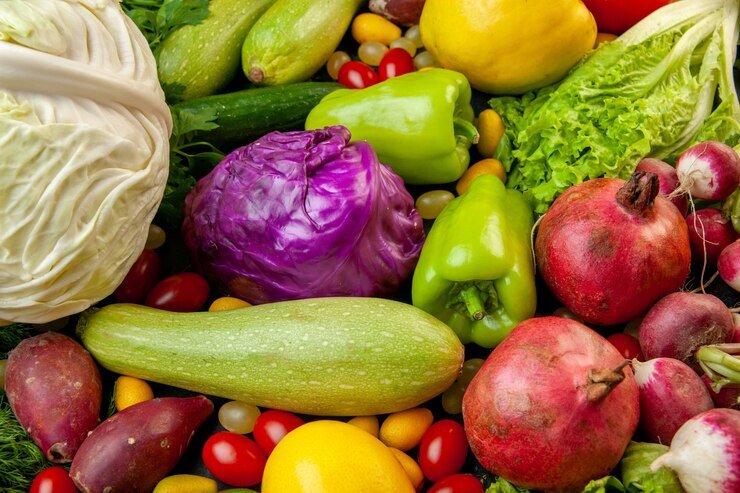
die Früchte (das Obst) - fruits das Gemüse - vegetables
der Apfel apple der Champignon, die Pilze mushroom
die Banane banana der Spargel asparagus
die Erdbeere strawberry der Spinat spinach
die Kirsche cherry die Erbsen peas
die
Orange orange die Kartoffel potato
die Traube grape die Tomate tomato
die Zitrone lemon die Zwiebel onion
die Grapefruit grapefruit die Bohnen beans
die Möhre, die Karotte carrot
das Fleisch - meat die Meeresfrüchte - shellfish,
seafood
das Lammfleisch lamb die Kammmuschel scallop
die Früchte (das Obst) - fruits das Gemüse - vegetables
der Truthahn turkey die Krabbe crab
der Schinken ham die Garnele shrimp
das Schweinefleisch pork der Fisch - fish
das Hähnchen chicken die Sardellen anchovies
das Rindfleisch beef der Lachs salmon
die Wurst sausage der Aal eel
die Milchprodukte - dairy products Other Foods
die Butter butter die Suppe soup
der Käse cheese die Pommes (frites) French fries
die Milch milk die Pizza pizza
der Joghurt yogurt der Hamburger hamburger
die Nachspeise - dessert der Senf mustard
das Bonbon candy das Brot bread
die Schokolade chocolate die Butter butter
die Torte tart der Salat salad
der Kuchen cake der Pfeffer pepper
der Apfelstrudel apple strudel der Reis rice
der (Apfel)Kuchen (apple) pie das Salz salt
das Eis ice cream der Zucker sugar
der Eisbecher bowl of ice cream die Konfitüre jam
11.3 Accusative Case
As you know from the introduction2
, in German, there are four cases. Three are used
often. The first, Nominative Case, you learned in Lesson 13
. It covers the subject4
, and
the predicate noun (in "He is (noun).", (noun) is the predicate noun). The second, the
Accusative Case, you will learn now. It covers the direct object5 and the object of several
prepositions6
. The third, the Dative Case will be taught later on. It covers the indirect
object7 and the object of many other prepositions.
The object of a sentence will be in accusative case. In, "You hurt me.", 'me' would be
accusative.
Note: The Accusative Case and Dative Case are identical in English; that's why German
has one case extra.
1 http://en.wikibooks.org/wiki/%2FProblems%23Food%21
2 Chapter 6 on page 17
3 Chapter 8.5 on page 28
4 http://en.wikipedia.org/wiki/Subject%20%28grammar%29
5 http://en.wikipedia.org/wiki/Direct%20object
6 http://en.wikipedia.org/wiki/Preposition
7 http://en.wikipedia.org/wiki/Indirect%20object
46
Accusative Case
11.3.1 Articles
Masculine Feminine Neuter Plural
Definite Article den die das die
Indefinite Article einen eine ein -eine*
* The indefinite article for plurals is non-existent. However related words, such as
possessives and the kein- words that you will learn later this lesson, will end in einefor
plurals.
In the articles, the memory hook for accusative case is "Der goes to den (pronounced "dane" UNKNOWN TEMPLATE audio De-den.oggaudio
) and the rest stays the same."
The masculine indefinite article goes to einen, and everything
else stays the same there. Therefore above, der Hamburger goes to den Hamburger and ein
Hamburger goes to einen Hamburger when the hamburger is the direct object, such as in
"Er hat einen Hamburger." ("He has a hamburger.")
If you are getting confused, it's fine. This topic is one of the hardest for English speakers
to grasp.
Here are some solutions:
To find out the case of something, first find the verb. The verb rules the sentence. Everything revolves around it. Next you find the subject of the sentence. The subject is the
thing/person that is doing the verb. The subject is always in the Nominative Case,
so it takes on the der, die, das, die, or ein, eine, ein.
Now you look back at the verb. If it is a being verb (am, are, is, etc.), the next noun
after the verb is the predicate noun. An easy way to figure this out is to write an
equation. If the verb can be replaced with an equals sign (=), then the following noun is a
predicate noun. If it can't be replaced by an equals sign, refer to the next paragraph. The
predicate noun is also always in the Nominative Case, so the same rules apply
to it.
Ich bin ein Junge.
Sie ist eine Frau.
If the verb of the sentence is an action verb (playing, throwing, making, eating), find what
the subject is doing the verb to. For example, if
the verb is "makes" (macht), you look
for what is being made. That is the direct object. The direct object is always in the
Accusative Case, so it takes on the den, die, das, die, or einen, eine, ein.
Sie haben den Cheeseburger.
Habt ihr einen Salat?
The indefinite articles, when you just look at their endings, select e, -, e for nominative
case, and en, e, -, e for accusative.
Remember, between nominative and accusative, the only third-person change is in the
masculine form.
11.3.2 Pronouns
The pronouns experience a much bigger change than the articles. This is also true in
English, as the articles (a, an, the) do not change ever, but I goes to me, we goes to us, etc.
Not everything is the same, though. While me is mich and us is uns, the second and third
persons undergo different changes. In third person, as in the articles, the only change is
in masculine singular.
Following the "der goes to den" rule, er goes to ihn when in the
accusative case.
The second person in English never changes. In German, du goes to dich and ihr goes to
euch. Sie, the formal version of either, stays the same. Remember, Sie (2nd person formal)
and sie (3rd person plural) only differ in their meanings and the fact that the former is
capitalized and the latter is not. This stays true throughout German grammar.
Here is a tabular representation of the above.
8 http://en.wikibooks.org/wiki/%2FProblems%23Articles
48
Accusative Case
Person Singular Plural
English German English German
1st me mich us uns
2nd you dich you (all) euch
3rd him, her, it ihn, sie, es them sie
11.3.3 Antecedents
Note: This is just a quick lesson in English grammar applied into German. If you already
know all about antecedents in English, skip the first paragraph.
When using a pronoun, you have to know what it is for it to work. There are some rare
exceptions, such as in mysteries or drama, but otherwise this is always true. Sometimes in
dialogue this is taken care of by pointing or making some other gesture, but most of the time,
the pronoun modifies something already mentioned. The object/person mentioned
earlier that turns into a pronoun later is called the antecedent.
In German this is very useful. You can't simply say 'it' any more. Many food words are
masculine and feminine, and when you turn them into pronouns, they turn into 'he', 'she',
'him', and 'her', not always 'it'. For example, the sentence "The cheeseburger tastes good.
It's very crunchy." turns into "The cheeseburger tastes good. He's very crunchy." Note:
You will learn how to say this in German later in this lesson.
Why is it "he"? This is where the antecedent comes in. Because there are foods that are
masculine and feminine in German, you can't assume the 'es'. You have to look back at the
previous sentence, at the antecedent, der Cheeseburger. "Der Cheeseburger" is replaced by
er (since it is the subject, and therefore in Nominative Case). Therefore, all you need to
know are these connections: der/den-er/ihn, die-sie, das-es, die-sie.
11.4 Food-Related Verbs

• essen (I) - to eat, to be eating, to do eat
• trinken - to drink, to be drinking, to do drink
• bekommen - to get/receive, to be getting/receiving, to do get/receive
• möchten (M) - would like
• wollen (M) - to want, to be wanting, to do want
Of these five verbs, only trinken and bekommen are regular. Essen is irregular (that's what
the "I" means). Do you remember from the last lesson 'lesen' and 'sehen'? In both of them,
the first 'e' changed to 'ie' in the du- and er/sie/es-forms. Well essen experiences the same
change, except that it changes to 'i', not 'ie'. Also, it acts the same as 'lesen' in the du-form:
You don't have three s's in a row.
9 http://en.wikibooks.org/wiki/%2FProblems%23Pronouns
10 http://en.wikibooks.org/wiki/%2FProblems%23Antecedents
50
Food-Related Verbs
Person Singular Plural
1st ich esse wir essen
2nd du isst ihr esst
3rd er/sie/es isst sie essen
Isst sounds and looks a lot like ist. The minute difference happens to be in the way you
pronounce the s. When you mean eats it is sometimes an overstressed hissing (i.e. extremely
sharp) sound. In normal life Germans, too, can only tell which verb is meant from knowing
the context.
Just like in last lesson, where you could say, "Ich spiele gerne Fußball.", you can also extend
it to food. "I like to eat cheeseburgers." is translated as "Ich esse gerne Cheeseburger."
Before 199611, the usage of ißt and eßt were common, but the new reform rules specify that
these spellings are now the only correct spellings.
The last two verbs (marked (M)) are modals. They will be discussed in the next section.
11.5 Modals
In the introduction13, you learned that German has no helping verbs. Instead, they have
modals, words that basically do the same thing.
Modals are conjugated very differently from normal verbs. The ich- and er/sie/es-forms are
always the same, while the du-form adds an 'st'. Most modals experience a vowel change
from singular to plural, and the rest is the same.
11.5.1 Möchten
'Möchten' isn't technically a modal, but it acts exactly the same. There is no vowel change,
and the ich- and er/sie/es forms are "möchte". Here is the complete conjugation:
11 http://en.wikipedia.org/wiki/German%20spelling%20reform%20of%201996
12 http://en.wikibooks.org/wiki/%2FProblems%23Food-Related%20Verbs
13 Chapter 6 on page 17
52
Modals
Person Singular Plural
1st ich möchte wir möchten
2nd du möchtest ihr möchtet
3rd er/sie/es möchte sie möchten
'Möchten' means "would like" and can be applied to food (e.g. Ich möchte einen Cheeseburger.). Möchten can be translated even more literally as "would like to", and is traditionally used with an infinitive verb at the end of the sentence (e.g. "Ich möchte jetzt
gehen"/"I would like to go now"). However, this infinitive is not necessary if it's completely
obvious what you're talking about (If you say "Ich möchte einen Cheeseburger", everyone
will assume that you would like a cheeseburger to eat.)
(Note: Technically, "möchten" is not a word. The above cited conjugation is actually
the "Konjunktiv" of "mögen", which has become so popular as a phrase, that even many
Germans today aren't aware of it any more, so you don't need to worry about it. "Etwas
mögen" means "to like to", and "I would like" is the closest translation of "ich möchte.")
11.5.2 Wollen
'Wollen' is a true modal; it even changes vowels. Ich/er/sie/es will and du willst. Here is
the complete conjugation:
54
Modals
Person Singular Plural
1st ich will wir wollen
2nd du willst ihr wollt
3rd er/sie/es will sie wollen 'Wollen' can also be applied to food, but may be considered impolite and demanding ("Ich
will einen Cheeseburger!" roughly means "I demand a cheeseburger!"
Möchten should be
used instead: "Ich möchte einen Cheeseburger!" = "I want a cheeseburger!").
'Wollen' should not be confused with the future tense, despite the presence of the English
word 'will' in the conjugations. However, will14 can also mean an intent or a document
showing what one wants to happen. So it is not so different from 'to want' as possibly
originally presumed.
11.5.3 Modals with other verbs
This is very important. When you need to use another verb with a modal (such as
expressing you would like or want to perform an action), the sentence's word order is
somewhat different than it would be in English. In English, you would state the subject
pronoun (such as "I"), an English equivalent to the modal verb (such as "want"), the action
you want to perform (such as "to eat") and then what the action will be performed on (such
as "hamburger"), making the sentence "I want to eat a hamburger."
In German you must
put the action at the end of the sentence, making the sentence "I want a hamburger to eat."
("Ich will einen Hamburger essen.")
11.6 Hunger and Thirst

In German, instead of saying, "I'm hungry."(Ich bin hungrig), you may also say "I have
hunger."(Ich habe Hunger) The same applies to thirst.
Here are the German translations
of the corresponding nouns:
Hunger - der Hunger
Thirst - der Durst
Like in English, these two words do not have a plural form. When using them, you don't
need to worry about the 'der'; you can just say, "Ich habe Hunger" to say "I am hungry"
and "Ich habe keinen Hunger" for "I am not hungry."
Somewhat archaic but still in use are the adjectives hungrig and durstig. Those are often
used when talking about someone (especially animals): "Der Löwe ist hungrig" for "The
lion is hungry".
Section Problems16 >>
14 http://en.wiktionary.org/wiki/will
15 http://en.wikibooks.org/wiki/%2FProblems%23Modals
16 http://en.wikibooks.org/wiki/%2FProblems%23Hunger%20and%20Thirst
56
Formal Conversations
11.7 Formal Conversations

In Lesson 117, you learned how to talk formally, using phrases like "Guten Morgen!" and
"Wie heißen Sie?". There are, however, a few words that are 'survival words' in Germany,
specifically:
Danke - Thank you, Thanks
Bitte - Please and You're welcome.
To make this even more formal, you can tack on the word 'schön' to the end of "Thank you"
and "You're welcome" to make 'dankeschön' and 'bitteschön' (both one word) in response.
'
Schön' literally means 'pretty' (you'll relearn this next lesson).
Some other ways to say "thank you":
• Dankeschön - Thank you very much
• Danke sehr - Thanks a lot
• Herzlichen Dank ("herzlichen" means sincere or from the heart; you may remember it
from "Herzlichen Glückwunsch zum Geburtstag!" last lesson)
• Vielen Dank - Thanks a lot
• Tausend Dank* - Thanks a million (literally meaning a thousand, but English is more
generous)
• Aufrichtigen Dank* - would be "thank you sincerely" (very formal)
* - You will not be tested on these phrases.
Some other ways to say "You are welcome":
• Bitteschön!
• Bitte sehr!
• Gern geschehen! - Don't mention it
• Gerne! - also meaning "gladly"
• Kein Problem! - No problem
• Dafür nicht!* - (Do) not (thank me) for this (only used in Northern Germany)
* - You will not be tested on this phrase.
These might also be useful:
Entschuldigung - Excuse me, Pardon
Es tut mir leid - Sorry, I'm sorry
11.8 Kein-words
Twice you have been taught that the ending of the indefinite article for plurals would be
eine (for Nominative and Accusative cases), if there was an indefinite article for plurals.
17 Chapter 8 on page 23
18 http://en.wikibooks.org/wiki/%2FProblems%23Formal%20Conversations Now that lesson applies. The kein-words have the same endings as the ein-words, and
they mean the opposite: no, not any, none.
For example, "kein Cheeseburger" means
"no cheeseburger". "Keine Cheeseburger" (in this case Cheeseburger is plural) means "No
cheeseburgers". Notice the 'e' at the end of 'keine'. That's the ending for plurals and
feminine nouns and can be likened to the "der, die, das -> die" relationship, where the
feminine article serves for the plural as well.
11.9 Ordering at a Restaurant in Germany

das Restaur'ant' (French pronunciation) - Restaurant
UNKNOWN TEMPLATE Audio
Fr-Restaurant.ogg
There are many restaurants you might find in Germany. Much like in English-speaking
countries, you would more likely use the name of the restaurant than name what kind of
restaurant. If you want to address the wish to eat a certain food, there are two ways:
example: "wanting to eat chinese food"
1. "Ich möchte gerne zum Chinesen." - literally: "I want to go to the Chinese (restaurant)."
2. "Ich möchte gerne chinesisch essen (gehen)." - literally: "I want to (go) eat Chinese (style
food).
"
Here are some more restaurants you can find in Germany:
• American food: "zum Amerikaner" / "amerikanisch essen"*
• Arabic food: "zum Araber" / "arabisch essen"
• Chinese food: "zum Chinesen" / "chinesisch essen"
• French food: "zum Franzosen" / "französisch essen"
• Greek food: "zum Griechen" / "griechisch essen"
• Italian food: "zum Italiener" / "italienisch essen"
• Indian food: "zum Inder" / "indisch essen"
• Japanese food: "zum Japaner" / "japanisch essen"
• Mexican food: "zum Mexikaner" / "mexikanisch essen"
• Spanish food: "zum Spanier" / "spanisch essen"
• Turkish food: "zum Türken" /
"türkisch essen"
* "zum Amerikaner" is often used in a jokey way, to express that one is going to either McDonald's
or Burger King. There are few American restaurants, in Germany and they are mostly referred to
as "(American) Diner", so it is not used like "zum Italiener".
19 http://en.wikibooks.org/wiki/%2FProblems%23Kein-words
58
Accusative case prepositions
11.10 Accusative case prepositions
You read at the beginning of this lesson that the Accusative Case covers the direct object
and the objects of some prepositions.
Here are those prepositions that always fall under
Accusative Case:
bis - until
durch - through
entlang - along
für - for
gegen - against
ohne - without
um - at, around
You learned um last lesson, and ohne earlier this lesson. Bis, durch, entlang and gegen will
be taught in depth later, and für will be taught now.
Up until this point, you have only worried about the Accusative Case in third person. Für,
meaning 'for', can and should be used in the first and second persons, too. Here's an
example:
"The cheeseburger is for me." - "Der Cheeseburger ist für mich."
As you can see, 'me' is put into accusative case because the preposition is für.
11.11 Saying How Food Tastes

In German (as in English) there are several ways of telling how food tastes. You can do
this with 'gut' and 'schlecht' from Lesson 121 to say:
Der Cheeseburger schmeckt gut - The cheeseburger tastes good
Der Cheeseburger schmeckt schlecht - The cheeseburger tastes bad
But this is bland. Hopefully the food has more flavor than the description of it. You can
use the following words to more colorfully describe how the cheeseburger tastes:
• delicious - lecker
•delicious - delikat* (a lot more formal than lecker)
• tasty - schmackhaft
• juicy - saftig*
20 http://en.wikibooks.org/wiki/%2FProblems%23Accusative%20case%20preparations
21 Chapter 8 on page 23
• crunchy - knackig (can also mean crispy)
• crispy - knusprig*
• spicy - würzig, pikant
• stale, tasteless - fade* (Austria: fad)
• salty - salzig
• oversalted - versalzen*
• sweet - süß
• bitter - bitter
• sour - sauer
• creamy - cremig*
• hot (in the sense of "very spicy") - scharf - literally meaning "sharp"
• hot (in the sense of "very warm") - heiß
• burnt - angebrannt*
• cold - kalt
• disgusting, terrible - schrecklich
*
- You will not be tested on these descriptors.
Schmecken is a regular verb. Here is it's conjugation:
60
Saying How Food Tastes
Person Singular Plural
1st ich schmecke wir schmecken
2nd du schmeckst ihr schmeckt
3rd er/sie/es schmeckt sie schmecken . The first and second persons really shouldn't be used. No one is going to say, "You guys
taste salty" or "I taste creamy."
So the only forms you really need to know are er/sie/es
schmeckt and sie (plural) schmecken.
You can use 'schmeckt' and 'schmecken' or 'ist' and 'sind' to state how the food tastes. Just
use whichever one you would use in English and it'll usually be correct.
Although the English meaning of schmecken is simply to taste, "Schmeckt der Cheeseburger?" can be taken in a positive way to mean "Do you like the cheeseburger?". In other
words, schmecken alone can mean to taste good.
11.12 Dieser-forms
"The cheeseburger tastes good." does not sound that specific as to which cheeseburger you
are talking about. You could be talking about a cheeseburger that is not directly in front
of you. It just isn't clear. Now, if you said, "This cheeseburger tastes good.", it would be
obvious that you're talking about the cheeseburger you're eating. 'Dieser' is the German
translation for 'this': "Dieser Cheeseburger schmeckt gut."
11.12.1 Dieser
'Dieser' is a special adjective. It changes forms in different situations: different genders and
different cases. It can also mean 'these' when modifying a plural.
Here are its forms:
Masculine Feminine Neuter Plural
Nominative Case dieser diese dieses diese
Accusative Case diesen diese dieses diese
As you can see, dieser is only appropriate for modifying masculine nouns in nominative case.
But 'Cheeseburger', which is masculine, is the subject of the sentence, "Dieser Cheeseburger
schmeckt gut." So it is correct in that circumstance.
11.12.2 Jeder
Jeder means 'every'. It acts exactly like 'dieser' in its endings, so it should be easy to
remember. Here are the different forms:
Masculine Feminine Neuter
Nominative Case jeder jede jedes
Accusative Case jeden jede jedes
22 http://en.wikibooks.org/wiki/%2FProblems%23Saying%20How%20Food%20Tastes
62
Dieser-forms
Notice the absence of the plural form. When you think about this, it's the same in English:
no one says 'every books'.
11.12.3 Welcher
'Welcher' is the third of this threesome of adjectives. 'Welcher' means 'which' and is used like
the other interrogatives23 (wer, was, wann, wo, warum, wie, and welcher). However, because
the general subject has to be specified, welcher must be inflected before use: "Welcher
Hamburger ist seine?" Its forms have the same endings as 'dieser'.
Masculine Feminine Neuter Plural
Nominative Case welcher welche welches welche
Accusative Case welchen welche welches welche
11.12.4 Connection with Time
You might want to say 'every day', 'this week', 'every morning', or 'which Tuesday night?'.
But to do this, not only do you need to know the jeder-forms, but also the genders of
the times and the cases. The second one is easy: Whenever you do something at a
certain time, that time is put into Accusative Case. Last lesson, you learned the
gender of one time: der Tag. So now you know everything to say 'diesen Tag', 'jeden Tag',
and 'welchen Tag?' (this day, every day, and which day?).
Here are the cases of all the
times in Lesson 224:
Masculine Feminine Neuter
• Tag
• Monat
• Morgen
• Abend
• Nachmittag • Woche
• Nacht
• Jahr
• Wochenende
When extending to 'which Tuesday night?', remember that the night stays feminine on
Tuesday, so it stays "Welche Dienstagnacht?". Likewise, you can say 'every June' the same
as 'every month': 'jeden Juni'.
11.12.5 This and That
Ich möchte einen Cheeseburger. Der schmeckt sehr gut.
Ich esse jeden Tag Cheeseburger. Die habe ich gern.
23 http://en.wikipedia.org/wiki/Interrogative%20word
24 Chapter 9 on page 31
Look at the second sentence of each of these German dialogues. What's missing? That's
right, instead of "Der Cheeseburger schmeckt sehr gut." and "Die Cheeseburger habe ich
gern.", both of the 'Cheeseburgers, so to speak, are dropped. We're left with just the
articles, only in this case, they aren't articles. They're demonstrative pronouns.
Demonstrative pronouns aren't scary. They're just the same as the normal pronouns, only
they give more oomph to the sentence. They can be translated as either 'this' or 'that'
("I'd like a cheeseburger. That tastes very good."), or 'these' or 'those' for plurals ("I eat
cheeseburgers every day. These I like.").
Demonstrative pronouns are exactly the same as the definite articles (well, there is one
change in dative, but that will be covered in Lesson 725). If you are not sure of the gender
(meaning in context, the speaker doesn't know, not that you've forgotten that it's 'der
Cheeseburger'), use 'das', like in "Was ist das?" (What is that?).
11.13 Money and Paying

Germany, Austria, Luxemburg, Belgium and Südtirol – in other words: all German speaking
regions except Switzerland and Liechtenstein– have given up their former currencies and
adopted the Euro as of 1999. One Euro is worth 100 Cents. Because they are not members
of the European Union, Switzerland and Liechtenstein have kept the Swiss Francs (Franken
= 100 Rappen).
'Euro' normally does not change in the plural in German, so you would still say "Ich habe
500 Euro."
Nevertheless, there is an exception: Euro coins. If you say "Ich habe vier
Euros.", you actually are saying that you have four 1-Euro coins. Because the backsides
of euro coins look different in each country, many people in Europe have started collecting
foreign euro coins. In this case you can say "Ich habe irische Euros." (I have Irish euro
coins.) for example.
There is not yet a rule whether or not the word "Cent" has a different plural form. The
majority of Germans are using the word "Cent" as a plural form, but when they don't it is
simply "Cents".
In German "euro" is pronounced [‘oi-ro], not [you-ro]. For "Cent" there are two pronunciations: you can either pronounce it as in English or you say "tzent". The latter version
seems to be preferred by older people.
When at a restaurant, you will want to pay at the end. You can use this vocabulary to help
you.
• to pay - zahlen
• the bill - die Rechnung*
• the waiter - der Kellner, die Bedienung (alsoder Ober)**
• the waitress - die Kellnerin (but not die Oberin because this means Reverend Mother)
25 Chapter 19 on page 121
64
Test
• "How much is that?" - "Was macht das?" ("What does that make?") or the "umgangssprachliche" "Wie viel kostet das?"
* To ask for the bill you can say, "Bitte zahlen!", or make it a complete sentence:
"Ich würde gern
zahlen!", or "Wir möchten/wollen zahlen!". You can also say, "(Herr Ober), die Rechnung bitte!".
The term "der Ober" is the waiter, but this sounds very old fashioned and is hardly ever used
today. To address the waiter you would probably say "Entschuldigen Sie, ..." ("Pardon, ...") as in
"Entschuldigen Sie, wir würden gern zahlen" (Pardon me, we would like to pay").
** Although it is perfectly OK to say “Bedienung” or “Kellner” when talking about a waiter or a
waitress, you should not address the waiter by saying "Bedienung!" or even “Fräulein!” which is
regarded very impolite since the 1980s.
.svg)



