
5.1 Introduction

If you have ever gazed out at the sky during a rainstorm, watching
lightning bolts shoot out from the sky, then you already have somewhat of a basic understanding of how electricity works.
Each bolt of lightning is actually a sudden, massive surge of electricity between the ground and the sky.
slices of toast in your toaster!
Electricity is the number one, most versatile
form of energy there is. Since homes and businesses have only been using it for around 100 years, it also remains one of the newest. Whilst it has played a big role in the past, it may serve an even bigger role in the future. More and more buildings are being built to generate
their own power, with the aid of wind turbines
and solar panels.
The purpose of this module is to give you, an aspiring
handyperson, the basic knowledge you need to be able to perform the simplest of electrical
jobs.
5.2 What Exactly is Electricity?
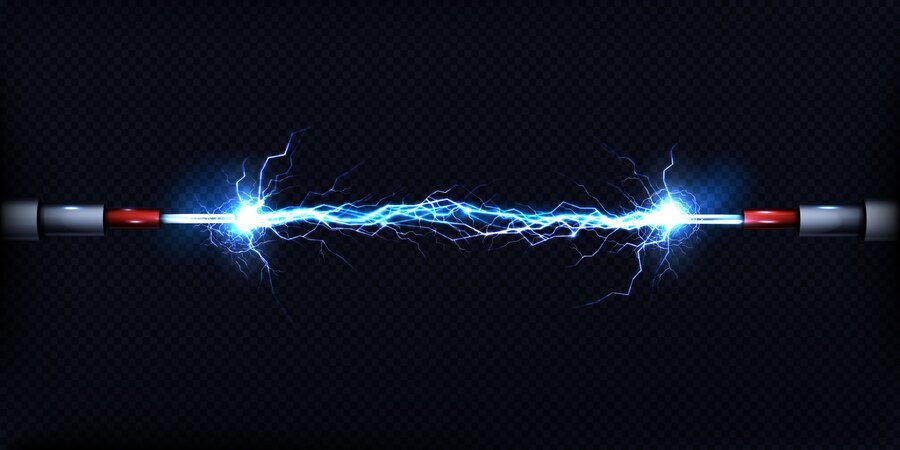
It is all around you, powering your computer, your mobile phone,
your refrigerator and your air conditioner, but do you really know what it is?
Electricity is simply defined
as “the flow of an electric charge”.
This still leaves so many questions - where does it come from? How do we, as people,
manifest the energy
and relocate it? Where do we move
it to? How does the energy cause something to move, even make something
light up?
Start with Atoms
To begin understanding the actual
makeup of electricity, you should start by looking at atoms, which are the basic building blocks of all things. Then, you need to go even deeper and look at what makes up an atom - its neutrons, protons and electrons.
Electrons are critical,
when it comes to the making up of electricity.
Unlike its other parts, not all electrons
are bound permanently to their atom. Valence electrons
are those that orbit the outermost part of the atom.
When enough force is generated on the outside,
valence electrons can escape that orbit and the atom altogether - and become
free. It is those free electrons
that allow for the moving of a charge.
In other words, creating the beginnings
of electricity.
Flowing Charge
In order to move those charges, we need what are known as charge carriers. Both the electrons
and protons in an atom will be carrying the same amount of charge, just different
types. This certain
charge to each of them is referred
to as the electrostatic force.
With this method, electrons will push away other ones and attract themselves to protons, which is the necessary tool needed to help create the “flow” of energy. When we free electrons
from their atoms and force them to move, we create electricity!
5.3 How a Domestic
Electrical System Works

For electricity to be safe for use in the home, there are many steps that need to be taken before it arrives on site.
Since we are concerned about electricity in the home, we do not need to get into how it is produced, just how it is delivered
and then used.
panel/fuse box.
charge of zero. If you have ever changed a plug in your life, you will know there is an Earth cable, otherwise referred
to as the ground cable. That is why they are called this. Both terms relate to the fact that the earth has an electrical charge of zero, meaning it is an insulator.
Why Insulators Matter
Electrical wiring is mostly comprised
of copper, which is the most cost-efficient for wiring. The conductors allow the electrical current to flow. Insulators, such as rubber, do the opposite and resist the electrical current. That resistance
is why safety boots have rubber soles on them, as it prevents electric
shocks. Without an insulator, if you were to come into direct contact with a live current, you would get an electric
shock.
All electrical systems have an earth/ground cable wired into the main supply. That earth/ground cable ensures a domestic electrical system is safe for use.
Are All Metals Conductors?
Yes. Copper is the most used though because it is the most efficient
material for electrons
to move along.The vast majority of electrical cabling is made up of copper wires.
Every home is surrounded by them - you just do not see them because they are built into the construction. They are hidden behind the walls, under floorboards and pretty much everywhere around the home. Anywhere you see a power source, know that there are cables powering
them.
5.4 Why You Cannot Replace Wiring as a Handyperson
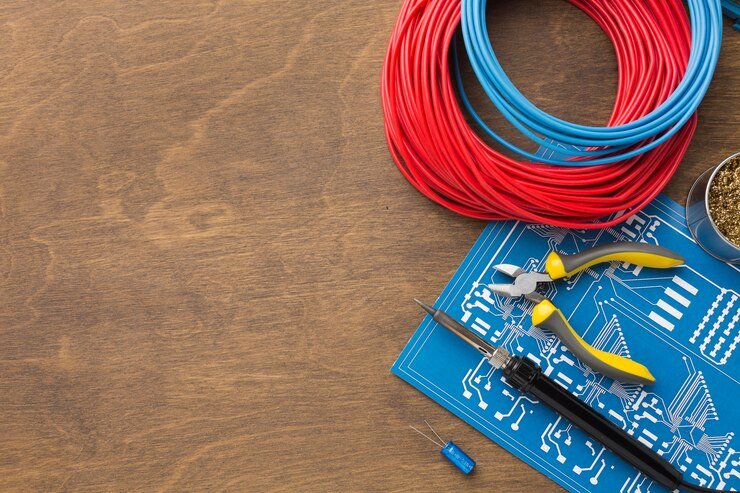
Wiring in buildings is more complex than you might imagine.
Since they are carrying electrical currents through them, they need to cope with varying
temperatures and humidity
levels. All cables are rated for circuit voltage levels, which means the cables used for a 32-amp circuit will be a different type than that used for a six-amp
circuit. The type of cable must be able to cope with the heat they will be subjected
to.
it can be the cause of an arc fault.
An arc fault occurs when a high power discharge
of electricity happens between two (or more) conductors. The higher the electrical discharge
is, the higher the heat temperature is. High temperatures can break down the insulation
of cables and that can be the start of an electrical
fire.
For that reason,
no electrical cabling
can be installed without it being done by a
registered and certified
electrician, thus ensuring you know the right cables for the right voltage distribution. There are laws surrounding building
codes and international standards that need to be abided by. Only certified
electricians in any part of the world can install
cabling.
like for like” and nothing
more.
If you are asked by a client to fit a ceiling
fan, you can do that, provided you only replace
the existing fixture and replace it like for like, connecting all the wiring as it was before.
If, on the other hand, you were asked to install an additional light in a low-lit room with only one light,
you could not do that because it would need new connections to the circuit within the consumer panel.
5.5 Where the Connections Lay
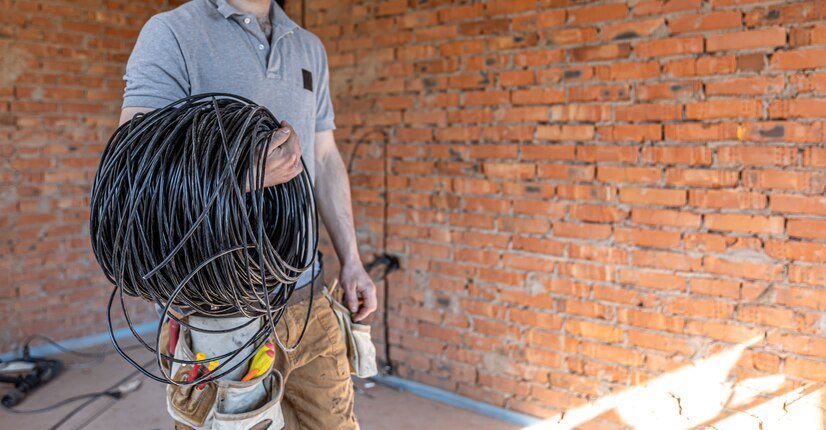
All electrical wiring is connected.
It needs to be, because electricity only works in a closed loop - it needs a negative
terminal and a positive terminal.
The electrons move along the copper wires from the negative terminal
to the positive terminal and back again. This happens
up to about 60 times every second and that is because homes use alternating currents.
What Are the Currents?
There are two types of currents
- alternating currents (AC) and direct currents (DC).
Battery operated devices use direct
current. Homes do not. Can you imagine trying to power your washing machine with some rechargeable
batteries? It would not happen, because it needs far too much power.
A direct current will only flow one way. From the power source (battery)
to the device it is powering. It is still a closed loop, but alternating current does not flow in one direction
- it alternates back and forth, therefore,
it continually creates power.
Fact
Faults
occur when the insulation system is compromised and current is allowed to flow through an unintentional path
Source: Eaton.com
5.6 Inside the Consumer Panel
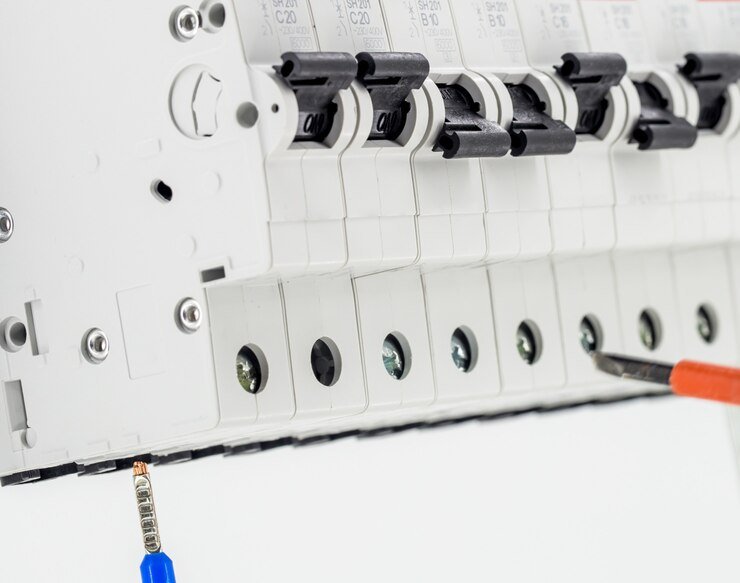
Just to be clear on what this is, here are some other names you may recognise
this as:
 *Breaker panel
 *Electrical panel
 *Circuit breaker
 *Consumer unit (CU)
 *Main panel
 *Fuse board
*Breaker box
*Panel board
Call it what you will, it is the box with all the fuses in it and the mother lode that is powering every electrical appliance, socket and light switch in the home. For the purposes of this module, we will just call it the consumer panel. That term should remind you that this is where the power is consumed and distributed.
The consumer panel is where all the magic happens,
though, all you can do with this box, without
being an electrician, is change a fuse - and that will, of course, need to be like for like. You cannot do any
wiring work, because that is too complex and highly dangerous. Well, it is
supposed to be, but considering the
purpose of the box is to isolate overloads, do anything wrong and it “should”
just trip. Nevertheless, it is not
advised to experiment with the electrics in the panel, unless you are certified.
Power is distributed by the power company into the home. The consumer panel is where all that power is distributed. There are different
sections, with corresponding fuses for each.
The fuses are indicated in amps, which could look like this:
*32-amp fuse
*16-amp fuse
*6-amp fuse
These will all be broken up into different
sections, known as circuits.
Purpose of the Circuits
Each fuse will be wired to the corresponding areas of the home they are powering.
For example
The 32-amp fuse could be wired to all the sockets/receptacles around the home, a 16-amp fuse could be powering the boiler, whilst the six-amp fuse could be powering all the lights around the home.
As previously mentioned
about circuits being closed loops, when the electrics are installed in homes, each section in the consumer
panel will have wiring going to the different areas of the home, for which each circuit is powering.
Fact
Homes specifically in the UK are typically
run on a stream of 230-240 volts.
Source: Electricity-guide.org.uk
How Circuits Work
be a dedicated
circuit for it, meaning it has its own fuse. A normal circuit for powering sockets/receptacles and lights could have all the electricity volts serving up to twenty lights.
In every circuit, there are many components
to it - it is not just some copper wire running from the consumer panel, behind the walls and connecting to each light switch. There is a breaker there so if things go wrong, the fuse will trip and cut the electric supply to the lights. There are also a variety of connections, switches and boxes throughout the home.
By using circuits,
electricians are more in control of where the electricity goes and where it does not.
For any socket/receptacle, light switch, or appliance to work, there needs to be a current flowing.
The current begins from the circuit in the consumer panel, travels along the copper wires to the terminals and then each appliance, socket/receptacle and light can be individually controlled.
Turn an appliance
off with its switch and you turn the current off. Turn it on and the current comes back through. The only way to stop any current is by using an isolator.
Remember, the electrics
need a continuous loop, in order to keep the current flowing. If anything breaks, such as a loose wire, there will be no flow. When there is no current flowing, there is no power at the outlet.
Activity 1
Estimated time: 15 minutes
Whilst this project
may seem a little elementary for some, it is a fun and simple way to understand a circuit and see firsthand
how it works. That's right - you are going to create your own circuit!
Materials
*One small light bulb
*Two batteries
(they need to have the correct voltage for your light bulb)
*Two alligator
clip wires (you can use aluminium foil instead, just cut two 15cm by 8cm pieces,
folding each one tightly along the longer edge to create a thin strip)
*Metal paper clips
*Electrical tape (or regular tape, if you don't have electrical
tape available)
Instructions
 *Attach
one end of each wire (or aluminium strip) to the screws on the bottom of the
light bulb. You may have to unscrew the screws just a bit, to get the aluminium
foil to squeeze in and get it secured.
*Attach the loose end of one wire (strip) to the negative end of one battery. Record anything that happens.
*Attach the other loose end of the other wire (strip) to the positive side of the other battery.
Now what happens? Record that as well.
*Disconnect the batteries and place them standing up. One should have the positive side pointing up and one should have its negative
side pointing up. You can tape them together in the middle, to keep them from moving.
*Lay a metal paperclip
on top of both batteries,
so that it touches both the positive
end of the first and the negative end of the second.
 *Without taping over the battery ends, put a small piece of tape over the paperclip to keep it in place.
*Turn the battery pack over and tape another paperclip to the ends, just as you did in the first.
*Attach the loose ends of the wires (strips)
to the light bulb now. Cool, right?
What happened, in the first part of the activity,
was that you made a simple circuit by using a battery
to light a light bulb.
When you switched
things around and the light bulb did not light, this proved that the correct flow of electricity was not going through the battery.
What you ended up making next is known as a closed circuit. This allowed the electrons a full circle
to flow from one end of one battery and on to the next. Along the way, it carried electrons
with it,causing the light bulb to light!
5.7 Wires and Switches
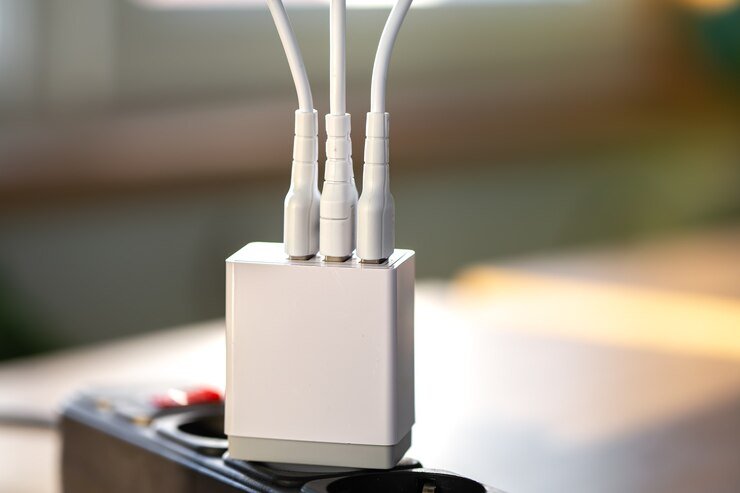
Wires are the backbone of every electrical system.
They have three parts to them. The easy way to remember
what wire is what is knowing that there are always three wires and two of them are live, or hot wires. These are the conductors and will mostly be the black and red wires. The other wire is your earth, also called a ground,
wire and that is the one that completes your circuit. That will either be white, or green and yellow.
The live/hot wires carry the electricity from the circuit to the appliance being powered and the earth/ground wire carries the current back to earth. Remember, the main supply is connected
to cables underground, to use the earth to neutralise the electricity, preventing fires, shocks and electrocution.
If anything interrupts the current, such as water seeping into
the electrical circuit
resulting in excess power, it will use the earth/ground wire (least resistance) to allow the excess power to travel back to the earth/ground. As it does, it passes through the circuit, alerting
the breaker, which then trips out.
Insulator or Conductor?
When electricity can flow through materials, those materials are known as conductors. When a material
stops the electricity from flowing, those are known as insulators. In the next activity, you will take the battery pack light you just made and test out certain items throughout your home, in order to gain a better understanding of the two.
Activity 2
Estimated time: 15 minutes
Take your battery pack and disconnect one of the wires (strips)
from one of the batteries.
Use another alligator
clip, or your aluminium version
and attach it to where you just removed the previous wire (strip), so that you have two free ends coming from this same battery. This is what is known as an open circuit and the bulb will not light.
around your home, gaining an understanding of what insulators and conductors are. If the material is a conductor, the bulb will light up. An insulator
will cause it to remain unlit.
You can test yourself by guessing if an object is going to be a conductor
or an insulator, before attaching
the ends of the wires (strips). Just be sure to attach both of the free ends to the object you are testing.
Use a plethora
of objects, to get the full effect and to understand what does what - use things made of plastic,
metal, paper, rubber and even wood! You might be surprised by what you find.
5.8 The Safeguards on Electrical Systems

In all electrical systems worldwide, there is always a
protection method in place.
They are known by different
names, but they all serve the same purpose - to function
as a safety shutoff.
In the UK, those safeguards are referred to as - RCD and RCBO (Residual-current Circuit Breaker with Over current protection).
The normal electrical current matches its predecessor, so any changes
will indicate a leakage somewhere. Within a fraction
of a second of that happening, the electrics will trip. This is what they are designed to do, as it could be someone
who has accidentally touched a wire, or there is a split cable somewhere
causing some current leakage.
Every home's electrical setup works the same way. Power is connected to the home from the electricity company to the meter. That meter is connected with an earth/ground cable, which works as an insulator for the electrical circuits in the consumer panel.
Any faulty wiring or hazards that cause a surge will cause the consumer panel to trip. In some instances, these will not trip the entire electrical
system but instead will only limit the power outage
to the circuit affected.
For example
Such an instance
might be someone using a steamer to strip wallpaper
and the condensation seeps into a socket/receptacle. That would indicate
water in the electrical system,
disrupt the alternating current and therefore,
cause the socket/receptacle circuit in the consumer panel to trip. If it was not segregated within the consumer panel, all electricity throughout
the home would shut off.
Every home's electricity consumer panel
has integrated safety features, which you cannot work with without being a registered and certified
electrician, due to the enormous repercussions mistakes can have from faulty work.
The only jobs you will be able to do are ones that involve
(and only involve)
switching like for like. You should never be installing
a new circuit or adding to an existing circuit within the consumer panel.
Module Summary
Every home is connected to the power grid through the electricity meter. The meter is grounded/earthed, providing an insulator
to all electricals connected through the consumer panel.
No electrical appliance
or socket/receptacle will work without being connected
to the consumer panel. Inside
the consumer panel, the electricity is distributed through
circuits, with each circuit delivering a set voltage to different
areas of the home.
The socket/receptacle circuit may be delivering an AC (alternating current) at 110 volts or within the 220v - 240v range (UK), which will use a fuse corresponding to the amount of power it needs to send. This will be a 32-amp fuse, 16-amp fuse, or a 6-amp fuse, depending on how much electricity to be needs distributed.
though?
Probably not, because
for a fuse to blow in the consumer panel, there would have been something that caused a surge in electricity. It could be an overloaded
circuit, or it could be a fault in the wiring interrupting the loop of the alternating current. Whilst you can change like for like, in the event of blown fuses, you can replace them. But, if you find it blows again, you are best to advise your client to seek the services of an electrician to troubleshoot the problem. Otherwise, it will be a never-ending cycle of replacing
fuses and not fixing the root cause of the problem.
Keep all of this in mind as we continue on through the modules.
 |
.svg)



