
9.1 Introduction
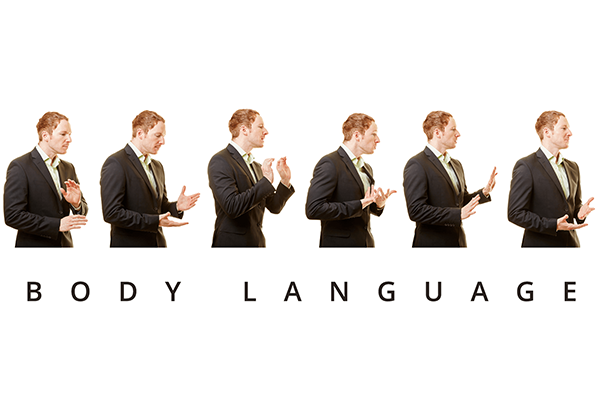
One of the basic lessons of communication is the fact that what people say is not always what they mean.
Therefore, it is important to interpret signals correctly, in order to be able to respond appropriately to people's requirements. Your ability to read people can help you make significant advances in your career, as well as business. Despite the increasing use of modern gadgets that have had an impact on the frequency of face to face communications, body language still plays a crucial role in helping you to communicate with others.
Technique
The techniques and strategies outlined in this module can not only help you to regulate your own verbal cues and signals, but it can become your greatest career asset by helping you to interpret the body language of others correctly. When properly understood and used, appropriate body language can become your key to higher levels of recognition and success in your chosen career.
Body language is an extremely effective communication tool, which can be used to influence and motivate people, develop healthy relationships in the workplace and bond with your colleagues and subordinates. As a result, you can expect productivity levels to rise, as well as minimisation of conflicts at work.
Smile
Smiling is a natural way to feel good about yourself and to get others to respond to you positively. A smile automatically disarms other people, smooths away awkwardness and paves the way for better communication. However, there are different types of smiles and smiling may be fake or genuine. This module will explain the different types of smiles and how to interpret each one of them.
Interviews
The word ”interview” can inspire tensions and stress and it can be a daunting task to appear calm and confident in front of strangers who may decide your career destiny. Your body language should show assertiveness and not aggression, transparency and openness, but not submission. In effect, displaying the right body language is a tightrope walk. Unfortunately, most aspiring candidates tend to concentrate more on the font and margin sizes in their CVs than about how their attitudes and beliefs reflect in their body language.
Fact
According to a study conducted by the University of Glasgow, it takes the human brain approximately 200 milliseconds to interpret a person's emotions from their facial expressions.
Source: gla.ac.uk
9.2 Tips to Improve Career Success by using the Right Body Language
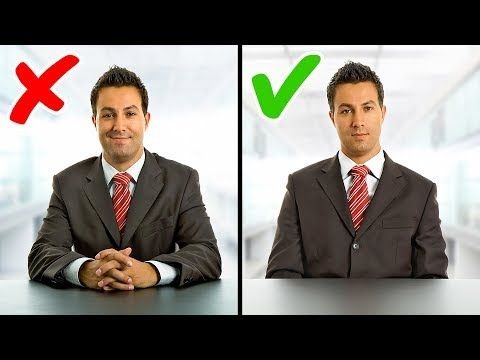
First Impressions
Practice making a great first impression before you physically walk into the room. First impressions are critical in business interactions. Once the first impression is negative, then others will have an instinctive tendency to view you through that filter. Hence, it is better to walk tall, square your shoulders, smile and practise making eye contact, before you enter the room. This is because you may not have the time to begin practising when you are already in the room.
Eye Contact
It is important to make just the right amount of eye contact. Inadequate eye contact can be perceived as a sign of weakness, low self-confidence and insincerity. Excessive eye contact, on the
other hand, is often interpreted as rude, overbearing and intimidating. The best way is to maintain eye contact for about 60% of the conversation, during the time that you listen. You can break eye contact at the times when you speak.
Touch
Use light, appropriate touch whilst using relevant words. Touching someone lightly and appropriately whilst using empowering words can help to establish and build instant rapport. Perhaps you could try saying someone's name and touching them lightly on the hand, arm, or shoulder.
The duration of the touch should be extremely brief and should last no more than 1/40th of a second. Touching someone lightly whilst saying something positive (saying someone's name implies that you remember it correctly) reinforces the connection between verbal and non-verbal language. Crossed limbs Try and get people to uncross their arms and legs. When arms and legs are both crossed simultaneously, the gesture is a ”double cross” and the person is feeling defensive, guarded, or resistant to the speaker. This could imply that either the person is not paying attention to what you are saying, or does not agree with what you are saying.
In order to avoid this, try to offer conference delegates tea, coffee, or water. You can also provide them with brochures and pamphlets, in order to keep their hands busy in a constructive, natural way.
Getting people to uncross their arms and legs will automatically succeed in subverting their resistance, as change in posture leads to a resultant change in attitude.
Hand gestures
Use your hands during the speech, but within reasonable limits. Studies indicate that waving your hands whilst speaking helps to improve verbal content.
For example
You will be able less inclined to use fillers such as “Uhh” or ”Ah”, etc. Using your hands also helps to form crisper, tighter sentences and reduces hesitancy. The audience is also more likely to perceive a speaker who uses his hands as passionate and charismatic.
Remember to keep your movements relaxed and visible and keep your palms open to the audience. It is also important to keep the gestures restricted to the area between the shoulders and waist, as you can produce greater impact. This area is considered better for gesturing, as it is perceived as assured and credible.
You need to remember that negative body language will sap the good things from your speech.
Twirling your hair, touching your skin, picking at your forehead and massaging your temples, etc, are all self-pacifying behaviour examples that we indulge in when we want to soothe ourselves in some manner. The trick is to consciously observe ourselves and mindfully stop the distracting behaviours.
Silences
It is not necessary to fill every moment with words. One of the most effective ways of talking is to intersperse words with small silences. You need not fill every moment with talking and words. Silences can be very useful because during this time, talking ceases and attention becomes focused. Silence can help you to allow listeners to absorb information and also to increase the effect of a dramatic pause.
Feet position
You need to be careful about where your feet are positioned. If you happen to be standing on a podium, keep your feet pointed towards the audience. The direction of our feet clearly indicates the direction of our interest.
If you are sitting in a chair, make it a point not to cross your legs (the ankle lock) and do not draw your feet around the legs of a chair. By unlocking your feet and allowing them to be placed in front of you, you can automatically experience a feeling of interest towards your audience or speaker.
Similarly, bouncing feet indicate happiness and feet placed close together (or shifting your weight from one foot to another) indicates nervousness and uncertainty. You can easily exude higher levels of confidence by placing your feet slightly apart and distributing your weight evenly.
Stand tall
Stand tall and take up space when you stand.
Most of us have an unconscious tendency to slouch and slump. The optimal use of height and space helps us to express credibility, authority and confidence. Keep your back straight (but avoid arching), keep your pelvis tucked under, keep your shoulders back (most of the time, our shoulders tend to slump forward) and keep your chin high.
If you happen to be sitting, keep your legs at shoulder distance apart and spread your items on the conference table. This will help you to claim more territory, both literally and figuratively.
Visualise
Think of a past success or achievement that increases your self-confidence. This will help you to actually express that confidence automatically through your body language.
Steeple fingers
Steepling the finger tips or crossing your arms behind your head is a sign of authority and power. Steeple your fingertips, whilst keeping the palms separate.
Activity 1
Estimated time: 10 minutes
Imagine that you are feeling nervous at the prospect of a one to one meeting with your boss.
How can you use your body to make yourself feel more assured and confident?
9.3 The Art and Science of Smiling

“Smile and the world smiles with you”
There are different types of smiles, but they can be mainly categorised into two categories - genuine and fake.
Fake smiles are usually produced by simply pulling up a corner of the mouth, whilst a genuine smile pulls at the wrinkles at the corners of our eyes.
A genuine smile is produced by the involuntary action of the brain and the response is automatic - we smile because of feelings of mirth, pleasure, or enjoyment. As a result, our cheeks rise, our eyebrows dip slightly and the eyes crease at the corners.
Smiling is a universal gesture of happiness and indicates to others that you are not a threat. Moreover, smiling also generates a corresponding reaction in others and helps to establish healthy, lasting rapport with others.
In fact, interesting social search studies show that smiling whilst tendering an apology gets far better results than an apology proffered with a grumpy face.
People usually respond with a smile when you smile at them, because human beings mirror body language at the basic level (you can read more about mirroring effects in module 4). A smile is a very effective form of body language, as it instantly precipitates a positive reaction and change in the attitudes of people around you. Sales personnel find that when they smile at the beginning of a meeting with a prospective customer, it establishes a friendly relationship and makes it significantly easier to achieve better sales outcomes.
People who flash a fake smile are able to smile very easily and keep it on for much longer than a genuine smile. In many cases, it is difficult to differentiate between fake and real smiles, because smiling in general is perceived as a disarming gesture. Most of us feel happy when someone smiles at us and do not really question the authenticity of the smile. But a fake smile can be similar to a grimace or sneer.
There is a technique to interpreting a smile. Smiles or any facial expressions are controlled by the right hand side of the brain. Hence, the effects are more emphasised on the left hand side of the face. If you want to observe a smile, it is a good idea to observe the left hand side of the face.
9.4 Types of Smiles

There are many types of smiles.
These are listed below, with the four most common types listed first.
Twisted Smile
This is a mixed smile, which is not symmetric in nature. The left hand side of the face usually expresses a smile, whilst the right side of the face (controlled by the left side of the brain) produces a frown. The effect is like seeing a twisted smile.
This type of smile is typical of western cultures and sends only one message loud and clear - sarcasm. Therefore, you should not be smiling in this manner if you wish to make friends or establish a friendly rapport with colleagues, etc.
This is an extremely asymmetric smile, which clearly shows a contrast between inner feelings and outward expression of them.
The Tight-Lipped Smile
The tight-lipped smile is again not a genuine smile in the correct sense of the word. The lips are tightly stretched and the teeth are concealed. A tight-lipped smile indicates a non-willingness to share your ideas with others. People who are usually transparent and open tend to flash a toothy smile. If the person flashes a tight-lipped smile and looks away, it could also signal embarrassment or shame.
The Sideways Smile
The sideways smile is usually expressed when the head is lowered and positioned slightly sideways, with the person looking up with her eyes. This particular type of smile is known to be perceived as seductive and alluring and triggers protective feelings in men. The sideways smile is perceived as coquettish and most women use it as a positive sign during courtship. Princess Diana was well known for her attractive sideways smile, which increased her appeal to both
men and women. Prince William is also popular, because he is known to smile like his mother. It makes him appealing and it reminds people of his mother, at the same time.
The Jaw Drop Smile
In this type of smile, the person simply lowers the jaw and gives the impression of laughter. It usually evokes a positive response from people. However, if interpreted in context with other expression clusters, the jaw drop smile, or open mouth smile, can come across as fake.
In addition to the four most common smiles listed above, there are some others:-
Polite smile
The person simply turns up the corners of the lips slightly, but the smile does not reach the eyes. A polite smile is one that people may use when they are entering an elevator and encounter a stranger. However, a polite smile should not be confused with a fake smile. A polite smile usually makes other people feel comfortable and warm.
Genuine smile
This is the best type of smile where the lips turn up revealing teeth and is registered by the eyes as well. If the smile is accompanied by a tilt of the head, it can be interpreted as a loving smile.
Smug smile
The lips are pressed together and one corner lifts up while the eyebrows narrow a little. This type of smile expresses smugness, which indicates that the person knows something that you do not.
Reminiscent smile
This is a half-smile, often accompanied by the eyes gazing upwards. This usually indicates that the person is relieving happy memories.
The important fact to bear in mind is that a smile is not always a sign of happiness (although it can be). People smile to relieve angry and stressful feelings (the tight-lipped or half smile) and they may smile to conceal annoyance and agitation. A smile may also be a sign of embarrassment. It is important to interpret smiles in context of other gestures, in order to read them accurately. Smiling and laughing are extremely important, from the standpoint of positive body language. Since human beings tend to mirror expressions and gestures, we tend to smile when we see someone smiling and frown when we see someone frowning.
Laughter and smiling release endorphins (these are chemicals that improve levels of psychological and physiological wellbeing) and help to relieve stress.
During staid, formal and often stressful office meetings, it is good idea to smile at others. The best thing about smiling is that it works both ways - we feel happy because we smile and we smile because we feel happy. Smiling allows you to bond more easily with others. In fact, we are unsmiling people, the corners of our mouth turn down and this gradually becomes a permanent expression (commonly called a “down-in-the-mouth” expression). People who sport a down-in-the-mouth expression can be described as despondent, unhappy, or depressed. There are also gender-based differences between the way men and women smile. An unsmiling woman is perceived as unhappy, whilst an unsmiling man is often perceived as dominant.
Social experts also suggest that excessive smiling by women may be construed as submissiveness. The best way is to mirror the other person's smiling behaviour. A woman may have to smile less in order to be accepted as authoritative and a man may have to smile more if he wishes to persuade a
woman to share his ideas.
Fact
In a study, patients reported lack of eye contact and a brusque tone of voice as a lack of interest on behalf of the doctor.
Source: bjgp.org
9.5 Body Language Tips for Aspiring Job Seekers
Perceptive job seekers understand that the body conveys a lot of information to the interviewer(s). Many times, we are unaware of the messages that we are sending about ourselves and we may lose the opportunity to land a good job. Interviewers are trained to look out for signals and gestures that betray our inner feelings and emotions. Our body language may end up contradicting what we say and in this situation, people are more likely to believe the body language than our actual words.
Enter the interview room with energy and enthusiasm.
This will help to convey confidence and assurance, whilst helping you to overcome nervousness. You never get a second chance to make a first impression, so it is important to get it right the first time. Keep your shoulders squared and erect and make smiling eye contact when you shake hands with every person. Keep your hand vertical and shake hands with the entire palm of your hand. Your attitude and non-verbal signals will signal if you are likely to fit into the new business family. Keep your steps elongated (between one and two feet long) and keep your feet and body pointing towards the interviewers.
Sitting posture
Remember to sit all the way back in your chair - sitting at the edge of the chair indicates nervousness. Sitting all the way back indicates confidence and assurance.
Eye contact
Whilst eye contact is important (lack of eye contact may indicate timidity or low self-confidence), keep the eye contact gentle and do not stare into the interviewer's eyes. Allow your gaze to settle on the nose, lips and forehead, etc, in rotation. Remember to establish eye contact with each person in the room.
Palms and gestures
Display your palms in the open and you can use gestures, as long as they are not wild and dramatic. In general, keep your body language upward facing - keep the chin up, face the palms upwards, etc.
Feet
It is best to keep both feet firmly on the ground. This will prevent subconscious ankle locking, etc, which can convey a defensive attitude. Research also indicates that keeping our feet on the ground helps to improve our creative thinking ability.
Breathing
Inhale deeply and speak on the exhale. This has two benefits - the deep breathing helps calm you down and you avoid getting out of breath while responding.
Show interest
Nod occasionally, to indicate interest and comprehension and lean slightly forward. Keep your shoulders back and down and lean your body slightly towards the interviewer.
9.6 Body Language Mistakes that can Spoil your Chances of Landing a Dream Job
A brilliantly crafted CV, impressive cover letter and insightful technical responses may be superficially sound as a winning combination to landing the job of your dreams; however, the wrong body language can jeopardise the chances of getting to the next level in the selection process.
In fact, most interviewers make up their minds on the suitability of the candidate even before the first question has been asked.
Here is a list of body language mistakes that job seekers should avoid.
Personal space
Whilst you can be friendly and courteous, do not overstep boundaries.
For example
Please do not hug the interviewer or stand too close to him.
The ideas of personal space vary significantly across cultures, so if you happen to be interviewing for a global or foreign company, you may wish to familiarise yourself with their norms.
Distracting gestures
Avoid distracting gestures like playing your hair, picking at your skin, or jangling your bracelets. Such gestures are interpreted as self-soothing and childish. The hiring manager is not likely to be amused. Keep your hands quietly on the table, in plain view.
Posture
Remember to sit up straight. Slouching, slumping and shoulders rolling forward indicate defensiveness, submission and nervousness. If slouching is a regular habit, do practise sitting upright in a chair.
Pay attention
Sending text messages, answering calls, or looking at social media is one of the quickest ways to get eliminated from the selection process. Please switch off your mobile phone, etc and give your full attention to the interview.
Activity 2
Estimated time: 10 - 15 minutes
What is the best way to practise before an interview?
Which gestures and postures should you focus on correcting?
How will this type of preparation help before an interview?
[Tweet "I just completed Module 9 of the Body Language Diploma Course"]
.svg)



