
3.1 Introduction
One of the very first books to be published on the subject of body language included Charles Darwin's “Expressions of Emotions in Man and Animals”.
The book was released in the year 1872, but was read by academics. Over the last fifty years, there has been a significant increase in the study of body language and its undoubted impact on communication between people.
Albert Mehrabian was another well-known expert on the subject of body language in the 1950s, as was Ray Birtwistle.
Every gesture and posture is a key to the emotion experienced by the person at that point in time.
During any interaction, a person can experience several different emotions, including happiness, doubt, uneasiness, stress, worry, anger, or resentment, amongst many others. One can regulate one's own body language, so that we do not precipitate negative and reciprocal responses in others.
Positive Body Language
Positive body language helps to emphasise confidence, assertiveness and warmth. People are more likely to want to know you better and you can enjoy an increase of respect and dignity from colleagues and loved ones alike. Positive language helps predispose people to support and favour you - a trait that proves extremely effective in enhancing business outcomes.
Although it may sound contrary to some, the fact is that first impressions are very powerful and we form a definite opinion (very often, without being aware of it) of another person's dominance, friendliness, warmth (or lack of it), or even suitability as a partner.
Positive body language helps reinforce impressions of likeability, warmth and trustworthiness.
People feel comfortable when they interact with us and find us approachable to communicate with.
Proper body language can help shape professional and personal relationships and pave the way for a happier and more compassionate way of living.
3.2 Dissecting Communication into its Different Components
Albert Mehrabiyan was known for his popular breakdown of communication into distinct percentage components.
According to his research studies, the total effect of a message consists of 7% spoken words, 38% tone, pitch, inflection, etc. and 55% non-verbal communication. This is referred to as the 7-38-55 principle.
Similarly, recorded sales interviews indicated in the 70s and 80s that an overwhelming 70 to 80% of communication is non-verbal.
What we say is not as important as how we say it. Birdwhistel was one of the first to observe that verbal and non-verbal communication and by paying attention to subtleties; you can evaluate what the person is saying to you.
The foundation of effective communication rests on being able to reconcile your body language with your words. In most cases, our words tend to tell one story, whilst our gestures seem to tell a different one.
The first impression may or may not be correct, but human beings are controlled by primeval biological urges that allow us to intuitively respond to body language. It is important to note that we can use this natural tendency to our advantage in our business and personal lives.
Fact
According to well known body language Ray
Birdwhistel, businessmen around a negotiating table form their first impression of a new acquaintance within four minutes.
Source: Definitive Book of Body Language, Allan and Barbara Pease
3.3 Body Language as a Faithful Reflection of Emotions
Every posture, gesture and expression can be described as a key to an attitude or emotion that the person is feeling at that point in time.
During any interaction, we may undergo several different emotions; we may perhaps feel happy, then surprised and finally worried about something. Similarly, in business interactions, participants may experience eagerness, doubt, or satisfaction, amongst several other emotions.
For example
A person who is conscious about excess weight may unconsciously keep tugging at the area under the chin.
A keen observer of body language will develop the uncanny ability to separate reality from fiction, or the wheat from the chaff, during communication. This, in turn, will help reduce the likelihood of conflict and misunderstanding.
In fact, politicians are often caught quite literally telling lies, because their body language often contradicts their spoken words. Likewise, a “gut feeling” or ”hunch” that someone is not quite speaking the truth usually stems from a subconscious awareness of body language. Speakers who speak regularly on stage can improve their address and connection to the audience, by consciously observing body language.
The body is able to effectively communicate emotions, feelings and attitudes to others and we are unconsciously sending out these signals all day long. In effect, words convey information, whilst body language conveys feelings.
For example
If people have crossed their arms across the chest and have their heads slumped downwards, it indicates that their interest in the speech has waned. The speaker may wish to then change his approach, in order to pep up audience interest.
In general, women's brains are wired differently to men's.
For example
A female human brain has about 12 to 14 areas dedicated to evaluation of others' behaviour, whilst men have about four to eight.
This explains, to a large extent, why women are generally more perceptive about others.
A woman is perhaps more likely to enter a party and correctly evaluate the couples who have had a tiff or a couple who is interested in each other, compared to her husband who may be completely unaware of any subtle cues.
3.4 How Body Language is learned
There has been a lot of debate regarding the acquisition of body language behaviours and gestures.
The three main modes of learning include genetic transfer of gestures, cultural acquisition (visual learning by observing others), or simply inborn.
Research studies that examined the body language of blind people found that they appeared to imbibe gestures specific to their culture, despite the non-availability of visual channels of learning.
This observation seemed to suggest that most body language is inborn or genetically transferred.
Research involved the closer study of our ancestors - the primates and apes.
Over the years, however, experts and social scientists have found that body language gesture acquisition can be attributed to all three modes. In other words, there are certain gestures that are inborn, some which are genetically transferred and others which may be learned from the culture in which we live.
Studies also discovered that newborn babies are able to smile, which shows that smiling is a gesture that is inborn and natural.
Positive Body Language
Body language is so intricately entwined into the business of daily living that each of us uses body language in the business, personal and interpersonal areas of life. Body language comes into play and plays an integral role in formal and informal conversations, interviews, meetings, discussions and conflict resolution. Your body language can attract or repel listeners and vice versa.
Let us take a closer look and understand positive body language, including gestures, postures and expressions. Learning to consciously use positive body language can help us to foster good relationships with others.
Before we begin, here is a list of salient features that constitute body language:
It is a set of involuntary or intuitive actions (however, please note that although body language is involuntary, it can be controlled and regulated)
Body language involves movement of the limbs and the head
It can be interpreted in different ways, depending on the situation and the people who are receiving the signals
Body language is essentially a two-way street - you have to be mindful of your own body language, as well as read others' body language
Most of us are unconsciously engaged in reading other people's body language
In general, any gestures or postures that suggest defensiveness must be minimised, or preferably eliminated, from our body language. Defensive body language can discourage others from approaching and interacting with us.
Similarly, body language must not indicate disinterest in the other person. Again, this can prove to be detrimental to business outcomes and even personal outcomes.
Everyone likes to feel cherished and treated with attention. Ensure that your body language does not give off contradictory signals.
Ideally speaking, body language should neither be submissive nor authoritative. It should come across as confident, without being either offensive or defensive.
3.5 Three Important Rules for Correct Body Language Interpretation
Always remember to read body language in clusters and not in isolation
Body language cannot be described as an exact science. This is essentially due to the fact that human beings are complex and often have a mix of multiple feelings that they express. This is why it is necessary to piece together a number of different behaviours, in order to be able to make an accurate reading of the emotion. However, the fact is that body language is never easy to fake and even if someone tries to camouflage his true feelings, his body will inevitably give him away.
Moreover, body language is fluid and continuous, so you have to observe a set of behaviours at once, as we cannot pause or rewind an expression or gesture. Accurate reading of body language involves the piecing together of a number of components of non-verbal communication.
For example
Consider a simple gesture such as scratching the head. This could imply multiple emotions, including perplexity, forgetfulness, confusion, uncertainty - or simply dandruff.
However, if the person scratching his head had also been peering at a notice on the office notice board, he may be puzzled regarding some information put up there.
Body language has its own set of “words” that need "punctuation”, in order to make sense. It is only when you perceive a set of gestures in a cluster, that you can evaluate them.
As a general rule, one would need at least three related gestures before we can make a judgement.
As you become more adept at interpretation, you will able to match the gestures with spoken words and piece it together to make an accurate evaluation.
If you observe someone stroking or touching their hair, it could mean boredom, ennui, anxiety or uncertainty. If the person is speaking about how her aerobics classes have finished for the summer, you may conclude that she is probably bored. On a further note, we often tend to touch or stroke our hair because our mothers often comforted us that way when we were young.
A common example of a cluster gesture is when a person (this usually applies to office situations) extends her index finger towards her ear, whilst the thumb is pointed towards the chin. If she is also observed to have tightly crossed her legs and has her other arm across her body, it is fairly obvious that she is listening critically to the speaker and is not in agreement with the content. She is also probably holding back her own negative feelings, at the same time.
This posture is referred to as the "Critical Evaluation Signal”. Please note that this was a set of gestures that were interpreted together, in order to arrive at an evaluation.
Congruence in Body Language Interpretation
Gestures and verbal language need to be congruent, in order to convey an impression of authenticity and honesty.
For example
Women tend to reject communication that seems incongruous.
If a person who is sending the “critical evaluation signal” is telling you that he completely agrees with the speaker, his message would be unconvincing and contradictory to the listener, because his body is conveying a different message from his words.
Similarly, if someone has crossed their arms tightly across their chest, it indicates repression of negative feelings. If you notice a prominent public speaker, such as a company CEO or politician, crossing their arms tightly whilst leaning over a lectern during a talk, the audience is unlikely to be convinced of the speaker's points.
A worker who has their hands in their pockets, whilst telling you that they did not take cash from the till, is probably lying to you. Congruence indicates alignment between body language and spoken words. Congruency is the bridge between two communication channels - the verbal and the non- verbal.
How to Interpret Gestures in Context
If a person crosses their arms tightly and hugs themselves on a cold winter's day, these gestures are most likely due to the cold and convey no special meaning at all. On the other hand, if you observe the same gesture during a negotiation or meeting, the gesture (taken correctly in context) could strongly indicate non-agreement or non-receptiveness to your message.
Similarly, an obese individual may be unable to cross their legs, but may still disagree with you - but their body language may not indicate that. A person who dons tight clothes or wears a diving suit may be restricted in their body language.
Gestures and other forms of body language must always be interpreted in context, otherwise there is a higher likelihood of misunderstanding.
For instance
A soft or limp handshake can be interpreted as a gesture of a man who is unsure of himself, of a weak character, or diffident. However, an individual with arthritis or sore fingers may prefer shaking hands softly.
In such cases, a limp handshake cannot be misinterpreted as a weak character.
Children exhibit some common gestures, such as covering the mouth if they have been telling lies.
The same gesture continues into adulthood, but we learn to retract the gesture almost immediately and often end up simply touching the lips or nose instead. If you interpret the gesture in context, most people who touch their nose or lips whilst responding may not be telling the entire truth.
3.6 The Difference between Practicing Studied Positive Body Language and Faking It
There are subtle but significant differences between practisingstudied body language and actually faking it. The truth is that body language cannot be faked over prolonged periods of time, because the body will unconsciously give the game away in the form of micro-signals.
For example
An interviewee may lie about details regarding their previous job. They may studiously try to avoid giving the game away by avoiding crossing their legs. They may also try to avoid touching their lips or nose during the conversation. However, involuntary gestures such as the twitching of an eyebrow or contracted pupils may give them away.
It is nearly impossible to fake body language over prolonged periods of time. People who learn to practice positive body language invariably come across as charismatic and popular.
Using studied body language can help you to reap several advantages.
For example
You can create a friendly and warm rapport with your children or students. However, this will work only if your gestures are congruent and in alignment with your spoken words and other non-verbal cues.
Activity 1
Estimated time: 10 - 15 minutes
Why is it necessary to interpret body language in context or in clusters?
What are the likely consequences of reading gestures in isolation?
What mistakes are you likely to make?
3.7 How to Interpret Legs Positioning
The face and neck are situated close to the brain, whilst the legs are further away, so we often tend to be oblivious of the way our legs are positioned.
Whilst we are often aware of our facial gestures and expressions, we are less conscious of how our legs are placed and it is this fact that makes them a voluble indicator of our innermost feelings. The four main standing positions include:
Legs straight and feet together. This is considered a neutral and honest position and one that is usually used by people of differing statuses.
For example
You would observe this position when students speak to teachers and when junior officers speak to their bosses.
Legs shoulder width apart and hands on the loops of the belt
This is usually a “masculine” display of dominance, where the man stands firmly, without any intention of giving any ground. This pose became popular during the era of westerns and is frequently referred to as the "cowboy” pose. It is common to find male participants at sports events striking such macho poses, to display their intention to dominate the other teams.
One foot moved forward
In this pose, one foot is leaned forward and the body weight is subtly shifted onto the other foot. The foot that is moved forward usually points to the person that you find the most attractive in the group. Alternatively, it could point to the person that you wish to actually speak to (this may not be the person that you are speaking to at that moment). If the foot points towards the exit, it usually indicates a wish to leave. The foot forward position allows the observer to make an accurate judgement of the person's immediate intentions.
Leg cross

This includes two positions - when the legs are crossed one over another and when a single leg is crossed over another.
The double crossed legs are usually indicative of submissive, defensive, or closed attitude.
It usually signifies that the subject is not receptive to your arguments, but is not ready to leave either. It could also demonstrate lack of confidence. When a woman crosses her legs, she is indicating that she is willing to stay, but is not open to any advances.
When a man is with (whom he considers) inferior males, he will usually strike the cowboy pose explained above. If he is with superior males, he will prefer the leg cross position, as the cowboy position may make him feel competitive. It is more common to find that introverts hold this position for longer than extroverts.
It is also common to observe that men and women who are predisposed to adopt the crossed legs position will also be predisposed to zip up their jackets and coats, etc. You may also notice that these individuals may stand apart from the rest of the group and may not make a conscious effort to mingle and get to know other people in the room.
A group of friendly people will invariably have their legs uncrossed, palms open and facing outwards and legs will be pointing towards others in the group.
People will also easily move in and out of each other's personal space (please refer to module 2 for further details regarding proxemics and space). The former group (in which people had crossed legs and buttoned coats, etc.) may appear relaxed, but their body language shows that they are not completely at ease.
Within the leg cross position, there are two types:
The European Leg Cross
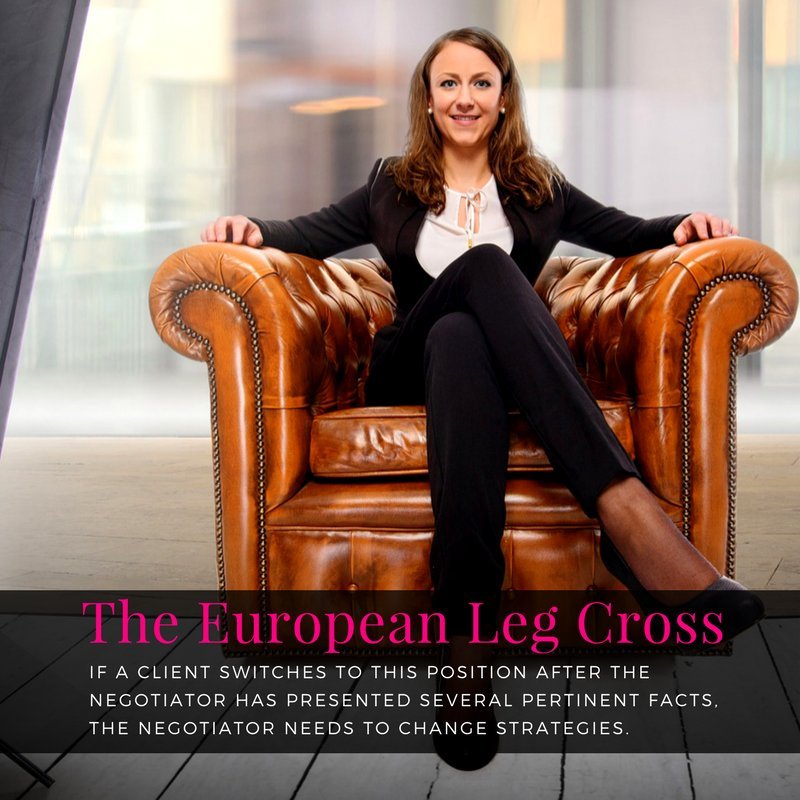
This posture involves one leg neatly crossed over the other. In some cases, the person may cross both legs neatly over each other. This sort of position usually indicates withdrawal from the group or communication. In terms of business interactions, people sitting in such positions are usually prone to rejecting ideas and they also speak in shorter, more staccato sentences. They are also likely to recall fewer details, in general. This is because their body language indicates that they have not opened themselves to the group. Hence, they are able to absorb less.
Fact
Whilst sitting in the European leg cross position, 70% of people tend to cross the left leg over the right.
Source: westsidetoastmasters.com
The American Leg Four Leg
The American leg four involves the positioning of the ankle of one leg over the knee of the other leg, whilst seated. One foot rests on the ground. This posture exudes dominance, youthfulness and relaxation.
British and European people very rarely adopt this position, but Americans frequently do. The posture is a typical example of body language indicating male dominance. However, regardless of the seated posture, when people need to make a decision, they invariably do it with both feet on the ground.
Activity 2
Estimated time: 10-15 minutes
Try to join a group of colleagues or acquaintances and stand with your legs or arms crossed. Now wear a serious expression on your face.
How do the others react? What do you notice? Are you able to establish a rapport?
[Tweet "I just completed Module 3 of the Body Language Diploma Course"]
.svg)



