
2.1 Introduction
So far, in module 1, we have seen the impact of non-verbal
communication and the difference with vocal communication - in module 2, we will discuss some parallels between the two. It is important to understand that non-verbal communication isa language of its own and hence, it is referred to as “body language”. Body language is the out ward expression or reflection of internal emotions, feelings and attitudes. People learned to study each other with the help of body language much before language played a more dominant role in connecting human beings across the world. Whilst words are useful in conveying actual information, body language helps us to make fairly accurate judgements regarding dominance, submission, interpersonal attitudes and suitability as a partner. Although telephonic conversations are not face to face, they involve the use of body language in an involuntary and unconscious manner.
A competent telephone sales executive need not always be equally adept at making face to face sales.
Personal and physical interaction with people requires a unique set of skills. Non-verbal communication comprises the interplay of several different elements. These include attributes such as physical appearance, eye contact, gestures, facial expressions, proxemics, silence, paralinguistic attributes and posture.
Chronemics refers to the perceptions of time and orientation towards the past, present and future.
The shifting dynamics between these different factors determines the level of success of any communication. In general, women are perceived as more intuitive and sensitive compared to men.
This is because, by default, they are observant of body language and compare it subconsciously with verbal cues. When you feel that someone is lying, it simply means that the person's body language and verbal cues are not in alignment.
2.2 Parallels between Verbal and Non-Verbal Communication
The phrase ”body language” is suggestive, as it indicates that body language has its own set of rules and principles.
For example Just as vocal language consists of words, phrases and sentences, body language consists of gestures, expressions and postures. The individual gestures can be grouped into a set of connected behavior cues and the observer can derive inferences regarding the attitudes, thoughts and emotions. In other words, just as spoken language has a set of words and sentences that help make sense of the communication, a congruent cluster of gestures, postures and proxemics, etc help us to understand the deeper meaning of communication.
In the year 1952, Ray Bird whistle suggested that kinesics supplied its own set of linguistic markers.
Bird whistle had studied kinesics for over 20 years, before recording his set of observations. Birtwistle noted that a speaker's head usually comes up on the last word of a sentence and the eyes are often raised at this point. On the other hand, if the speaker continues to speak in the same pitch, there is less likely to be changes in the body language. Please understand that these observations and conclusions are not absolute. Different gestures may indicate different emotions or attitudes across people and they need to be studied as a congruent sector in context, in context to be accurate. Individual gestures may mean one of several things and when taken together, they make more sense. Birdwhistel also suggested that change in posture can be compared to punctuation in vocal communication. Usually, people would have a tendency to change their posture during a pause in a conversation. Vocal language has an extensive vocabulary, whilst non-verbal communication has a limited set of gestures, expressions and postures, etc that serve as its vocabulary. Body language is associated with signals, whilst spoken language is represented in the form of symbols. Signals can be described as a set of continuous behaviors that constitute a single unit of meaning. These can bee valuated in order to understand the other person's (or your own) emotions and feelings. Please note that body language can be positive (confident, friendly, warm, accepting, etc), as well as negative (rude, unfriendly, cold, hostile, arrogant, etc). The outcome of your interactions will depend on
maximizing your ability to accentuate the positive traits in your body language.
Fact
Out of 90 facial muscles, about 12 are used to create a smile. Source: sciencemadesimple.co
2.3 Conventional Dimensions of Non-verbal Communication Physical appearance
Appearance is one of the very first aspects of non-verbal communication that helps us to make an evaluation or judgement about another person (and vice versa). Our individual choice of colours, clothing, hairstyle, shoes, etc has a strong impact on what others think of us. Physical appearance also includes nails, nail polish, general cleanliness (body odour, sweat, etc), tattoos, perfume and aftershave and so on. The reason for this is that the way we dress and present ourselves tends to give a strong message about how we feel about ourselves in general. A neat, well presented person will tend to exude a sense of confidence and emotional wellbeing. Similarly, well dressed or
attractive people have been found to be more effective in persuasive situations. Physical appearance can also have a strong impact on personal communication, including matters of dating and marriage.
Personal space (proxemics) or territory
Personal space is our own area that we feel comfortable having around ourselves. On the other hand, territory is the larger area that we like to operate in.
For example This could include our office cubicle, desk, favourite chair, etc.
Most of us tend to be protective of our territory and may defend it if we perceive it to be invaded.
The idea of personal space varies widely across cultures. In cultures of the West, such as the UK, people like to emphasise personal space (these are classified as individualistic societies), whilst in
other cultures, people may prefer closer personal space. We will discuss each individual dimension of body language in detail in a later section.
Facial Expressions
One of the most important, intuitive and involuntary dimensions of body language is the face. Facial expressions are often a window to the inner feelings of an individual.
The six main facial expressions recognized by experts include: happiness, anger, sadness, disgust, fear and surprise. There are however several others.
Gestures and posture
Postures and gestures can be described as frequent, continuous changes in body movement that reflect the inner state of feeling and help to regulate communication.
For example Standing erect, with shoulders squared and the stomach sucked in helps to exude an aura of confidence, enthusiasm and awareness.
Different gestures and posture will be covered in depth in module 3.
Touch (Haptics or tactile communication)
Touch can be used in a variety of ways to express love, affection, support, friendship or congratulations. This is a very personal form of non-verbal communication and is culturally regulated in most organisations.
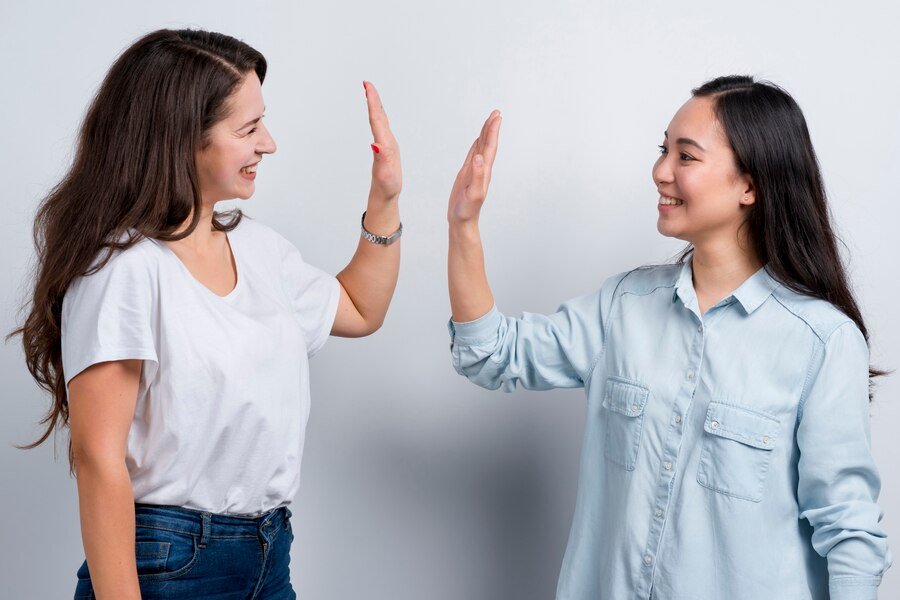
Examples In the west, touch in professional environments may be restricted to handshaking. Other examples of tactile communication can include kissing, shoulder or back patting, giving high-fives and so on. In Japan, for example, touching an acquaintance the first time would be considered rude.
Eye contact
In any face to face communication, eye contact comprises about 10-30 % of the communication. Eye contact usually signifies the roles of the communicators and can effectively indicate acknowledgement or avoidance of others. Eye contact can be extremely revealing and can reveal power plays, dominance, submission, emotion and attitudes. People who are able to maintain steady eye contact are usually associated with confidence and higher transparency of feeling.
Paralanguage
The perception and meaning of spoken communication depends not only on what we say but also how we say it.
For example A simple word such as ”yes” can be intoned in several different ways and each way conveys a different meaning to the listener.
The “how” of saying a word is known as “paralanguage”. Paralanguage plays a critical role in the defining and interpretation of non-verbal communication. Paralanguage includes syllable stress, intonation, inflection and volume, etc. In effect, it includes everything except the actual words.
Whilst paralanguage may not strictly be categorised as body language (since it cannot be seen), it affects the outcome of any communication. The syllables, “um“ ”ah”, giggling, spluttering, “tsk tsk”, etc are all associated with paralinguistic expression of communication. They are often very effective in communication. ”Phew” (sounds like the expelling of air) and is often used to express relief after a difficult task or situation. Different types of breathing can also express different emotions.
For example People breathe fast when they are stressed or angry, or they may take a deep breath before communicating bad news or issuing a warning.
Chronemics or time
The way an individual uses or talks about time can be an important factor in indicating information; individuals can be past-oriented, future-oriented, or present-oriented. Chronemics often depends on cultural background. The way people structure time or think about it is extremely important in the study of body language and non-verbal communication.
For example People in the UK may be perceived to be more aware of time compared to say, islanders who are more laid back and may be perceived as more relaxed. A UK businessman visiting an island country on business would find it very rude to be kept waiting beyond the appointed time.
However, native islanders would not find anything amiss later - they may not even be aware that they have transgressed protocol.
Hall and Hall, in their book, describe all North Europeans and North Americans as functioning on ”M-time”. This means the emphasis is on schedules, punctuality and promptness. On the other hand, Latin American cultures, Africans and islanders were often found to prefer ”P-time”. P-time was more lax with regard to time, but had more importance given to people.
Fact
The human visage is capable of giving off approximately 250,000 facial expressions. Source: The New York Times

2.4 A Closer and Detailed Look at Proxemics
An integral component of body language involves the interpretation
of spatial relationships. This is called “proxemics” (hence the word “proximity”) and this is interpreted in different ways across cultures. Proxemics involves the complex interaction of several elements, including position, movement and orientation. Similarly, the dynamics of these elements can be interpreted in situations where multiple people interact with each other. In fact, the ideas can be used to precipitate or even direct effective communication. Proxemics determines how each one of us physically interacts with other people, as well as with other objects in the environment. The subject studies the interpretation, utilisation and perception of physical distance and social distance. The concept applies not only to other people in the environment, but also to fixed objects and semi-fixed objects (such as a chair fitted with castors).As a general rule, people may find it difficult to operate in a place where the idea of proxemics is different from the one that they are familiar with.
Proxemics is studied on the basis of the following distinct factors. Intimate space/distance
This is usually pegged between 0 to 1.5 feet for people belonging to western cultures. Only people who are considered very close are allowed into this distance. Intimate space is a voluntarily selected space (hence, enforced closeness in a crowded lift, for example, is not included in the definition).Strangers who invade this space (even inadvertently) are often seen as threatening or intimidating. Most of us would enjoy only a handful of people in our intimate space. Lovers, parents and young children, etc would use this space. In general, women would use this space more than men, as their relationships and manner of interaction tends to be more intimate and intense. Personal space
In the UK, personal space begins at roughly 18 inches and includes a radius of about four feet around us. You may be comfortable with good friends in your personal space. In this space, we are free to allow people to become closer, or to psychologically push them away.
Social space extends from four feet to approximately 12 feet. It would be common to maintain social distance at meetings and gatherings, where you would spend time with colleagues or acquaintances that you have met for the first time. In general, people who are in the social zone will not touch each other physically. You can see the person's face and it is possible to effectively disengage from a conversation if you want to.
This is the area that extends from 12 to 25 feet. We use public space when we take a walk through the park, through the shopping centre, or are seated at a restaurant. Individuals who demand more public space, for example, are usually trying to establish authority. In this space, voices are usually louder and speech is slower. The well-known anthropologist Edward Hall explored the subject of proxemics in different cultures
and came to the conclusion that westerners like to keep more personal space around themselves, compared to people of other ethnic cultures.
In general, westerners tend to feel crowded more easily compared to other nationalities and need more personal space. There is no way to actually determine if the ”line” has been crossed, but your brain will know at once if someone is standing too close for comfort. VIPs, politicians, film stars and other charismatic people are well-versed in the art of using space to create rapport with their fans and following. When a celebrity or sports star allows you close enough for an autograph, it feels like a special occasion. According to Hall, space reveals as much information about a person as his actual words. Most of us tend to learn about spatial relationships through random observation and trial and error, rather than systematic observation. In general, non-verbal communication and body language can help to reinforce or dispel communication in the following ways:
Emphasise / accentuate the words: For example, nodding your head along with saying “yes” emphasises or complements the affirmative. Similarly, pounding the table along with speaking helps to reinforce words
Body language can help to control, regulate and manage communicationRepetition: It can also help to repeat the meaning of vocalised communication. For example,we tend to point whilst explaining directions
Substitution for spoken words: Non-verbal gestures may often be used to substitute realwords. For example, we place a finger on our lips to request silence, or simply nod instead ofsaying the word “yes”
Activity 1
Estimated Time: 10 - 15 minutes Think of a situation where you said something that did not produce the results that you wanted. How could you have communicated differently, in order to improve the outcome? Can you think of ways in which you can make your communication more engaging and friendly?
2.5 Other Important Non-Verbal Feedback Signals
Silence can also be considered as an important part of paralanguage and silence can be serene, stressful or heavy. The interpretation of silence depends on various factors, such as duration, whether the silence precedes or succeeds communication and the existing relationship between the individuals. In eastern cultures, silence is considered a beneficial and common form of non-verbal communication. However, in the west, silence is perceived as uncomfortable and non-functional and most people may feel that it signals the end of the communication.
Similarly, laughing, giggling, crying out, yawning, groaning, or shouting can all be considered as vocalisations that help to confirm or dispel your actual, spoken words. Vocal feedback signals also include hesitation, enthusiasm, gruffness, loudness, etc and help to convey the meaning of the words. Similarly, nodding, rolling the eyes and shrugging, etc can be construed in several ways and are largely open to cultural interpretations.
Inadvertent non-verbal gestures include rapid blinking (often indicates lack of comprehension) or pupil dilation (could indicate surprise). Another common and important example of non-verbal feedback is whistling. A person may whistle because he is surprised, happy, to attract someone's attention, or simply to hum a melody. Similarly, a person may end up warbling, due to apprehension or nervousness. In general, paralanguage consists of several “non-lexical” signals. The word non-lexical refers to words/symbols that lack an independent meaning of their own. We will now move on to discuss the primary functions of non- verbal communication.
2.6 Primary Functions of Non-Verbal Communication
Communication of Interpersonal attitudes
This refers to relationships and consists of non-verbal behaviours such as gazing, touching and tone of voice. The non-verbal signals will strongly indicate the wish (or lack) to establish or maintain a relationship with someone else.
Expression of Emotion
Emotions are commonly expressed through the usage of the face and body. For example, straightening of the back may indicate resentment or disagreement.
Self-Presentation
Self-presentation involves presenting ourselves to others by our appearance and so on.
Accompany and support speech
This refers to non-verbal communication that is used to corroborate what the other person is saying.
For example Nodding the head or saying ”Huh, huh” to indicate interest, comprehension and
agreement.
Rituals
Rituals in non-verbal communication include handshaking, greetings, hugs, etc.
Activity 2
Estimated time: 15 - 20 minutes Why is it important to learn about non-verbal communication and body language cues of different cultures? What do you think would happen if you continued to stick to your set of conventional body language interpretation principles that you learned back home? Would you be able to communicate in a foreign country?
2.7 How Men and Women practice Body Language Perception
As a general rule, women tend to be far more perceptive compared to men, because they learn to read body language early on. Women mentally compare the non- verbal cues to the vocal words and are able to judge fairly accurately if someone is perhaps lying.
Women are also nurturers, from an early age when they care for young children and babies who communicate exclusively through body language signals. This is the reason that women make extremely good negotiators. They are able to incorporate their body language reading skills and read more meaning into the subtle but powerful signals that accompany words. Many non-verbal communication cues are genetic or inborn.
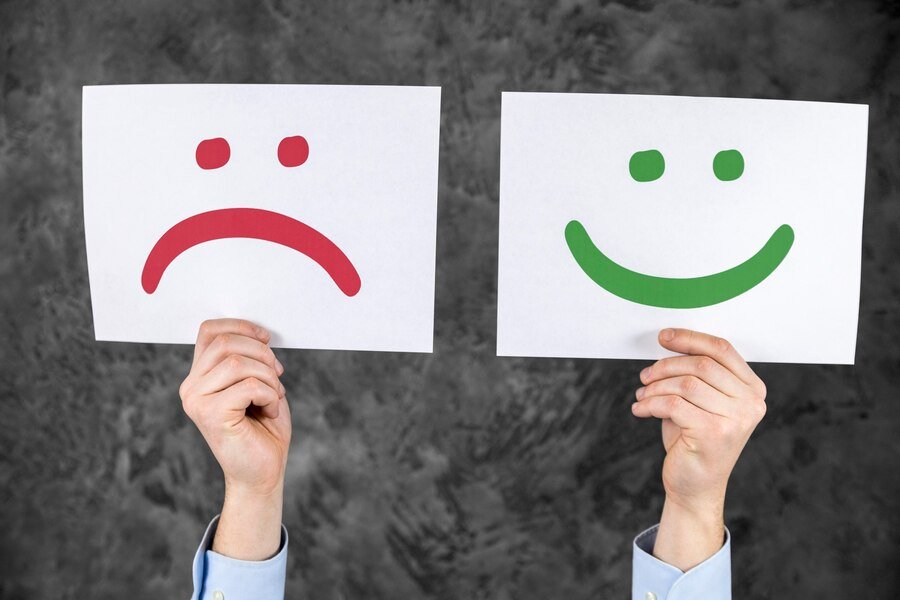
For example We smile when we are happy, frown when we are sad, or scowl when we feel angry. Similarly, nodding the head to indicate affirmation or to indicate a ”no” is universal and independent of culture. Similarly, the shoulder shrug (accompanied by open palms facing outward and head hunched in) is common to many cultures. It indicates that you do not know the response and that you have nothing to hide. Open palms facing the listener indicate transparency. The meaning of different gestures and body language varies significantly across cultures. Whilst a gesture may be meaningful in the western culture, it may mean nothing at all in say, Japan, or may mean something
entirely different. If you travel a lot on business or even leisure, it is a good idea to familiarise yourself with the different forms of body language. This will help you to improve your ability to bond with a set of new people.
.svg)



