
5.1 Introduction
Our hands can increase the power and impact of our messages significantly.
When used properly, you can use your hands very effectively and keep your listeners interested in what you have to say, without sounding melodramatic or aggressive.
Hands
Human hands are extremely unique in that they can build and create whilst communicating all the time. Hands can reveal our innermost feelings and tell their own unique story.
Thumbs have been used for centuries, to symbolise communication. Julius Caesar used his thumbs pointed upwards or downwards and this gesture would decide the fate of a gladiator. A closed fist with a thumb pointed upwards is popularly used to wish someone luck before an event or examination, etc.
Body language reveals inner emotions and feelings. The converse is also true - we can alter our gestures to change our feelings.
Sitting with the arms crossed or ankles locked can make us feel defensive or submissive. On the other hand, uncrossing your arms or unlocking your ankles consciously can help you to feel confident and will dispel nervousness.
Handshakes

Handshakes are more or less a ubiquitous gesture that are used to greet others. Although other cultures have other forms of greetings, the handshake is almost universally accepted as a conventional greeting, especially in business environments.
The way you choose to shake hands can reveal a lot of information about your personality and can make or break the first impression. Handshakes should be short, firm and gentle and one should be mindful about the other person.
This module explains the basic rules and etiquette of handshaking.
Fact
Barack Obama is known to make excellent use of hand gestures as he uses his thumb and index fingers to emphasize points
Source: scienceofpeople.com
5.2 The Significance of Hands in Body Language
We use our hands all the time, to communicate at a subtle (and sometimes blatant) level with others.
They play an integral role in non-verbal communication. In fact, even blind people gesture with their hands - it is a movement that comes to human beings automatically. By using our hands, we can add emphasis to our spoken communication and make it more effective.
Research studies indicate that young children who communicate effectively with their hands eventually demonstrated excellent problem solving abilities later in life.
Body language researchers explain that hands have the maximum number of nerve connections to the brain and are therefore one of the most expressive parts of the body, as far as communication goes.
Yet, with so much information regarding hands, most of us would be hard pressed to explain exactly what specific hand gestures mean. Regardless of the fact that human beings have developed spoken language for thousands of years, the brain continues to engage its faithful ally, the hands, to convey emotions and feelings.
In certain societies, such as the British, wildly gesticulating hands are not encouraged and are frowned upon as being excessively dramatic. Other nationalities, such as the Spanish or Italians, for example, are likely to use their hands to a much larger extent.
Throughout history, hands have been used to convey various important gestures.
Examples
Palms have been used to indicate allegiance, swear an oath, indicate openness and honesty and demonstrate submission.
In a court of law you hold the bible with your left hand and open your right palm to the court, so that everybody, including the judge and jury, is able to see it.
Smooth, fluid hand gestures help emphasise and support your spoken words. It is best to keep your hands purposeful and relevant. Keeping them crossed all the time may be perceived as too stiff, while raising them above your head may be perceived as overcompensation for the spoken word.
If you notice, people often use their hands for summarising points after a debate or talk. They will tend to use one hand for listing the points and the other for listing opposing points. Right handed people will tend to use the right hand for favoured points, whilst left handed people will use their left.
For example
During a debate people who are right handed will tend to raise their right hand slightly while speaking of points they feel strongly about.
Using appropriate hand gestures helps people to recall the details of the speech or talk better. This point was proved by a research study undertaken at the University of Manchester:
George Bettie and Nina McLoughlin used hand gestures in tandem with some old cartoon stories to demonstrate to the control group. For example, they used their hands to indicate a plump character, or waved their fingers to show a hair dryer, etc. The other group simply watched the cartoons without any hand gestures. The control group was able to recall the details of the cartoons significantly better than the other group.
5.3 Hand Gestures
Rubbing the hands together
Rubbing the hands usually indicates a positive expectation of a good outcome. You may rub your hands together (with raised palms) in excited anticipation of a good holiday. A board game player
rubs the dice between his palms in expectation of a lucky throw. The speed at which we rub our palms together suggests the extent of our expectation.
For example
Rubbing our hands together rapidly indicates excitement.
The speed at which we rub our hands together also indicates who we think the beneficiary of the gesture will be. Rubbing the hands slowly is usually perceived as a benefit to ourselves, whilst rubbing them rapidly indicates a benefit to the other person. Sales personnel are specifically taught to rub their hands in a positive way, so that they do not discourage the buyer.
In fact, slow hand rubbing can be interpreted as sneakiness or deviousness and usually does not convey a good impression of the person performing the gesture.
Finger and thumb Rub
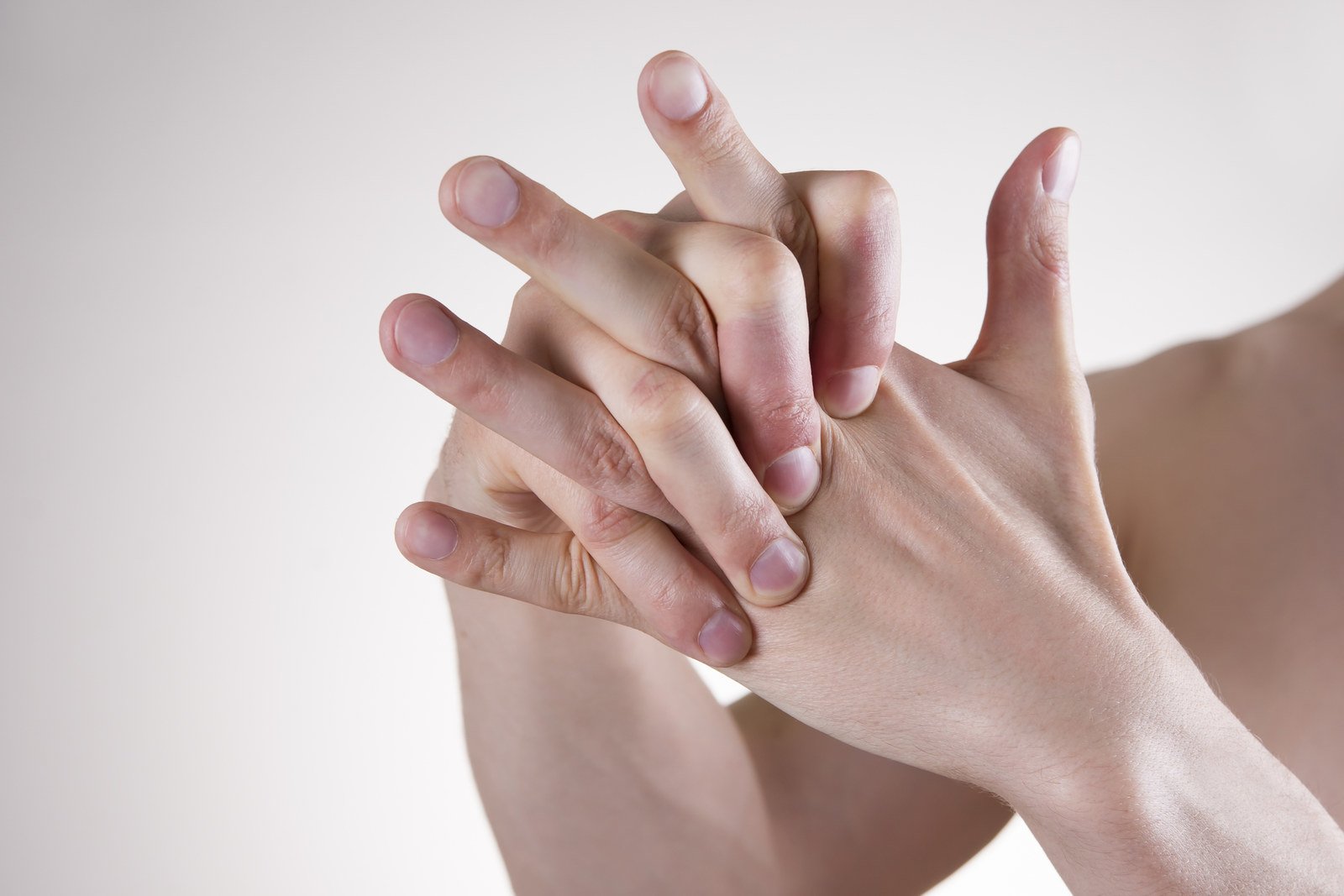
Rubbing the finger and thumb together indicates that the person is thinking of, or referring to, money. Fingers interlocked and clenched together In this position, the hands may either be positioned under the chin, or in the lap. It usually indicates anxiety or restraint.
In fact, when fingers are interlocked and raised to the chin, it can even denote frustration. The face may be smiling, but such a hand gesture is indicative of negative inner feelings. It is common to find people clenching their hands in this position when they feel that they have not convinced the other person of their viewpoint. Hands may be clenched either at the chin (or half covering the lower part of the face), on the desk, or held in front of the body (roughly covering the genitals).
Clenched hands held at the chin level reveal a higher degree of negativity, compared to holding the hands in front of the genitals. When you observe someone with this gesture, try to take steps to get them to unclench their hands.
For example
Try offering them a drink, or give them something to hold.
Resting your palms under your face (also called the face platter)
You may sometimes observe people (especially women) placing their palms one on top of the other under the chin and resting their face on the palms. This is called the face platter and is only used during personal interactions, especially courtship. The gesture symbolises offering your face to your prospective date as a gift.
Holding the hands behind the back (palm-in-palm, hand gripping wrist, hand gripping upper arm or elbow)
People who hold their hands behind their back usually tend to exude power, authority and confidence. This position is commonly observed in the members of the British Royal family.
The hands-behind-the-back gesture is also commonly used by leaders, headmasters and senior military personnel.
The hands are clasped behind the back (with one hand usually holding the wrist of the other), or one palm is in the other and the chin is held high. Please note that whilst the palm-in-palm denotes power, the hand gripping the wrist could be a sign of frustration and repression. One hand restrains the other from striking out.
Research indicates that if you stand in this position, you will begin to feel confident and authoritative, even if you were feeling nervous or fearful to begin with.
Yet another hands-behind-the-back gesture is when one hand grips the elbow or the upper arm of the other arm.
This position indicates a controlling gesture - the higher the hand, the more is the self-control being exercised. This gesture is a physical representation of “trying to get a grip on
yourself”.
Policemen who are without firearms are often found to use this gesture as a symbol of power. They also often rock back and forth on their feet. If you find yourself inadvertently adopting the hand gripping the wrist position, change to the palm-in-palm instead and you will experience a change in feeling.
Thumbs protruding out of the pocket
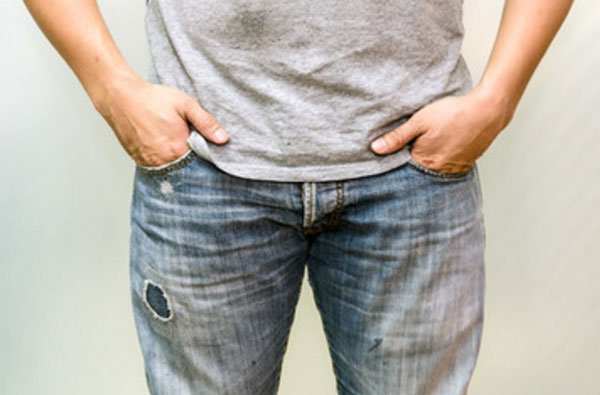
Putting your hands into your front trouser or jeans pockets with the thumbs protruding out is a sign of authority and confidence.
For example
Subordinates would not adopt this gesture in front of their boss (although he may adopt the attitude).
Arms hugging yourself with the thumbs pointing upwards
This is usually perceived as an extremely defensive and negative stance, coupled with confidence as displayed by the thumbs. People who adopt this posture usually rock back and forth on their heels as they speak.
The thumb thrust
This is again a derisive gesture used to point to someone or something that one doesn't like. Women normally do not use the thumb thrust position, but it is used by men usually to snicker or convey derogatory remarks about the object being pointed at.
The hand steeple
The hand steeple is not restricted only to the steepling of fingertips described in module 4. The hands are held together with the fingers and form the rough shape of a church roof.
The hands may be positioned in front of the abdomen, or resting in the lap or on the desk.
This is one of the few gestures that do not require a cluster of gestures in order to interpret it. The gesture exudes confidence.
5.4 Palm Gestures
The palms can be used to demonstrate power, authority and openness.
Open palms or palm up
Open palms have always been a symbol of honesty, transparency and submission. When someone is opening up to you, for instance, they will start by placing their palms where you can see them in full view.
Psychiatrists and therapists often take note of subtle palm signs, because they reveal a lot of hidden information about our state of mind and emotions at that point.
The palm up gesture is a non-threatening or even submissive gesture, which is intended to convey that we do not mean any harm. Fraudsters and con men try to keep their palms in plain view, as well as keep them facing upwards. However, if you are a keen observer, you will notice other little signs (like dilated pupils) or leg movements, etc, which give them away.
The palm down position
The palm down position conveys authority and power and should be used only in the correct situations. The gesture would not be out of place from a boss to a subordinate, but would be inappropriate among equals. The palm down position is useful if you want to dominate another person or establish your superiority.
Amongst couples, the palms reveal a lot about the nature of their relationship. If the couple's palms are vertically hanging side by side as they walk, you can conclude that their relationship is balanced.
One of the most famous palm down gestures was practised by Adolf Hitler during the Nazi regime.
If the man walks slightly forward and his palm is facing backwards towards the girl (and the girl's palms are facing forwards towards the man), this usually indicates that the male is protective and slightly dominant over the female.
Palms closed with the finger pointed
This is a derisive, authoritative gesture, which invariably gives offence. This is because the closed palm with the pointed finger subconsciously resembles a club and moving your finger up and down is actually symbolic of a physical beating. This gesture silently says: Do it my way or go your way. Social experiments have also found that listeners recall less of what the speaker has said if he or she is a habitual pointer. In fact, when the speaker pointed to the audience, their attention shifted from the content and they began making silent personal judgments against the speaker. This is because the pointed finger puts people on the defensive.
If you have had a habit of pointing in this manner, try to replace this with an open palm gesture. You will immediately observe that you are able to relax the atmosphere and connect with your listeners on a better level.
This gesture evokes negative feelings in the audience or your listeners, so please consider eliminating it from your body language.
Activity 1
Estimated time: 5 - 10 minutes
How and why do you think hands play such an important role in body language communication? How can you use this to your advantage?
5.5 How the Law of Cause and Effect works with Respect to Body Language
We have read and understood that the law of cause and effect reveals our innermost emotions and feelings.
This can work effectively the other way round too; simply keeping your palms open and upwards will help to reduce any propensity to tell untruths. Telling untruths does not always brand us as liars.
People tell lies for different reasons (it does not always brand them as chronic liars).
These include:
.For fear (you are scared to tell the truth)
.For approval (telling the truth about yourself may turn off your peers)
.For protection (you may tell your father that you studied late, because he will punish you otherwise)
Regardless of the reason, keeping your body language positive helps to curb the tendency to lie. As a result, you become more confident to tell the truth under different situations. Our unconscious gestures have emotions attached to them and practising those gestures automatically triggers the corresponding emotion.
For example
Simply crossing your arms across your chest or locking your ankles may make you feel defensive.
Opening your palms and becoming more honest also helps to force the other person to avoid telling untruths. Overall, the communication and interaction is less likely to contain false information and untruths. Consequently, the results will be more productive, as the conversation will be less impacted by pretences and posing (which are variants of lying).
Fact
According to a report in the Guardian, one of Tony Blair's best body language features was his confident walk.
Source: The Guardian UK
5.6 Different Types of Handshakes and what they Reveal about your Personality
From ancient times, tribal people used to greet each other and show their willingness to make friends, by opening their palms to each other.
The underlying idea of the greeting was toindicate that they were not carrying any concealed weapons, etc. During the Roman era, the forearm grasp was a common way of greeting, because Romans often concealed daggers under their sleeves.
The handshake as an accepted form of greeting is thought to have originated around the 5th century, in Europe. Today, the handshake is a ubiquitous greeting of old and new acquaintances and friends. It signifies equality, balance and a willingness to converse and interact, with no threatening motives.
During the 19th Century, the handshake was commonly used to seal business deals and transactions. Whilst the handshake was initially a male gesture, handshakes can be limp, strong, aggressive and standoffish, amongst many other types.
Similarly, people across different cultures shake hands in specific ways. In countries, including Japan and Thailand, the handshake is becoming increasingly popular in business environments. While Europeans and Americans are generally brief hand shakers, the French and Germans are more effusive in their handshake and are known to hold the hand for a longer period of time.
In the western world, women who shake hands easily and naturally are perceived as more open minded and receptive to ideas. Your handshake reflects your confidence, attitude and personality, so it is extremely important to learn how to shake hands in the right manner.
Here is a list of occasions where you may need to shake hands with others:
.Job interviews
.Initial introductions
.Greeting guests as a host, or the host as a guest
.Greeting old friends and relatives
.Bidding farewell to a colleague or friend
.Responding when someone extends a hand for a shake
Activity 2
Estimated time: 5 - 10 minutes
What do you think is the advantage of shaking hands in the beginning, as well as during departure from a meeting?
How is this better compared to a single handshake at the beginning?
5.7 Etiquette of Handshakes
The following rules explain the etiquette of handshakes.
This is deeply related to body language, as we learn to regulate our handshake according to the
situation.
General Rules regarding the Initiation of a Handshake
Although it can feel instinctive to reach out to initiate a handshake first, it may not always be appropriate to do so. Since the handshake is a gesture of friendliness, trust and welcome, you have to be sure of your position first.
For example
Sales people are trained not to initiate a handshake if they have called on a customer unannounced. This is because they cannot be sure that they are welcome and the handshake may be perceived as a forced interaction.
Similarly, in certain other cultures (including Arab cultures), it may be considered inappropriate to shake hands with women. In general, it is courteous to allow the person older in age or higher in authority to initiate the handshake first.
Stand and make eye contact with the person before you extend your hand
If you happen to be sitting, stand up while making eye contact and smile at the person, before extending your hand. Face the person and do not walk away or position your body away from them. This gesture shows respect, interest and attention to the other person.
Handshakes are always performed in the upright position, unless you happen to be confined in a small space (like a restaurant booth).
Remember to vocalise a greeting while extending your hand
Perhaps you may wish to greet the other person (“How do you do, Mr Ramsay?”), while extending your hand at the same time.
Squeeze firmly but gently
An ideal handshake lasts between two and five seconds.
Squeeze the other person's hand gently and firmly - but not crushingly so. If you are shaking hands with someone superior to you, follow their lead and withdraw your hand politely.
On the other hand, if you are shaking with subordinates or juniors, remember to withdraw your hand after a short handshake. Short handshakes are best and if you notice that the handshake has lasted for longer than five seconds, please withdraw your hand politely, while continuing to make eye contact and conversation.
Remember to be mindfully observant of what the other hand is doing
Most people shake hands with their right hand (including habitually left handed people). Keep the other hand unclenched and free, as well as in sight. Do not keep the left hand in the pocket.
If this is a personal meeting and you are friendly with the other person, you can try lightly patting him or her on the shoulder (this should not be done whilst shaking hands with superiors).
Shake the hands in the correct manner
Grip the other person's hand firmly but gently and shake it up and down and not from side to side. Also avoid a vigorous pumping motion, as this may make the other person feel uncomfortable. Shake the other person's hand with the full web of your hand (from the top of the thumb to the top of the index finger).
Please avoid hurting others with a pointed ring worn on the right hand. If you are communicating with the elderly, please be mindful of weak or arthritic fingers before you squeeze.
[Tweet "I just completed Module 5 of the Body Language Diploma Course"]
.svg)




Class Sessions
1- Introduction to Body Language
2- Dimensions and Attributes
3- Basics of Body Language (Part I)
4- Basics of Body Language (Part II)
5- Hand Gestures and Introduction to Handshakes
6- Different Types of Handshakes and Crossed Arm Postures
7- Eye Signals and Eye Contact
8- Gestures and Postures that Reveal Deceit and Lies
9- Body Language for Career Success
10- Cross-Cultural Interpretations of Body Language, Common Gestures and Postures in Daily Life