
7.1 Introduction
Research suggests that eye contact is an important source ofinformation, regarding responses in face to face encounters. Eye contact provides important feedback on aspects such as intimacy, affiliation, openness and furtiveness, during communication. People make eye contact during social and professional encounters. You may also have to make eye contact with multiple people, one by one, during meetings and conferences, etc. Module 7 explains the significance of eye contact and how to interpret eye signals.
You will also learn how to make the right eye contact, for maximum impact. Pupil dilation / gazing
The two main components of eye contact are pupil dilation and gazing behaviour. Unlike other forms of body language which we are able to regulate easily, eye signals are intuitive. Dilated pupil sizes usually indicate interest and attraction, whilst contracted pupils indicate disinterest. Pupil dilation plays an integral role in courtship, where partners may be unconsciously responding to pupil dilation.
Eye contact

Excessive and inadequate eye contact may make or mar a communication. Excessively prolonged eye contact may come across as threatening and intimidating, whilst lack of eye contact may be perceived as shiftiness or disinterestedness. It is a good idea to learn how to make the right amount of eye contact.
Eye contact signals vary significantly across cultures. If your business involves communication with other nationalities, you may wish to make it a point to learn how others interpret eye contact.
The gaze
The gaze that you choose will have a profound effect on the nature of your interaction. You will choose different gazing behaviour with an errant subordinate, a lover and a friend. The way you direct your gaze reveals a lot about your interest and attitude towards the person or people. It is possible to make eye contact with multiple people at once, such as during a talk or presentation.
7.2 Eye Contact and Signals during Face to Face Communication
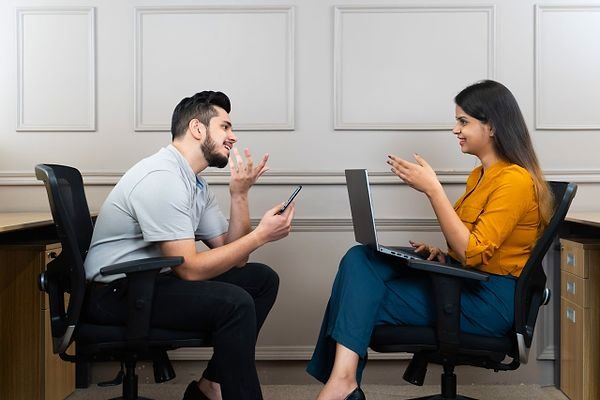
”Eyes are the mirrors of the soul” (Yiddish saying)
Aside from sight, the eyes provide important clues to how we feel about someone. Body language experts suggest that we can determine a lot of relevant information about a person's state of mind by studying their eyes.
Looking down your nose at someone or looking someone in the eye can convey different states of attitude (condescension, assertion, aggression) and regulate a conversation by giving crucial feedback regarding dominance, submission and concealment. In addition, piercing eyes, soft gaze, penetrating eyes, inviting eyes, look to kill, looking daggers at someone, etc., all indicate that our eyes reveal our feelings at that point, very clearly.
Eye signals are determined by two main components - our gaze and the size of our pupils. Both play a crucial role in giving feedback regarding our feelings. Eye contact is an especially important form of non-verbal communication, because it does not lie under our voluntary control.
7.3 Eye Pupils and their Significance in Communication
The pupils dilate and contract, in response to positive or negative feelings.
Excitement and sexual attraction can cause our pupils to become larger. In fact, studies indicate that pupils can dilate up to four times the normal size at these times. Conversely, when a person experiences negative feelings or anger, her pupils will usually become small and beady. This is like an involuntary narrowing of the eyes. People with constricted pupils can appear to be unpleasant.
Our pupils begin to dilate, when we perceive something as attractive or interesting. They reach their maximum dilation, when we are most interested or attracted. Similarly, a person with dilated pupils is more likely to attract attention from listeners, compared to someone with contracted pupils.
For example
If we looked at photographs of leaders or politicians that we admire, our pupils would dilate.
Most importantly, pupils automatically dilate in dark places, to compensate for the lack of light. This is the underlying reason why couples feel more romantic in dimly lit restaurants and pubs. The pupils get dilated due to the aesthetic lighting and this, in turn, heightens the feelings of romance and attraction. The phrase "gazing into each other's eyes” is often used to describe couples in love with each other. On a subtle level, what is really happening is that the pupils become dilated and each partner decodes this signal on a subconscious level.
Babies, for instance, have naturally dilated pupils, in order to attract love and attention from parents.
In general, women's pupils dilate faster compared to men. Men's pupils tend to dilate most due to sexual arousal. Overall, small pupils can indicate a silent "I do not want more”; while dilated pupils can indicate "I want more”.
However, please remember that unusually small pupils (less than 3 mm) and unusually large pupils (more than 6.5 mm) may indicate substance addiction and may not be reliable for interpretation. In reality, “looking someone in the eye” during negotiation is to be able to subconsciously interpret pupil dilation correctly. This will tell you the direction in which the negotiation is moving. Research studies also indicate that women are better at decoding eye signals compared to men. In fact, we have a better, inbuilt ability to read and interpret eye signals, compared to general body signals.
This is why autistic individuals find it difficult to form social relationships, although many of them have a very high IQ. They are unable to interpret eye pupil dilations and contractions as well as others.
Human beings have “whites of the eyes” which other animals, including primates, lack. The whites of the eyes make it possible to decode the direction of the glance and size of the pupils better. Again, women in general are associated with a greater “white of the eyes” compared to men.
Fact
The preferred duration of ideal eye contact is usually between three to three and a half seconds, before you can break it and look away.
Source: Business Insider
7.4 Different Types of Gazing Behaviour
Looking Up
The action of looking upwards is generally indicative of thinking about something or recalling information while speaking. The individual is trying to form pictures in their mind and the gesture is suggestive of a visual thinker. The gesture can be decoded at a deeper level.
For example
If the person looks up and to the left, they are most probably trying to recall a memory. On the other hand, if they are looking upwards and to the right, they could be trying to trigger their imagination. Hence, a person who looks upwards and to the right while speaking is more likely to embellish facts or distort the truth.
In some cases, the two gestures are reversed in that the person may try to recall a memory while looking upwards and to the right, etc. If in doubt, casually try to get the person to recall something and observe the natural direction of their head. In other situations, looking up could also be interpreted as a sign of boredom, as the individual looks around for something to observe and amuse themselves with whilst you speak.
If the head is positioned down and the eyes are looking up, it could signal submission (lowered head) and coquettishness (eye contact), at the same time. The person may also have their head lowered and may look upwards at you, whilst frowning - this usually means disapproval or displeasure.
Since children are smaller than adults, they usually lower their heads and look up. Hence, one tends to feel parental and empathetic towards someone who emulates the gesture. Looking up can also be construed as a mark of respect towards someone who is higher in status or rank.
For example
A taller officer will raise their head and look up at a higher status officer. This gesture has nothing to
do with physical height.
Looking down

Looking down can be interpreted in several ways - you should always understand gestures in context. Looking down can signal submissiveness or respect to someone higher in status. It may also indicate guilt.
Looking sideways
When we look sideways, we are doing any one of two things:
. We are looking away from something in our field of vision
. We are looking at something else that attracts our attention
A quick or fleeting sideways glance indicates that you are distracted and want to check out the irritation. In courtship, looking sideways can mean that the person (women usually use the sideways glance more often) is attracted to you and wishes you to know that. In such cases, it may be accompanied by raised eyebrows and a smile. If the sideways glance is accompanied by a frown, it could indicate hostility or suspicion.
Sideways gazing with lowered eyelids could also signal shiftiness or low self-esteem, when the person is checking the reactions of other people whilst he speaks. In addition, it could indicate a conspiratorial attitude; as if you are doing something that you do not wish other people to know.
Activity 1
Estimated time: 10 minutes
If eye contact signals are intuitive and involuntary, then how can we make an attempt to regulate our eye contact and gazing behaviour?
Do you think that (since much of it is involuntary) eye contact alone should be used to determine the feelings of the person? Would the results be reliable?
7.5 Different Types of Eye Contact
When people meet face to face, there is always some level of eye contact between them. Eye contact can indicate submission, dominance, interest, or boredom, amongst other things. Eye contact is one component of body language that varies significantly across cultures.
In the west, regular and persistent eye contact is perceived as necessary to productive communication. In certain eastern cultures (like Japan), prolonged eye contact may be perceived as rude and obnoxious.
The best way is to follow the gaze behaviour of others in your meeting, or follow the host.
As a social tool, eye contact can take up a surprisingly high level of energy.
Making Eye Contact
Making eye contact with someone indicates attention and interest.
For example
If you have looked away and someone says something, you make eye contact with them.
This indicates that what they are saying has attracted your attention.
Breaking Eye Contact

Prolonged and intense eye contact is often perceived as offensive or threatening. It is a good idea to break eye contact once every few seconds and look away. However, do not look away for a prolonged time, as this in turn may indicate boredom or loss of interest.
Longer Eye Contact
For many, longer eye contact would indicate an interest in the topic under discussion or interest in the speaker, or both. Visual thinkers or creative personalities usually like to make eye contact and then look away into the distance - they usually like to visualise everything that is spoken.
Whilst longer eye contact can be a sign of interest (especially during courtship), liars can also stare for a disconcertingly longer time, in an effort to overcompensate for the stereotype. Usually, shifty eye contact is associated with liars. Hence, they may try to cover up by staring at your eyes for too long, without blinking.
As a general rule, we tend to like to look at people who look at us more and vice versa. People who make limited eye contact may be timid, shy, or nervous. However, this should be interpreted in conjunction with other gestures. Some of us simply feel awkward making eye contact and in such cases, may choose to become the listener for some time. This will allow time to make eye contact with others.
Rapidly darting eyes can indicate extreme nervousness and insecurity.
Staring
We may stare at someone after hearing bad or shocking news and may continue to stare, out of disbelief. Sometimes, you may continue to stare at someone after shocking news, without really paying attention to where you are staring.
In some cases, when two people stare at each other, it can become a competition for dominance, to see which one glances away first.
Narrowing or Squinting the Eyes
Narrowing the eyes or squinting can indicate suspicion or evaluation, as the person considers the information that you have provided. Squinting may also indicate uncertainty. When a person narrows his eyes and looks at a woman, the gesture may also demonstrate suggestiveness. You can address such people directly.
Blinking
By itself, blinking is a natural process that helps to hydrate the eyes. However, we may blink more rapidly under stress or tension. When we are actively involved in a conversation or interested in the interaction, we often blink at the same rate as the other person. It is also natural to blink when there is a pause in the conversation - we like to keep our eyes open when the other person is speaking.
Excessive blinking may also be a sign of lying (as a means of overcompensation, liars may try to avoid blinking too much). Blinking accompanied by fluttering of eyelashes can be interpreted as a coy signal from a woman and it may also indicate surprise. Extended blinking is also a subconscious way to block vision, because the person in question is bored or disinterested in you - it could indicate arrogance or a superior attitude.
In western cultures, it is also common to signal superiority or condescension by tilting one's head back and slowly blinking (almost like closing your eyes).
Fact
The average person blinks at a rate of six to 20 times
per minute. Anything faster than this could indicate stress, nervousness, or lying behaviour
Source: huffingtonpost.in
7.6 Gazing
Gazing behaviour can also be divided into the following three types. The Social Gaze
During social encounters, it is common to observe the person looking at the triangular area between the eyes and the mouth. Gazing at this area is considered non-threatening and is the usual norm during social interactions.
The Intimate Gaze
This is a common gaze that takes place between men and women. The intimate gaze includes the area between the eyes and the chest and gives each person the opportunity to check out the person in front of them. The intimate gaze also includes two quick glances, the first at the lower part of the body and the second at the face. Men usually tend to be more obvious in their manner of gazing, whilst women are discreet and combine it with a lowered head or looking away.
The Power Gaze
The power gaze exudes authority and power and includes staring at the area between the eyes and centre of the forehead. This can come across as intimidating, so please eliminate it from your body language during friendly or romantic interactions.
The power gaze is a useful form of eye signal if you are confronted with a bore, or someone who simply will not allow you speak. If you are a person who is easily intimidated or feels nervous, try using this type of gaze during official interactions.
Activity 2
Estimated time: 5 -10 minutes
You make eye contact with friends and acquaintances, as well as with strangers.
Do you think the mode and level of eye contact varies depending on the kind of relationship that you
have with people?
7.7 Other Types of Eye Contact
Eye Blocking
Eye blocking is indicated by excessive rubbing or blinking. It indicates disagreement or consternation. It is especially very common in children to rub their eyes when they hear something unpleasant.
Synchronising Eye Contact
If used in a subtle way, synchronising eye contact during a conversation can help build rapport with the other person. But making it obvious may feel embarrassing or creepy, so use this method discreetly.
The following eye movements indicate different meanings:
. Eyes moving upwards: The person is trying to recall a picture
. Eyes moving to the side and head slightly tilting: They are trying to recollect something that they heard
. Eyes moving down to the right: The person is trying to recapture an emotion or feeling
. Eyes downwards and to the left: The person is chatting mentally to themselves
Most people prefer the visual information channel, as it is easier to understand and communicate. Phrases such as "Is it clear?"”, ”Can you show me how” and ”I can look into that for you” indicate the importance of the visual channel in body language. A lower percentage of people prefer the auditory channel, while others give importance to feelings.
The following signs may indicate that eye contact is too little:
. The listeners or meeting participants move in closer to hear you
. An increasing number of people may leave the conversation and start side conversations
. Most people will keep staring at you, to make the required eye contact that is absent
The following signs may indicate that eye contact is too much:
. The listeners may back away from you
. They may cross their arms and legs in a "closed off” gesture
. The eye contact could shift to a point behind you, or they may take longer to resume eye contact with you
7.8 Tips for Making Eye Contact with a Group
It is easier to make eye connection rather than eye contact with people in the audience.
This way you can acknowledge everyone's presence, without wasting time creating too much eye contact with only a few people.
Allot no more than four to five seconds to maintain eye contact. During that time, pretend that the specific individual is the only person in the room. This has a two-fold advantage - you can draw on your conversational skills and not feel nervous worrying that you are actually speaking to a group of people.
Break eye contact and move to the next person, at the end of a sentence. If the sentences are lengthy, remember to switch eye contact to another person at the end of a phrase.
You may have to pace your eye contact, by taking into account the cultural differences between people in the audience.
For example
Some people may not mind extended eye contact, whilst others may feel uncomfortable.
Make sure that you include those who feel nervous, but keep up eye contact according to their comfort level.
[Tweet "I just completed Module 7 of the Body Language Diploma Course"]
.svg)



