
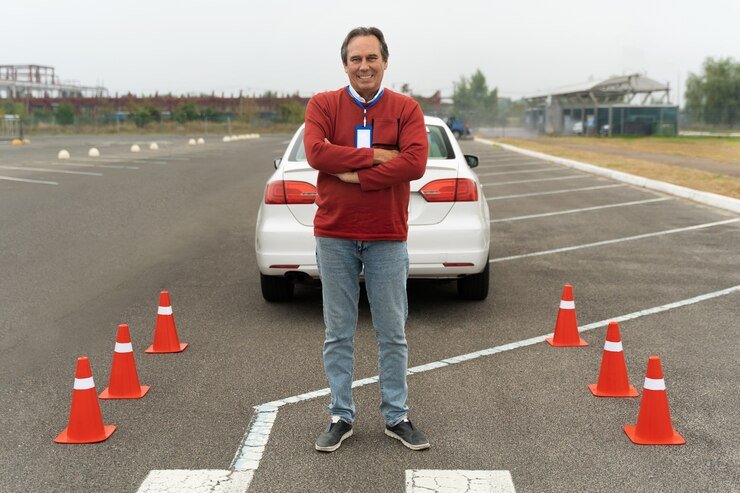
10.1 When Should you Take your Practical Driving
Test?
There is
no universal rule that you should follow, when it comes to deciding when you
should take your practical driving test.
Some
people learn quickly, whereas others might need a few weeks or a few months
longer than average. Various factors determine how many hours an individual will
need. These include any previous driving experience, attitude and age. In
general, younger learners will require fewer hours than those learning later in
life.
Consistency
is also a consideration - people who take lessons on a regular basis are much
more likely to get into good driving habits and therefore learn more quickly
than those who try to learn in phases, taking weeks or even months off in
between.
Those who
can undertake private driving practice between lessons are also at an advantage
and will probably need fewer tuition hours because they will have the
opportunity to consolidate what they have been learning in real-life
situations.
However,
the most important consideration is whether or not your driving instructor
thinks that you are ready for your test. Allow them to notify you, when they
think that it is time for you to book your test. A good instructor will have
accumulated plenty of experience in gauging the point at which their students
are ready to take the test.
You
should have some kind of record, detailing the progress that you are making.
Most driving schools have a standard manual that they give to learners. An
instructor will tick off each skill, when they are satisfied that you have
mastered it, providing you with a tangible record of your strengths and
weaknesses.
Your
instructor should also give you a mock test, to ensure that you are capable of
passing the actual test. It is understandable that you want to pass the test as
quickly as possible, but, for the sake of your own safety and that of other
road users, it is more important that you are properly prepared.
You must
have passed your theory test, before booking your practical test. There are a
few circumstances in which you will not need to have passed a theory test,
prior to booking the practical test.
You do
not need to have passed the theory test if you wish to do the following:
·
take a
practical tractor test
·
take a
test, in order to upgrade from an automatic-only to a manual driving licence
·
take a
test, in order to move through the motorcycle licence categories
·
take a
car and trailer test
·
take a
lorry and trailer test
·
take a
bus and trailer test
·
take a
large lorry test, when you already have a medium lorry licence*take a large bus
test, when you already have a medium bus licence
10.2 How
to Book your Test

To book a
practical test, visit https://www.gov.uk/book-driving-test.
This
service is appropriate for those looking to gain a licence, in order to drive a
car, motorcycle, lorry, bus or coach. To make your booking, you will need your
UK provisional driving licence number, a credit or debit card and your driving
instructor's personal reference number, if you wish them to accompany you on
the day of the test and want to check their availability. The online booking
service is also designed for those who need to pass some of the tests required,
in order to practise as an
Approved Driving Instructor (ADI).
This
online service is available from 6am to 11.40pm, seven days a week. Those
looking to take any form of 'upgrade' test should call the DVSA on 0300 200
1122. Once you have booked your test, you can check for earlier appointments
that have unexpectedly become available. These are known as 'cancellation
appointments'.
Fees
You will
need to pay the test fee, as part of the booking process. The current cost of
taking a test in a car is £62.00 for weekday tests and £75.00 for tests
scheduled during evenings, weekends and bank holidays.
Motorcyclists
sit two practical tests: an off-road test that currently costs £15.50,
regardless of the time or day on which it is scheduled, and an on-road test
that costs £75.00 on weekdays and £88.50, if scheduled for an evening, weekend
or bank holiday.
If you are taking the test as a disqualified
driver, the test process will be longer and, as a result, more expensive.
Currently, the fees are £124.00 for a weekday test and £150.00 if scheduled for
an evening, weekend or bank holiday.
Fact
The
average number of tuition hours that a learner driver will require before
passing their test is 45, plus 20 additional hours of private practice.
Source:
DVSA
10.3 Choosing which Vehicle to Use

The DVSA
does not supply cars for use in a driving test; therefore, you must supply an
appropriate vehicle.
Most
people use their driving instructor's car, but you can use your own car, if you
prefer. Most learners find that it is best to take their test in the car in
which they learnt to drive. This will usually be their instructor's car. Either
way, the car in which you intend to take your test must meet certain
requirements; if it does not meet these requirements, your driving test will be
cancelled, and you will not receive a refund.
The car must meet the following criteria:
·
Taxed
·
Insured
for a driving test (you should check with your insurer)
·
Roadworthy
and, if it is over three years old, have a current MOT certificate
·
No
warning lights showing
·
No tyre
damage
·
The legal
tread depth on each tyre
·
No
space-saver tyre fitted
·
Smoke-free
(you cannot smoke in the car just before or after the test)
·
Able to
reach at least 62 mph and have a mph speedometer
·
Four
wheels and a maximum authorised mass (MAM) of no more than 3,500 kg
·
An extra
interior rear-view mirror, for the examiner's use
·
L-plates
(L-plates or D-plates in Wales) on the front and rear
·
A
passenger seat belt, for the examiner
·
A proper
head restraint, for the examiner (you cannot use a slip-on head restraint)
You may use a camera, fitted for insurance
purposes, provided it faces outside the car, does not film the inside and does
not record audio from inside the car.
You can
take the test in a manual car (those with three pedals) or an
automatic/semi-automatic car (those with two pedals). If you take your test in
an automatic or semi-automatic car, you will only be able to drive automatic
and semi-automatic cars, after passing your test.
Provided
it is fitted with dual controls and meets all of the above criteria, you can
take your test in a hire car. You can also use a car that has an electronic
parking brake, hill-start assist or both.
There are
some specific models of cars that you cannot use in your test because they do
not afford the examiner all-round vision.
You
cannot use any of the following cars:
·
BMW Mini
convertible
·
Ford KA
convertible
·
Toyota Iq
·
VW Beetle
convertible
You
should check with the DVSA, prior to booking a test, if you wish to use any
convertible car or a panel van.In addition, you cannot use a car that has a
known safety fault. The Government provides an up-to date list of vehicles that
have been recalled and are therefore not deemed appropriate for use in a
driving test.
If your
test needs to be cancelled, due to reasons, such as examiner illness, you will
be able to claim out-of-pocket expenses from the DVSA.
If you
are taking a motorcycle or moped test, you must use a vehicle that is in the
same subcategory as the licence for which you are applying. The vehicle must
also have the same type of transmission as those in the relevant subcategory
(manual, automatic or semi-automatic).
The subcategories are outlined as follows
·
Moped,
tricycle
·
Standard
·
Unrestricted
·
Subcategory
·
Light
motorcycle or quad bike
The
motorcycle or moped that you use for your test must meet the following
criteria:
·
A solo
machine (unless you have certain disabilities)
·
A
speedometer, measuring speed in mph
·
Display
L-plates (L-plates or D-plates in Wales) on the front and rear
·
Insured
·
Taxed
·
Roadworthy
·
Have no
engine warning lights showing
If you pass your test on a motorcycle with an
automatic or semi-automatic transmission, you will only receive a licence
enabling you to drive these kinds of motorcycle.
If you
restrict the engine power of a motorcycle to subcategory A2, the restricted power
must be at least half the unrestricted power. If you choose to do this, you
must bring proof that you have restricted the power; otherwise, your test will
be cancelled. This proof must be on headed paper, from a main dealer, an
official importer or a recognised specialist, and show the motorcycle's
registration number.
You may
only use a motorcycle with a sidecar for your test, if you have certain
disabilities - check with the DVSA, to confirm whether this applies in your
case. You cannot have a passenger in the sidecar during the test. If you take
the test on a motorcycle with a sidecar, you will only receive a licence
allowing you to ride a motorcycle with a sidecar.
If you
are using a switchable engine control unit (ECU) or variable power device, your
motorcycle cannot have interchangeable carburettor heads, an exhaust manifold
restrictor or a hidden ECU. It must be clear what power mode the motorcycle is
in, at any given time.
You must
wear appropriate clothing, when taking the test.
Specifically,
you must wear the following:
·
A
motorcycle helmet that meets British safety standards
·
Motorcycle
boots or other sturdy footwear that supports and protects your ankles
·
Textile
or leather motorcycle trousers or heavy denim trousers
·
A textile
or leather motorcycle jacket or heavy denim jacket, with several layers
underneath
·
Motorcycle
gloves
Occasionally, a test may need to be cancelled.
For instance
A riding
test will not go ahead if the weather is dangerous, for example, if the roads
are icy, or if there is flooding, thick fog or high winds.
If the
weather appears dangerous on the morning of your test, call the test centre
number provided in your confirmation e-mail. If the test cannot go ahead, the
DVSA will automatically book your test for the next available date and send you
the details within three working days. However, this may be up to seven working
days, in the event that there is a prolonged period of bad weather. You cannot
make a claim to the DVSA for expenses incurred as a result of bad weather.
10.4 How
the Test is Structured
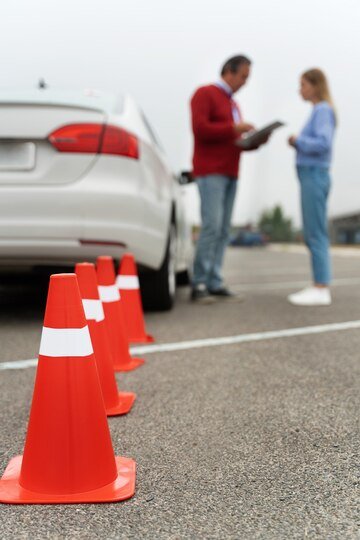
You must
bring with you to your test: your UK photo card driving licence, your theory
test pass certificate and a car.
If you
neglect to bring these with you, your test will be cancelled, and you will not
receive a refund.
You can
choose to have someone sit in the back of the car, to be with you when you
receive your results and feedback or both. This person can be anyone aged 16 or
over, who can be relied upon to follow the rules on observing tests. In short,
they cannot make comments or interfere in any way.
It is
common for learner drivers to have their instructors sit in the back of the
car. Not only can this provide a source of psychological security, but it is
also valuable feedback for the instructor. If you fail and have to take your
test again, your instructor will have a solid idea as to your strongest and
weakest areas.
The test
must be taken in English or Welsh. You cannot take an interpreter with you, and
you cannot take the test in any other language.
Driving
tests begin with an eyesight check. You will be asked to read a new-style
number plate from a distance of 20 metres or an old-style number plate from a
distance of 20.5 metres. If you cannot pass this check, the test will end
immediately. If you need glasses or contact lenses, in order to meet the
required sight standards for driving, make sure that you take these with you on
the day.
You will
then be asked two vehicle safety questions, known as 'Show me, tell me'
questions. The examiner will ask you one of each of these types of questions.
The possible
questions are as follows:
·
Show me
how you would check that the direction indicators are working.
·
Show me
how you would check that the brake lights are working (if you need to switch
the ignition on, please do not start the engine).
·
Show me
or explain how you would check that the power-assisted steering is working,
before starting a journey.
·
Show me
how you would check the parking brake (hand brake) for excessive wear - make
sure that you keep safe control of the vehicle.
·
Show me
how you would check that the horn is working.
·
Show me
how you would clean the windscreen, using the windscreen washer and wipers.
·
Show me
how you would switch on the rear fog light(s), and explain when you would use
it/them (there is no need to exit the vehicle).
·
Show me
how you switch your headlights from dipped to main beam, and explain how you
would know that the main beam is on.
·
Show me
how you would set the demister controls, to effectively clear all the windows.
·
Tell me
how you would check that the brakes are working, before starting a journey.
·
Tell me
how you make sure that your head restraint is correctly adjusted, so that it
provides the best protection, in the event of a crash.
·
Tell me
how you would check that the headlights and tail lights are working (there is
no need to exit the vehicle).
·
Tell me
how you would check the tyres, to ensure that they have sufficient tread depth
and that their general condition is safe to use on the road.
·
Open the
bonnet, and identify where you would check the engine oil level, and tell me
how you would check that the engine has sufficient oil.
·
Open the
bonnet, identify where you would check the engine coolant level, and tell me
how you would check that the engine has the correct level.
·
Open the
bonnet, identify where the brake fluid reservoir is, and tell me how you would
check that you have a safe level of hydraulic brake fluid.
·
Identify
where the windscreen washer reservoir is, and tell me how you would check the
windscreen washer level.
·
Tell me
how you would know, if there was a problem with your anti-lock braking system.
·
Tell me
where you would find the information for the recommended tyre pressures for
this car and how tyre pressures should be checked.
You can watch videos about these questions on
the DVSA's YouTube channel.
Following
the questions, the driving part of the test will begin. The examiner will give
you a set of directions. These may be verbal, provided as a diagram or both.
There is
no way to practise driving test routes in advance, as they are not made
available to the general public. The examiner will ask you to drive in various
road and traffic conditions, in order to assess your general driving ability.
During your test you will be asked to pull over and pull away. You will be
tested on your ability to perform a normal stop at the side of the road, to
pull out from behind a parked vehicle and to perform a hill start. You may also
be asked to carry out an emergency stop.
If you
are looking to obtain a motorcycle licence, you will take a two-part test. The
two parts are referred to as 'Module 1' and 'Module 2'. The Module 1 test takes
place in an off-road area.
It lasts
for approximately 20 minutes and covers the following:
·
Wheeling
the moped or motorcycle
·
Using the
stand
·
Riding a
slalom
·
Riding a
figure of eight
·
A slow
ride
·
A U-turn
·
Cornering
and a controlled stop
·
Cornering
and an emergency stop
·
Cornering
and hazard avoidance
During the hazard avoidance and emergency stop
exercises, you must be riding at a minimum speed of 19 mph on a moped and 31
mph on a motorcycle.
You must
bring with you to your test:
·
Your UK
photo card driving licence
·
Your
theory test pass certificate
·
A moped
or motorbike
·
Your
compulsory basic training (CBT) certificate (unless you are taking the test, to
upgrade your full motorcycle licence)
The
Module 2 test takes place on a public road. You must pass the Module 1 test,
before you can take the Module 2 test, but you can book both parts of the test,
so that they take place on the same day. If you fail the Module 1 test, you
must wait at least 3 working days before rebooking it.
The
Module 2 test lasts for around 40 minutes. It includes an eyesight check, road
riding, independent riding and 'Show me, tell me' vehicle safety questions. You
must bring your Module 1 pass certificate to the test, plus the other documents
that you had to bring to the Module 1 test.
During
the road riding part of the test, you will be asked to carry out normal stops,
an angle start and a hill start. In order to monitor and assess your riding
ability, the examiner will follow behind you, on a motorcycle, providing
instructions via radio.
During
the independent riding period, you will be asked to follow a particular route.
The examiner will repeat the directions, if you forget them. This part of the
test is not designed to assess your navigation skills, and you will not be
penalised for heading in the wrong direction.
Activity 1: How Many Questions Can you Answer?
Estimated time: 10+ Minutes
Look back at the 'Show me, tell me' questions.
How many questions can you answer?
Now check your responses, either by looking up
the answers in a book, or by using the videos on the DVSA's YouTube channel.
10.5 What
do Examiners Look for on the Driving Test?
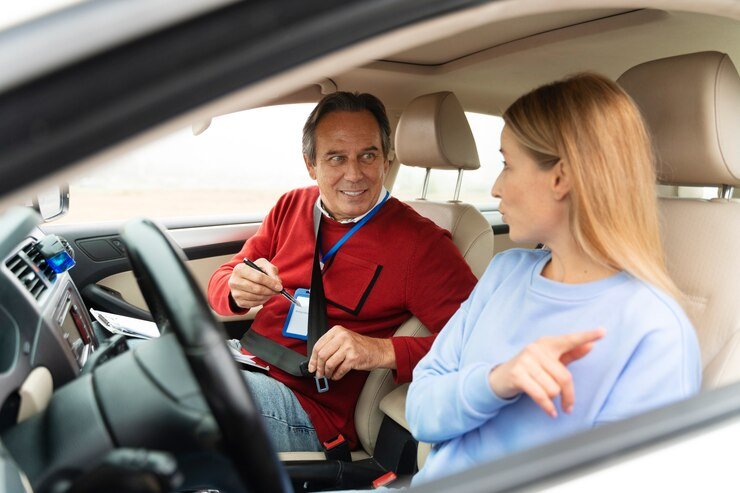
The DVSA
has published a guide: the 'National Standard for Driving Cars and Light Vans
(category B)', which sets out precisely what you should be able to do, before
attempting the test.
It not
only specifies what you must be able to do in practical terms (the
'performance' standard), but also what you need to know and understand (the
'knowledge and understanding' requirements).
Look
through the standards below, before booking your driving test. If you think or
know that you cannot meet a standard, talk to your driving instructor, before
making your booking. Your driving instructor is responsible for ensuring that
you are up to a suitable standard, before attempting the test, and should take
time to repeat any areas of training that concern you.
The
standards are extremely detailed, but to follow is a brief outline:
Role 1:
Prepare yourself, the vehicle and its passengers for a journey
Unit 1.1:
Prepare yourself and passengers for a journey. This entails choosing a suitable
mode of transport, ensuring that you are personally fit to drive and taking
into account any risks associated with the passengers, animals or load that you
are carrying in your vehicle.
Unit 1.2:
Make sure that the vehicle is safe to drive. This entails making safety checks,
as required, ensuring that the vehicle is in a roadworthy condition and making
sure that the vehicle's legal documents meet the necessary requirements.
Unit 1.3:
Plan a journey. This entails knowing how to plan a suitable route, taking into
account factors, such as weather conditions, likely levels of traffic and
whether you are certain that there will be a suitable place in which to park,
when you reach your destination.
Role 2:
Guide and control the vehicle
Unit 2.1:
Start, move off, stop and leave the vehicle safely and responsibly. You must be
able to bring the vehicle to a stop and know how to park, in a safe and
considerate manner.
Unit 2.2:
Drive the vehicle safely and responsibly. This entails knowing how to monitor
and respond to incoming information from the environment and the vehicle
itself, such as driving instruments and aids. You must understand how to safely
steer, guide and manoeuvre the vehicle.
Unit 2.3:
Drive the vehicle, while towing a caravan or trailer. If you wish to tow a
caravan or trailer, you must understand how to do this in a safe manner, with
due regard for legal and safety requirements.
Role 3:
Use the road in accordance with 'The Highway Code'
Unit 3.1:
Correctly negotiate the road. This entails maintaining a suitable position on
the road, understanding how to negotiate bends, negotiating crossings of all
kinds and driving on motorways and dual carriageways.
Unit 3.2:
Comply with signals, signs and road markings. You must know how to respond to
signals, signs and road markings, whether given via signs or an authorised
individual.
Role 4:
Drive safely and responsibly in the traffic system
Unit 4.1:
Correctly interact with other road users. This entails knowing how to
communicate your intentions to other road users, and cooperate with them, as
necessary, in order to uphold road safety.
Unit 4.2:
Minimise risk, when driving. You must be able to identify and respond to
hazards, know how to drive in a defensive manner and drive in an ecologically
sound way.
This is
sometimes referred to as an 'eco-safe' way.
Unit 4.3:
Effectively manage incidents. You must know what to do, in the event that your
vehicle breaks down, and what to do, if you are involved in or witness a
collision.
Role 5:
Review and adjust driving behaviour, over your driving lifetime
Unit 5.1:
Learn from experience. This entails appreciating the importance of practising
and developing your driving skills, factors that could affect your competence
on the road and knowing when to seek help, if required.
Unit 5.2:
Keep up to date with changes. This entails understanding changes to 'The
Highway Code' and laws governing road use. It also entails understanding how to
use new technology in a safe and appropriate manner.
Role 6:
Demonstrate developed skills, knowledge and understanding
Unit 6.1: Demonstrate developed understanding
of 'The Highway Code' and the national standard for driving. This entails being
able to answer questions pertaining to 'The Highway Code', the national standard for driving and how to
apply this on the roads. It also entails showing a generally high level of
driving competence.
The above
standards have been published in addition to 'The Highway Code' - you will be
expected to show a good general knowledge of both.
Your
examiner will be keen to make sure that you can be trusted to safely operate a
vehicle, at all times. They are not looking to make the test unduly difficult -
they simply wish to ensure that only those suitably competent in driving are
allowed to use the road unsupervised.
Activity
2: How Confident are you In Adhering to the Above Standards?
Estimated
time: 5+ minutes
Read
through the above standards.
Do you
feel as though you are currently at the standard required to pass the practical
driving test? If not, why not? How can you improve in these areas?
10.6 What
Happens when you Receive your Test Results
Immediately
following the test, you will be told whether you have passed or failed.
The results are clearly laid out on the
examiner's mark sheet. Whether you pass depends on the number and type of
mistakes that you make.
These are referred to as 'faults':
. A
'dangerous fault' is a mistake that causes direct and serious danger to
yourself, the public, the examiner or property.
. A
'serious fault' refers to a mistake that could potentially cause danger.
. A
'driving fault' is the least serious fault. It is a mistake that does not pose
a threat in and of itself, but, if you were to keep making it, could develop
into a serious fault.
In order
to pass your test, you must make no more than 15 driving faults. If you make a
serious or dangerous fault, you automatically fail the test.
If you
are taking a motorcycle test, you must make no more than five minor faults, in
order to pass the Module 1 test. If you make any major faults, you
automatically fail the test. In order to pass the Module 2 test, you must make
no more than ten minor faults, with no major faults.
Whichever
test you take, the process is the same, following the test. If you have passed
the test, the examiner will tell you what faults, if any, you made, before
presenting you with a pass certificate.
They will
then ask you whether you wish for your new, full licence to be automatically
sent to you. If so, you will need to give them your provisional licence.
You can
drive under the terms of a full licence, as soon as you have passed your test -
there is no need to wait until your new, full licence arrives. If you do not
wish to be automatically sent your new, full licence, you can apply for it by
post, within two years of passing your test.
If you
fail the test, the examiner will explain why. They will tell you where you went
wrong and advise you that, if you wish to resit the test, you must choose a
date that is at least ten working days away.
If you
think that your examiner did not follow the correct procedures, when carrying
out your test, you can appeal in a Magistrate's Court or a Sheriff's Court.
Your test result cannot be changed, but, if you win your case, you will receive
a free retest. If you took your test in England or Wales, you must appeal
within six months, and, if you took your test in Scotland, you must appeal
within 21 days.
Fact
Pass
rates for drivers under 25 is fifty-one per cent.
Source:
UK Government
 |
.svg)



