5.1 Driving in Adverse Weather Conditions
In this
module, you will learn how to adapt your driving, in the face of bad weather
conditions, and how to safely share the road with vulnerable users.
When
driving, a good rule to bear in mind is to expect the unexpected! Even if you
avoid bad weather, whenever possible, you still need to know how to drive
safely in unfavourable conditions. You never know when the weather will change,
which means that you may have to adapt your driving style, at any time. Knowing
that you can rise to the challenge will help you become a more confident
driver.
You may also
find yourself in a vehicle with someone who is unsure how to cope with changing
weather conditions. If you are in a position to advise them, this will help
both of you to safely arrive at your destination. When you are driving with
reduced visibility, you are legally obliged to use headlights, when you cannot
see for more than 100 metres (328 feet) in front of you.
You can also
use front or rear fog lights, but the law states that you must turn them off,
as soon as visibility improves; otherwise, you may dazzle other road users.
5.2
Driving During Wet Weather
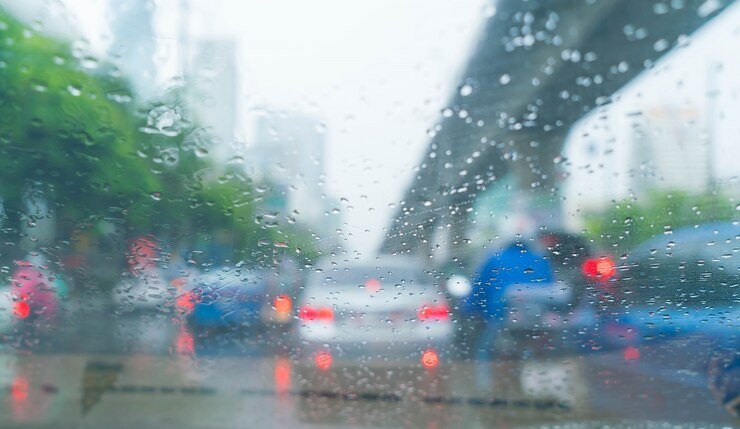
During wet
weather, stopping distances will be at least double those required for stopping
on dry roads; this is because your tyres have less grip on the road.
In wet weather, you should keep well back from
the vehicle in front this will increase
your ability to see and plan ahead. If the steering becomes unresponsive, it
probably means that water is preventing the tyres from gripping the road. You
should ease off the accelerator, and gradually slow down.
The rain and
spray from vehicles may make it difficult to see and be seen. You should also
be aware of the dangers of spilt fuel, which will make the driving surface very
slippery.Vulnerable road users will also be affected by the conditions, so take
extra care around pedestrians, cyclists, motorcyclists and horse riders.
5.3
Driving During the Winter
In winter,
check the local weather forecast, for warnings of ice or snow.
Do not drive
in these conditions, unless your journey is absolutely essential. If it is,
take great care, and allow more time for your journey. Take an emergency kit of
de-icer and an ice scraper, a torch, warm clothing and boots, a first aid kit,
jump leads, a shovel, and a warm drink and emergency food, in case you get stuck,
or your vehicle breaks down.
Before you
set off, check that you are able to see your surroundings, whilst driving. By
law, you must have good visibility, so clear all snow and ice from all your
windows. You also have a legal duty to ensure that lights are clean and that
number plates are clearly visible and legible. Check that the mirrors are clear
and that the windows are thoroughly de-iced/demisted.
Take time to
move all snow that might fall off into the path of other road users, and check
that your planned route is clear of delays and that no further snowfalls or
severe weather are predicted. When driving in icy or snowy weather, you should
always drive with care, even if the roads have been treated. Keep well back
from the road user in front of you, as stopping distances can be ten times
greater than on dry roads.
Take extra
care, when overtaking vehicles spreading salt or other de-icing materials,
particularly if you are riding a motorcycle or cycle. Watch out for snow
ploughs that may throw out snow on either side. Do not overtake them, unless
the lane that you intend to use has been cleared. Be prepared for the road
conditions to change over relatively short distances.
Listen to
travel bulletins, and take note of message signs that may provide information
about the weather and the road and traffic conditions ahead. Drive extremely
carefully, when the roads are icy. Avoid sudden actions, as these could cause
loss of control. You should drive at a slow speed, in as high a gear as
possible, and accelerate and brake very gently.
Be sure to
drive particularly slowly on bends, whereby loss of control is more likely.
Brake progressively on the straight stretch of road, before you reach a bend.
Having slowed down, steer smoothly round the bend, and avoid sudden actions.
When there is
snow or ice, check your grip on the road surface, by choosing a safe place in
which to brake gently. If the steering feels unresponsive, this may indicate
that ice is causing your vehicle to lose its grip on the road. When travelling
on ice, tyres make virtually no noise, so sound is not a good indicator of grip
or tyre condition.
Fact
A vehicle's
stopping distance can increase by up to 10 times, in icy/snowy conditions.
Source:
Brake UK
5.4
Driving During Windy Weather
Highsided
vehicles are most affected by windy weather, but strong gusts can also blow a
car, cyclist, motorcyclist or horse rider off course.
This can
happen on open stretches of road exposed to strong crosswinds, or when passing
bridges or gaps in hedges. In very windy weather, your vehicle may be affected
by turbulence created by large vehicles. Motorcyclists are particularly
affected, so keep well back from them, when they are overtaking a high-sided
vehicle.
5.5
Driving in Foggy Conditions
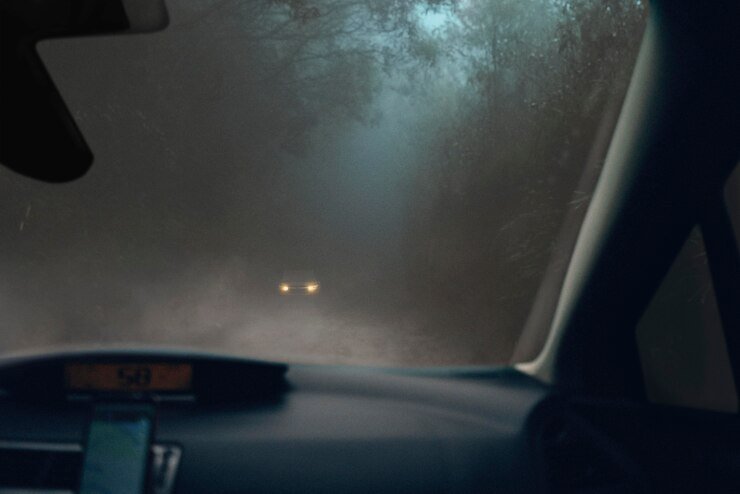
Before
entering fog, check your mirrors, then slow down.
If the word
'Fog' is shown on a roadside signal, but the road is clear, be prepared for a
bank of fog or drifting patchy fog ahead. Even if it seems to be clearing, you
can suddenly find yourself in thick fog When driving in fog, you should use
your lights, as required, and keep a safe distance behind the vehicle in front.
Rear lights can give a false sense of security, so pay attention. Make sure that you are able to pull up well
within the distance in which you can see clearly. This is particularly important
on motor ways and dual carriageways, as vehicles are travelling faster.
Always use
your windscreen wipers and demisters, as appropriate. Remember that not
everyone is a competent driver - beware of other drivers who are not using
headlights. Do not accelerate, to get away from a vehicle that is too close
behind you - instead, slow down. Check your mirrors, before reducing your
speed, then use your brakes, so that your brake lights warn drivers behind you
that you are slowing down.
Stop in the
correct position at a junction with limited visibility, and listen for traffic.
When you are sure that it is safe to emerge, do so positively, and do not
hesitate in a position that puts you directly in the path of approaching
vehicles. The law states that you must not use front or rear fog lights, unless
visibility is seriously reduced, as they dazzle other road users and can
obscure your brake lights. You must also switch off fog lights, when visibility
improves.
5.6
Driving During Hot Weather.
Keep your
vehicle well ventilated, to avoid drowsiness.
Be aware
that the road surface may become soft or slippery, following rain after a dry
spell. These conditions could affect your steering and braking. If you are
dazzled by bright sunlight, slow down and, if necessary, stop.
Fact
If the external temperature is 22 degrees
Centigrade, the inside of a car can reach 47 degrees Centigrade within one
hour.
Source:
RSPCA
5.7
Driving at Night
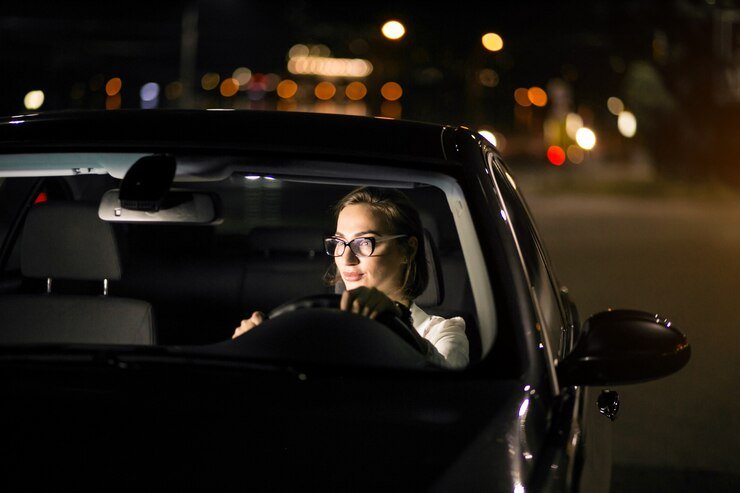
You are not
able to see as far in the dark, so potential hazards, such as cyclists and
pedestrians, may be harder to notice.
This is
particularly true, if you are using a rural lane, or a road with poor lighting.
You should always use full-beam headlights, unless you are following another
vehicle or meeting oncoming traffic. Always dip your headlights, when you meet
another road user, to avoid dazzling them. When you are going around a
left-hand bend, dip your lights earlier than you usually would, when meeting
another vehicle. This is because, otherwise, your headlights will be at the eye
level of anyone coming to meet you.
Sometimes,
it is a good idea to switch your headlights on at dusk, even before it is dark.
This is because some paintwork is harder to identify in low light levels, as it
blends in with the decreasing light levels.
It takes a
few minutes for our eyes to adjust to low light levels, so give yourself a few
minutes, before setting off, if you have just come out of a brightly-lit
building. Always keep your windscreen and lights clean, in order to minimise
dazzle and glare. You must turn your headlights off, if you have to stop for
any reason - it is an offence to keep them on, when the car is parked.
Activity 1: Driving In The Dark
Estimated
time: 5-10 minutes
What should
you bear in mind, when travelling at night?
Think of at
least three measures that you should take, in order to ensure your own safety
and that of others, when driving in the dark.
5.8
Accommodating Vulnerable Road Users and those Requiring Extra Care
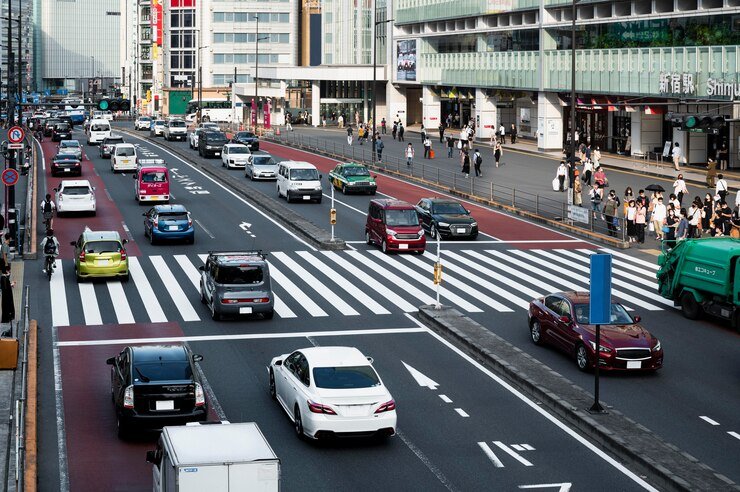
The most
vulnerable road users are pedestrians, cyclists, motorcyclists and horse
riders.
It is
particularly important to be aware of children, older and disabled people and
learner and inexperienced drivers and riders. You must also be aware that
certain types of vehicles require special treatment. In order to stay safe on
the roads, you need to be aware of your responsibilities, not only to yourself
but to others.
5.9 Accommodating Pedestrians
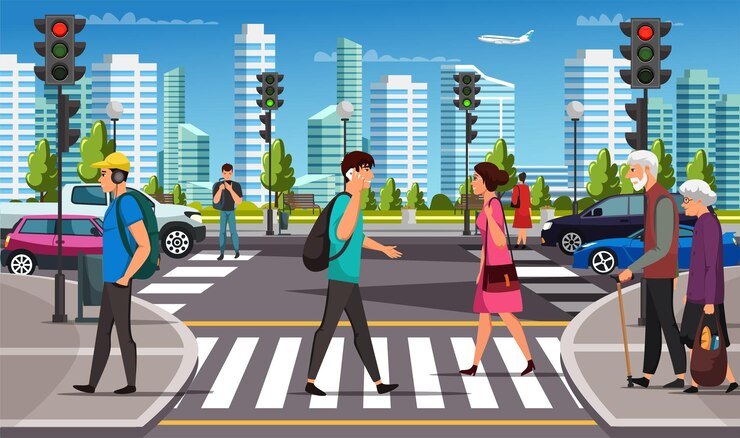
There is a
risk that pedestrians, especially children, will unexpectedly step into the
road.
You should
drive with the safety of children in mind and at a speed suitable for the
conditions. Drive carefully and slowly, when in crowded shopping streets, Home
Zones and Quiet Lanes or residential areas.
You also
need to be vigilant, when driving past bus and tram stops, because pedestrians
may suddenly emerge into the road. Parked vehicles also warrant special
attention. This is especially true for ice cream vans, as children are more
interested in ice cream than traffic, and may unexpectedly run into the road.
Be vigilant if you need to cross a pavement or cycle track; always give way to
pedestrians and cyclists on the pavement.
For example
*When
crossing a pavement to reach or leave a driveway.
* When
reversing into a side road, look all around the vehicle, and give way to any
pedestrians who may be crossing the road.
* When
turning at road junctions, give way to pedestrians who are already crossing the
road into which you are turning. If the pavement is closed, due to street
repairs, and pedestrians are directed to use the road, drive slowly in a way
that does not intimidate them.
* When
approaching pedestrians on narrow rural roads, without a footpath, always slow
down, and be prepared to stop, if necessary, giving them plenty of room, as you
drive past.
Particularly Vulnerable Pedestrians
All
pedestrians face some degree of risk, when using the road, but some groups are
particularly vulnerable. Children and older pedestrians may not be able to
judge your speed and could step into the road, in front of you. For this
reason, it is especially important that you adhere to the speed limit. At 40
mph (64 km/h), your vehicle will probably kill any pedestrian that it hits. At
20 mph (32 km/h) there is only a 1 in 20 chance of the pedestrian being killed.
If in doubt,
always drive slowly. Some older pedestrians may need more time to cross the
road. Be patient, and allow them to cross in their own time. Do not hurry them,
by revving your engine or edging forward, as you may misjudge the distance, and
knock them over. In addition, they may fall or otherwise injure themselves, in
an attempt to move more quickly.
Look out for
people with disabilities. Those with hearing impairments may not be aware of
your vehicle approaching, and those with walking difficulties require more
time, to cross the road or get on the pavement. Blind or partially-sighted
people also warrant extra attention. They may be carrying a white cane or using
a guide dog. They may not be able to see you approaching, so anticipate the
possibility that they may behave in an unexpected manner.Deaf-blind people will
usually carry a white cane with a red band or use a dog with a red and white
harness. They may not see or hear instructions or signals.
Driving Near schools
Drive
slowly, and be particularly aware of young cyclists and pedestrians. In some
places, there may be a flashing amber signal below the 'School' warning sign,
which tells you that there may be children crossing the road ahead. Drive very
slowly, until you are clear of the area. Drive carefully and slowly, when passing
a stationary bus, showing a 'School Bus' sign, as children may be getting on or
off the bus. By law, you must stop, when a school crossing patrol shows a 'Stop
for children' sign.
Activity 2: Who Are The Most Vulnerable Road
Users?
Estimated
time: 5 minutes
Make a list of who you believe to be the most
vulnerable road users. Try to think of at least five distinct groups.
What makes
them especially vulnerable? As a driver or rider, how can you accommodate their
needs?
5.10 Sharing the Road with Motorcyclists and
Cyclists
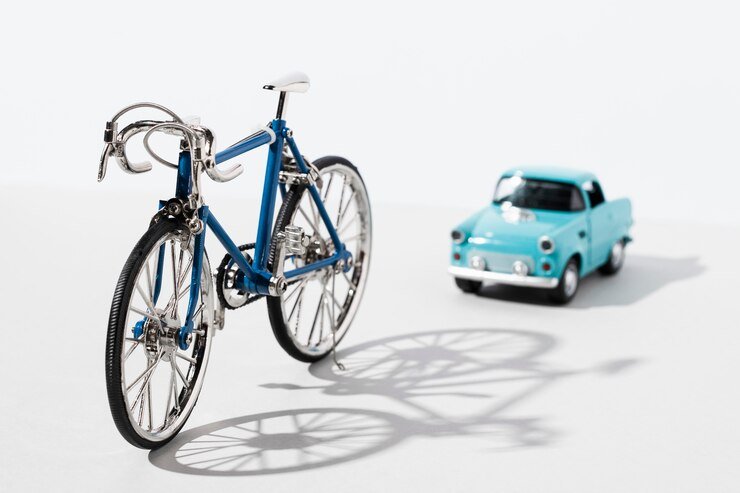
It is often
difficult to see motorcyclists and cyclists, especially when they are coming up
from behind, coming out of junctions, at roundabouts, overtaking you or
filtering through traffic.
Always look
out for them, before you emerge from a junction they could be approaching
faster than you think. When turning right across a line of slow-moving or
stationary traffic, look out for cyclists or motorcyclists on the inside of the
traffic that you are crossing. Be especially careful, when turning and when
changing direction or lane. Be sure to carefully check mirrors and blind spots.
When passing
motorcyclists and cyclists always give them plenty of room. If they look over
their shoulder, it could mean that they intend to pull out, turn right or
change direction. Give them time and space to do so. Motorcyclists and cyclists
may suddenly need to avoid uneven road surfaces and obstacles, such as drain
covers or oily, wet or icy patches on the road. Give them plenty of room, and
pay particular attention to any sudden change of direction they may have to
take.
5.11 Accommodating Other Road Users/Vehicles
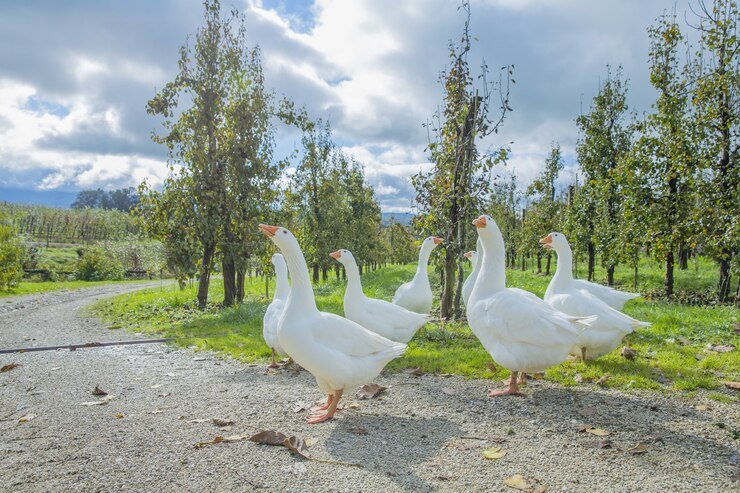
Animals
When passing
animals, drive slowly. Give them plenty of room, and be ready to stop. Do not
scare animals, by sounding your horn, revving your engine or rapidly
accelerating, once you have passed them. Look out for animals being led, driven
or ridden on the road, and take extra care.
Keep your
speed down at bends and on narrow country roads. If a road is blocked by a herd
of animals, stop and switch off your engine, until they have left the road.
Watch out for animals on unfenced roads. Be particularly careful of horse
riders and horse-drawn vehicles, especially when overtaking. Always pass wide
and slow. Horse riders are often children, so take extra care, and remember
that riders may ride in double file, when escorting a young or inexperienced
horse or rider. Look out for horse riders' and horse drivers' signals, and heed
a request to slow down or stop. Take great care, and treat all horses as a
potential hazard - they can be unpredictable, despite the efforts of their
rider.
Drivers in particular age groups
These
drivers are also especially vulnerable. An older driver's reactions may be
slower than that of other drivers. Make allowances for this.
Also, watch
out for and be particularly patient with learners and inexperienced drivers.
They may not
be so skilful at anticipating and responding to events. Drivers who have
recently passed their test may display a new driver plate or sticker. Do not
bully or harass them, even if they are slowing your progress on the road.
Home Zones and Quiet Lanes
These are
places where people could be using the whole of the road for a range of
activities, such as a play area for children or for a community event.
You should
drive slowly and carefully, and be prepared to stop, to allow people extra
time, to make space for you to safely pass them.
Accomodating Emergency Vehicles
You should
look out and listen for ambulances, fire engines, police, doctors or other
emergency vehicles, using flashing blue, red or green lights and sirens or
flashing headlights, or traffic officer and incident support vehicles, using
flashing amber lights.
* When one
approaches, do not panic.
* Consider
where the vehicle appears to be heading, and take appropriate action, in order
to let it pass, while complying with all traffic signs.
* If
necessary, pull over to the side of the road and stop, but try to avoid stopping before the brow of a hill, a
bend or a narrow section of road.
* Do not
endanger yourself, other road users or pedestrians, and avoid mounting the
kerb.
* Do not
brake harshly, on an approach to a junction or roundabout, as a following vehicle may not have the
same view as you.
Powered vehicles used by dissabled people
These small
vehicles travel at a maximum speed of 8 mph (12 km/h). On a dual carriageway,
whereby the speed limit exceeds 50 mph (80 km/h), the law stipulates that they
must have a flashing amber beacon, but, on other roads, there may not be that
advance warning.
Large vehicles
These may
need extra road space in which to turn or to deal with a hazard that you are
not able to see. If you are following a large vehicle, such as a bus or an
articulated lorry, be aware that the driver may not be able to see you in their
mirrors. Be prepared to stop and wait, if it needs room or time to turn.
Large
vehicles can block your view. Your ability to see and plan ahead will be
improved, if you pull back, in order to increase your separation distance. Be
patient, as larger vehicles are subject to lower speed limits than cars and
motorcycles. Many large vehicles may be fitted with speed limiting devices,
which will restrict their speed to 56 mph (90 km/h), even on a motorway.
When you can
safely do so, give priority to buses, coaches and trams, especially when they
signal to pull away from stops. Look out for people getting off a bus or tram
and crossing the road. Be careful of electric vehicles, such as milk floats and
trams. Trams move quickly, but silently, and cannot steer, to avoid you.
Watch out
for vehicles with flashing amber beacons. These warn of a slow-moving or
stationary vehicle, such as a traffic officer vehicle, salt spreader, snow
plough or recovery vehicle, or abnormal loads, so approach with caution. On
unrestricted dual carriageways, motor vehicles with a maximum speed of 25 mph
(40 km/h) or less, such as tractors, first used on or after 1st January 1947,
must use a flashing amber beacon.
 |
.svg)