
2.1 Why you Need to be Aware of these Rules.
As a driver, your natural inclination might be to focus on the rules that you need to follow, when personally using a vehicle on the roads.

2.2 General Guidance for Pedestrians

If at all possible, a pedestrian should walk along a pavement, so that they are facing oncoming traffic. This gives them the best chance of spotting a potential hazard in advance.
For example
If a car appears to be out of control, the pedestrian will be able to move and avert the source of danger. Just as drivers have a legal obligation to show due care and consideration for others, so too do pedestrians. It is not appropriate for a pedestrian to act in a manner that could be considered distracting to passing motorists. If a pedestrian needs to step into the road for any reason, they should look both ways before crossing.
Occasionally, there may not be a suitable pavement available for use. In this case, pedestrian should walk on the righthand side of the road, so that they can see oncoming traffic. They should bear in mind that walking on the road is much more dangerous than using a pavement, and therefore take extra care. If more than one pedestrian needs to walk along the side of the road, they should move in single file. This is particularly important, if the road is narrow, or the levels of light are dim.
Although it is better to stay on the right-hand side of the road, it may be sensible to cross over before a sharp right-hand bend, then cross back after the bend. Thus,drivers of oncoming traffic are more likely to notice the pedestrian, as they round the corner.
If out in dim lighting, a pedestrian should take reasonable precautions to alert other road users to their presence. During the daytime, they should wear or carry something fluorescent, bright or light- coloured.
If it is necessary to walk in the dark, reflective materials should be worn. Armbands, jackets, footwear, waistcoats and trousers featuring reflective strips can all be purchased in hardware stores and some garages. They are worth the investment -a car driver with their headlights turned on can see reflective materials at three times the distance compared to nonreflective materials. Young children should always be accompanied by an adult or older child, when walking near to or on roads.
When accompanying children, you should position yourself between their body and the flow of ongoing traffic. It is important to firmly hold their hand at all times. Toddlers and babies should be securely strapped into pushchairs. Young children can also be kept on reins, to restrict their movement. If pushing a baby or young child in a buggy, it is important to look carefully, before pushing the buggy out into the road, prior to crossing. This is particularly important, if you are moving out from between two parked vehicles.
If a large group of people are out walking, they should kept to the left hand side of the road, and always use a pavement , where possible. The group should walk in single file. The first and last people in group should be the designated ‘look- outs’, who pay special attention to other road users and wear flurescent or reflective clothing as appropriate. If the group is walking at night ,the front look-out should carry a while light, and the back look-out should carry a red light.
If it is not possible for a group of pedestrians to walk in single file, those on the outside of the group should also wear reflective clothing and carry lights. Unless there is a serious emergency, under no circumstances should a pedestrian walk on a motorway or slip road. Doing so is against the law.
Activity 1: Your Experience as a Pedestrian
Estimated time: 5 minutes
Have you ever had to walk along the side of a road after dark, whether alone or as part of a group? Did you follow the instructions contained within 'The Highway Code'? Why or why not?
2.3 The Green Cross Code
The Green Cross Code was drawn up to provide pedestrians of all ages with a set of guidelines that will enable them to safely cross roads.
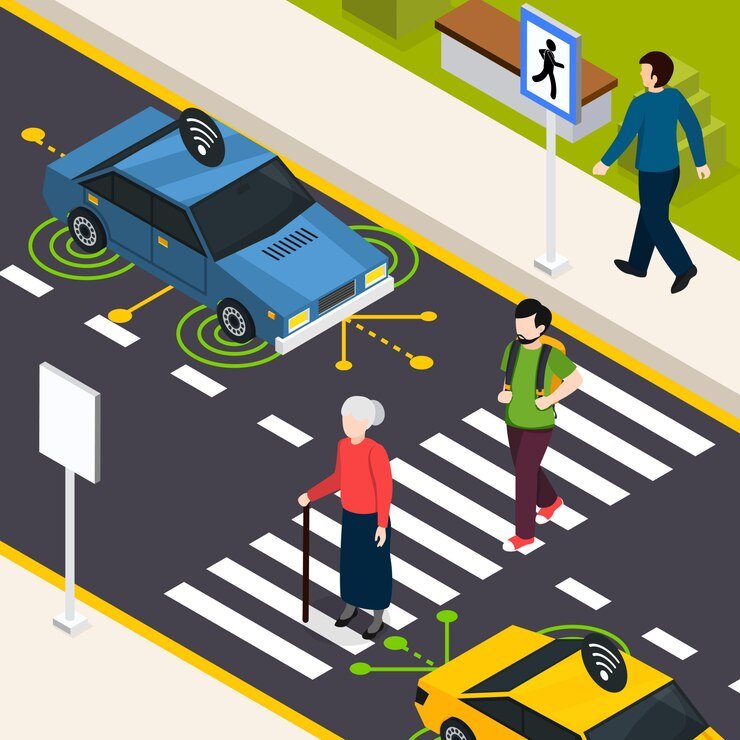
Children should be taught the Code and not be allowed to go out unaccompanied, until they can demonstrate a consistent understanding of the principles that it teaches. It is difficult for a child to judge vehicle distance and speed, and the age at which children attain proficiency in using the Code will vary. It is the responsibility of a child' parent or carer to decide when a child in their care is able to use the Code alone. It is important to model the Code, when accompanying a child on the roads, as they learn by example. The steps of the Code are outlined in 'The Highway Code' as follows:
Find a safe place to cross
Use a pedestrian crossing, if there is one nearby. Wherever you cross the road, you should check that there is space in which to reach the pavement on the other side. Ideally,
you should choose a place that allows you to see in all directions. If at all possible, avoid crossing on the brow of a hill, On a blind bend or between two a parked vehicles. You should do your best to ensure that you can monitor traffic attimes. Always cross the road in a straight line. Crossing diagonally will make it harder for you and motorists to judge your speed and distance.
Stop before you arrive at the Kerb
Stand near the edge of the pavement, taking care to avoid standing at the edge of the road. If there is no pavement available, stand back from the edge of the road, but make sure that you can still see approaching traffic.
Look and listen for traffic
Traffic may come from any direction, so be vigilant. Listen carefully, as sometimes you can hear traffic before seein it traffic is coming, let it pass.You must wait until there is a sufficient gap in the traffic. Bear in mind that, even when traffic appears to be a long way off, it may approach quickly.
Cross the road in a straight line,when it is safe to do so.
Never run across the road. Keep looking and listening out for traffic, as you cross. Watch out for cyclists and motorcyclists who may be travelling between two lanes of traffic.
Activity 2: Teaching The Green Cross Code to Children
Estimated time: 5-10 Minutes
If you were asked to teach a young child the Green Cross Code, how would you do so? How would you know whether they were capable of using it alone?
If you were asked to teach the Code to a class of children, how might you plan the session in such a way that stresses the importance of following the Code?
Additional guidance for pedestrians
The Highway Code provides additional guidance for pedestrians crossing the road.
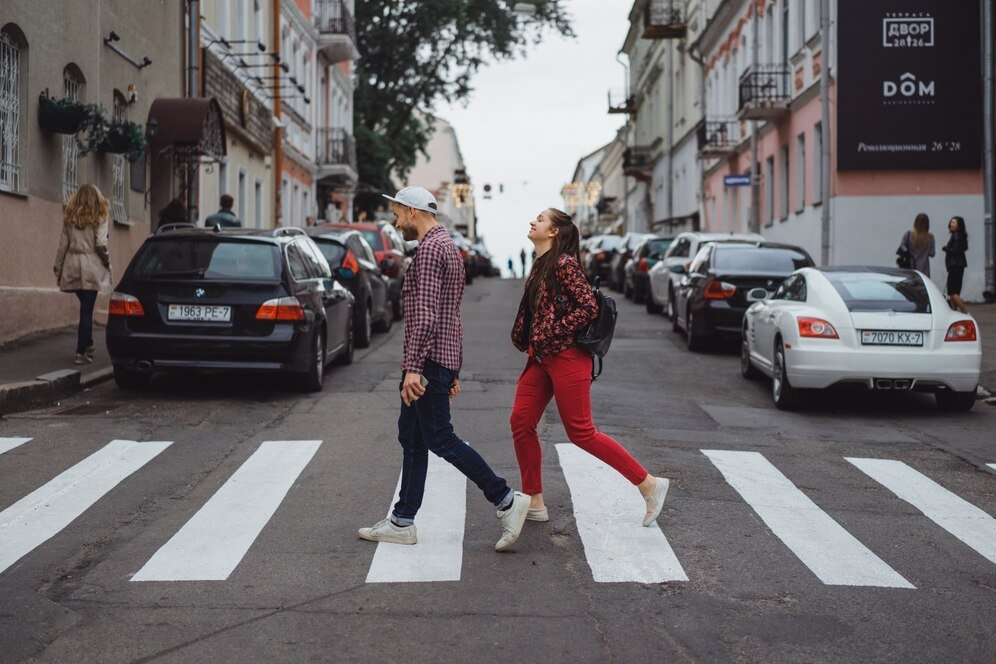
When crossing near a junction, a pedestrian should look in both directions in front and behind to make sure that no vehicles are attempting to turn in the road. However, if a pedestrian has begun to cross the road, and then a vehicle wishes to turn into the road, the pedestrian has the right of way.
If there are any pedestrian safety barriers, pedestrians should never climb over them or walk between the barriers and the road. They should only walk through the gaps that are specially designated for their use.To assist pedestrians with visual impairments, some pavements feature raised, tactile surfaces that provide guidance. The most common surfaces of this type are a series of raised studs, which are used at crossing points with a dropped kerb, and a series of rounded raised bars that are used at level crossings, at the top and bottom of steps and at some other hazards.
When crossing a oneway street, pedestrians must check which way traffic is moving, and take this into consideration, when preparing to cross. When crossing bus or cycle lanes, they should anticipate that traffic may be moving more quickly than they expect, faster than traffic in other lanes, or against the flow of other traffic.
Some segregated routes contain sections of tactile paving, to help blind or partially sighted pedestrians stay on the correct side. Specifically, paving on the pedestrian side is in 'ladder' pattern, with bars running across the direction of travel. The side allocated to cyclists features bars running in a tramline pattern. If a route is not segregated, all users should take extra care. Pedestrians should not attempt cross the road behind a vehicle moving in reverse. Under no circumstances should they hold onto, or get onto, a moving vehicle. To do so is an offence under the law.
2.4 Guidance for Pedestrians Using Crossings
When using any type of crossing, pedestrians should always check that the traffic has stopped, before crossing the road or pushing a pram onto the crossing.
Pedestrians must cross between the crossing studs or over the zebra crossing markings. They should not walk over the side of the crossing or on zigzag lines, as this may be highly dangerous. They must not loiter on any type of crossing - doing so is against the law.
Zebra Crossing
At a zebra crossing, pedestrians should give traffic plenty of time to notice their presence, before they start to cross. If road conditions are slippery, vehicles will need more time to stop. Although traffic should stop at zebra crossings, pedestrians should make sure that vehicles have come to a complete stop or that the road is clear, before starting to cross. Drivers are not legally obliged to stop, unless someone has stepped onto the crossing. Whilst crossing the road, pedestrians should look and listen for traffic, in case a motorist attempts to overtake a vehicle that has stopped at the crossing.
*If there is an island in the middle of the road, a pedestrian should wait on the island, and then treat the second half of the road as a separate crossing.
*If there is a traffic light featuring red and green figures, pedestrians should only begin to cross when the green light is showing.
*If the green light fades whilst a pedestrian is crossing, they should continue walking across the road to the other side, without delay.
*At traffic lights with no pedestrian signals, a pedestrian must not cross the road until the lights have turned red, and the traffic has stopped.
*It is important to bear in mind that traffic lights may allow traffic to continue moving in one lane but stop it moving in others.
Pelican Crossing
Pelican crossings are controlled by signals activated by a pedestrian pushing the control button. A red figure indicates that it is not safe to cross. Pedestrians should not move onto the crossing until the figure has turned green. The green figure will flash before turning red once more. If it is flashing, a pedestrian should not begin to cross. However, if they are already on the crossing, they should continue moving to the other side.
Puffin Crossing
A puffin crossing is similar, but the red and green figures are on the pedestrian's side of the road, above the controlbox, and the figures never flash. If the road is particularly congested, vehicles may be forced to stop on a pedestrian's side of the road before the crossing, even when traffic lights indicate that they can move forward. However, a pedestrian should still use the crossing in the usual manner because traffic on the other side of the roadmay still be moving.
Toucan Crossing
A toucan crossing allows pedestrians and cyclists to cross at the same time. Again, they are operated using a push button system. When the green signal shows, all users may cross. Cyclists are allowed to ride across the road. Some crossings will feature a bleeping sound or voice signal. This helps blind or partially-sighted people use the crossing in safety. There may also be a tactile signal or sign, designed with deaf-blind people in mind.
Some crossings are designed to be 'staggered', with a central island in the middle. If the crossings are not aligned, they are to be treated as two separate crossings. This means that, when a pedestrian reaches the central island, they must press the button again.
Equestrian Crossing
An equestrian crossing is specially designed for horseback riders. They have pavement barriers, wider crossing spaces, horse and rider figures in the light panels and either two sets of controls (one higherthan the other) or just one higher control panel. They are typically sufficiently wide that two horses can cross at thesame time.
Crossing control

Some crossings are controlled by an authorised person, such as a traffic warden, police officer or member of a school crossing patrol. Pedestrians must always cross in front of the authorised person. If there is no controlled crossing available, it is best to cross the road where there is an island available. The Green Cross Code should be employed by all pedestrians, as they cross to the island, and then again, as they cross the second half of the road.
There are certain situations that require extra caution:
*Should an emergency vehicle approach - as indicated by sirens, flashing lights or both - it is important that pedestrians keep off the road.
*When getting on or off a bus, pedestrians must wait until the bus has stopped, before moving.
*When getting off a bus, they must watch for cyclists, avoid crossing the road directly behind or in front of the bus and wait until it has moved off, and it is possible to see clearly, in both directions.
Tramways
Tramways may run through pedestrian areas. Their path will be marked out by shallow kerbs, changes in the pavingor other road surface, white lines or yellow dots. Pedestrians should cross at designated crossings, where provided.
If no such crossing is available, trams should be treated in the same manner as any other vehicle. Pedestrians should not walk along tram tracks, as a tram may quietly approach. Moreover, it is important to bear in mind that trams cannot steer, in order to avoid a pedestrian.
Railway level crossing
At a railway level crossing, pedestrians must not cross or pass a stop line, when the red lights show. These crossings may include a red pedestrian figure. If the barriers are being lowered or an alarm is sounding, no pedestrian should attempt to cross. The tone of the alarm may change, if another train is approaching. Pedestrians should cross, only when there are no lights, alarms or barriers. They should stop, look both ways and listen carefully, before crossing.
A tactile surface, comprising rounded bars running across the direction of pedestrian travel, may be installed on the footpath approaching a level crossing, to warn visually impaired people of its presence. The tactile surface should extend across the full width of the footpath and should be located at an appropriate distance from the barrier or projected line of the barrier.
Finally, a pedestrian should take extra care, if a pavement is closed, and, as a result, they are forced to walk in or across the road.
2.5 Rules for Users of Powered Wheelchairs and Mobility Scooters
In legal terminology, powered wheelchairs and mobility scooters are referred to as 'invalid carriages'.
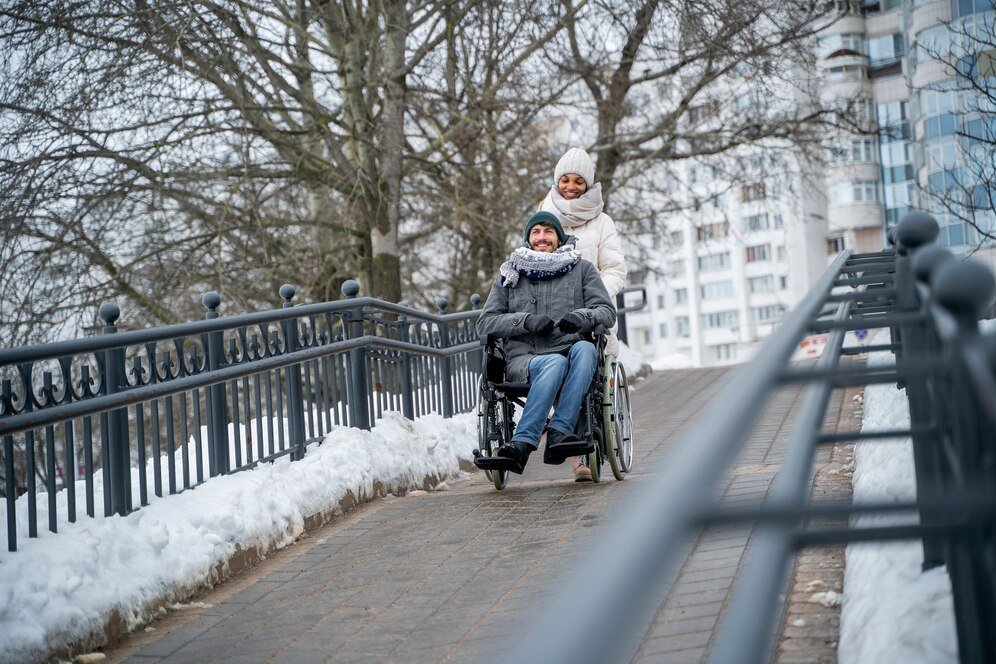
There is one class of manual wheelchair, called a Class 1 invalid carriage, and two classes of powered wheelchairs and powered mobility scooters.
Manual wheelchairs and Class 2 vehicles are those with an upper speed limit of 4 mph (6 km/h), and are designed tobe used on pavements.
Class 3 vehicles are those with an upper speed limit of 8 mph (12 km/h) and are equipped to be used on the road, as well as the pavement. Users of these vehicles should obey the same guidance and rules that apply to other vehicles.When they are on the pavement, they should follow the same guidance and rules that apply to pedestrians.
Where possible, it is generally safer for a rider to use the pavement, as opposed to the road. They should give pedestrians priority and act in a considerate manner at all times. This is particularly important when a pedestrian has a visual or hearing impairment.
It is against the law to travel at speeds faster than 4 mph on pavements or other pedestrian areas. It may be necessary for a rider to reduce their speed, in order to allow pedestrians adequate time to move out of the way or in the event that the pavement is narrow.
Fact
There are approximately 250,000 mobility scooters on UK roads.
Source: Boyes Turner
Moving off
When a rider is moving off, they should take care, to monitor the environment around them. They should try to use a dropped kerb, when moving off. This may require further travel, in order to reach a suitable place at which to crossIf a rider needs to climb or descend a kerb, they should approach it from a right angle, and follow the manufacturer's guidance, as appropriate. Whilst on the road, a rider should take care when travelling. Their vehicle will be moving at a slower rate, compared to other traffic - it will only be travelling at 8 mph and may be less visible to other road users.
Road Travel
Whilst on the road, a Class 3 vehicle should travel in the direction of the traffic. If available, users of Class 2 vehicles should always use a pavement. If this is not possible, they should use caution, when travelling on the road. If applicable, Class 2 users should travel in the direction of the traffic.
Night travel
When travelling at night, a rider must use lights and follow the direction of the traffic. This will reduce the risk of confusing other road users. If the vehicle is fitted with lights, indicators and horns, a rider must follow the same rules as those that apply to other road users
A rider should make a reasonable effort to ensure that others can see them, by wearing reflective clothing and strips, as appropriate. Reflective strips can also be applied to the back of the vehicle.
Junctions
It is important that riders take extra care at junctions. When going straight ahead, they should check, to make sure that there are no vehicles about to cross their path from the left or right or about to overtake them or turn left.
Right turns
There are several options for dealing with right turns, especially turning from a major road.
If moving into the middle of the road is difficult or dangerous, a rider can stophand side of the road, and wait for a safe gap in the traffic.
Alternatively, they can negotiate the turn as a pedestrian, i.e., travel along the pavement, and cross the road between pavements, where it is safe to do so.
Pavement travel
Class 3 users should switch the vehicle to the lower speed limit, when on pavements. If the junction is too hazardous, it may be worth considering an alternative route.
Similarly, when negotiating major roundabouts, i.e. those with two or more lanes, it may be safer for them to use the pavement or find a route that avoids the roundabout altogether.
Parking restrictions
Riders of invalid carriages must observe all the usual parking restrictions. If the vehicle will cause an obstruction, inconveniencing other pedestrians, especially those in wheelchairs, it must not be left unattended.
The usual parking concessions provided under the Blue Badge scheme also apply to invalid carriages displaying a blue badge.
Carriage Restrictions
It is illegal to use invalid carriages on motorways. They should not be used on unrestricted dual carriageways, whereby the speed limit is in excess of 50 mph.
However, if they are used on dual carriageways whereby the speed limit is up to 50 mph, then, by law they must have an operational flashing amber beacon.
.svg)



