
8.1 Introduction
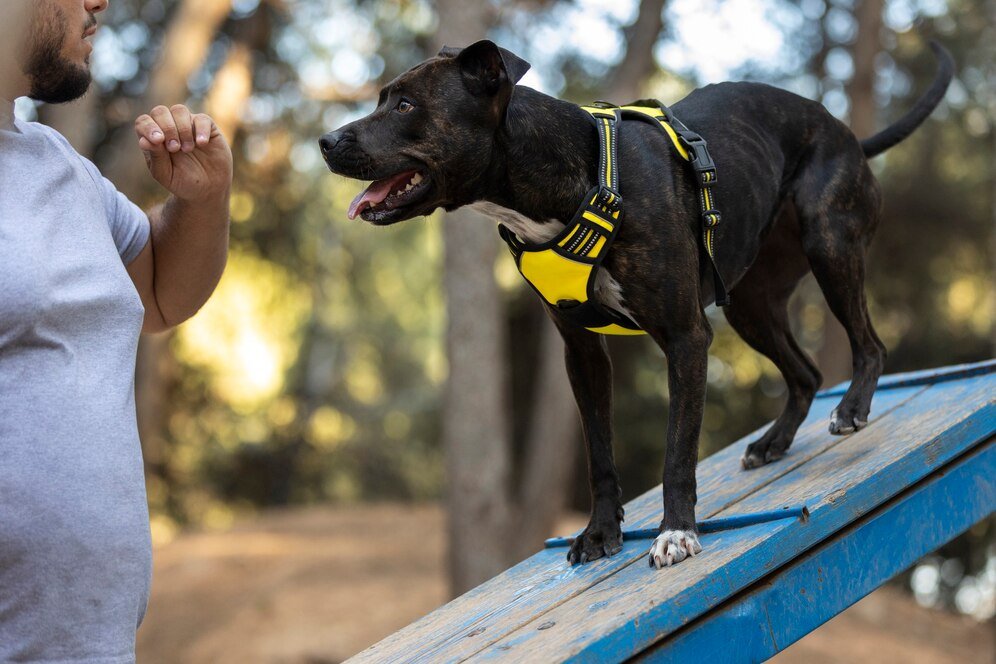
Now that you know how dogs communicate with humans and how humans communicate with dogs, you can take this information and learn how to better train your dog. As long as you have been following this course in order, you know what a dog means with its bark, its tail and other movements. In this module, we will explore how to teach your dog basic commands. Remember, dogs are not mind readers and what might seem normal to us, is often a foreign concept to a dog - and might even be offensive. As you work through this module, it is important that you remember that humans are primates and dogs are canines, so we are working with two different types of understanding. As primates, we touch, hug, gesture and change our tone of voice - but dogs do not do any of this. In fact, these actions are quite confusing to dogs and can even seem threatening. This module will teach you how to use your gestures, voice and actions, to teach your dog commands in the most effective way possible.
8.2 How Dogs Interpret What We Say
.jpg)
If you are like many people who work or live with dogs, you likely chatter away at them, throughout the day. Ultimately, this is likely a one-sided conversation, especially because they will never understand every word that we say to them. Do we really believe that a dog understands when we say, “No more biscuits for you. The vet says you have to go on a diet", or “Dogs are not supposed to eat chocolate, so stop begging"? Part of why we talk to our dogs as we might talk to other humans is that the dogs react as if they know exactly what we are saying. As you have come to know if you are following this course, though it is true that dogs can understand some words and, in some cases, as many as 1,000, they cannot string words together to understand full sentences.
Even when we believe that we have taught our dogs a command, in most cases, there has not been enough training and repetition in different situations. What dogs do understand, however, is our tone of voice, when we speak. If you are speaking to your dog, for instance, and you say “I love you" in a nice, pleasing tone, the dog is certainly going to react in a positive way, such as wagging its tail, running to you, licking your face, etc. However, if you speak to your dog and say “I love you" in a stern tone, such as the one you use to discipline the dog, the reaction will not be the same. The dog might put their head down, look away from you, or back away. This behaviour is actually backed up by science. Studies have shown that the behaviour is affected by whether or not the tone is intimidating or friendly, no matter what is said.
8.3 How to Teach Commands to Your Dog

Now that you know how dogs interpret what is said to them, you must learn how to speak with them, in order to ensure that they truly understand what you are saying. Keep soft eye contact and keep your voice gentle but firm. Maintain an upright posture to exude confidence without being rigid. Do not bow or duck or keep stooping to pet your dog while teaching – he or she may assume that you're being submissive. Your body language and words should be free of meaningless emotion as your pet may get confused with excessive gesturing. Communicating effectively with your dog involves more than just words.
For example: If you say 'sit' in a sing-song tone, then in an angry tone and then in a loving tone, the dog is going to be completely confused. To your pet, the three 'sit' commands said in different tones mean different things. Delivering a command that varies in tone, pitch and strength can be confusing. Pick a consistent sound with each word and stick with it. The trick lies in assuming assertive (not aggressive or submissive) body language and use this throughout your training sessions.
When you want your dog to stop doing something, say 'stop' in a dismissive tone instead of sounding like a drill sergeant. All of the commands that you give to your dog must be preceded by the dog's name. This way, the dog will know that you are speaking to them. Before you start giving commands, however, you must make sure that the dog knows to look at you. To do this, take an index finger and point at the dog's eyes and then bring the pointed finger to your own.
As soon as eye contact is established, begin talking to the dog and encourage it to keep contact with a command, such as “good watch". If the dog is not following the finger well, get their attention by taking a small piece of food, allowing the dog to sniff it and then moving the food near your eyes. When the dog makes eye contact, praise it and give it the food. We have discussed in this course how dogs learn a lot from their mothers - and when it comes to commands, this is no exception.
The mother of your dog did not repeat herself when training her puppies - and you should not do this either. When the dog understands a command, the command should only be said one time. If they do not react, you should give them a stern reprimand, such as “No, sit". If the dog does not sit, it is ok to place the dog in the sitting position, by pushing your hand onto its hindquarters. This is also a useful
trick when teaching a dog a command for the first time. Remember, dogs are not born just knowing what words mean. They must learn them - and they learn it by associating the sound of the word with the action. You also must be consistent, when communicating with commands. Only ask the dog to do one action at a time.
For instance
If you tell your dog to "sit down" and the dog knows the commands for “sit" and “down", this is going to be confusing. Also, do not switch between commands for the same thing. If you and your partner do not want the dog on the sofa, one of you should not use “down" and the other “off". Instead, make sure to use the same commands. The most important thing to remember is to keep things positive when commanding and communicating with your dog. You are attempting to communicate in a meaningful way and building a relationship. It will certainly be worth it when the dog begins making progress.
The following are commands that are common and often taught by professional canine trainers:
Watch or Look - This command tells your dog that you want them to look at you and to make eye contact.
No or Wrong - This is telling the dog that what they are doing is the wrong action. This should be said in a firm and low, tone of voice.
Ouch! Or Making a Yelp Sound - This is the sound one should make when the dog begins mouthing or biting too hard.
Good Dog/Girl/Boy - When a dog does something correctly, you should tell them that they are a good dog. Do this in a happy, upbeat tone, as the dog will interpret this as a job well done.
Sit - This is the most basic command of them all - and this command should be used before a dog eats, when at a street corner, around other people and basically anywhere you want to gain control of your pet.
Down - When you say down to a dog, you want it to lie down. Some dogs might not comply at first. “Down" should be used when you want the dog to be more comfortable, or when you need more control over your dog.
Stand - When the dog is sitting or lying down and you want it to move into an upright position, use the stand command.
Stay - The stay command is telling the dog that he or she should not move from where they are. You can combine “sit stay", so that the dog remains sitting in its position, or “down stay".
Okay - This tells the dog that they are released from the previous command. The dog is free to do as they wish until they get the next command.
Let's Go - This is the command that one will give when they want their dog to move. It is especially helpful when out on a walk when the dog is on a leash.
Heel - The heel position is a precise command, which means the dog should take the position directly to your left. When you walk, the dog walks, when you stop, the dog stops. This is a good command for a dog to know when in a crowd, or when you want your dog to stay close to you.
Come - When you say “come" to a dog, it should drop whatever it is doing and come right to you. This can be a lifesaving command and you should always use an inviting, cheerful tone.
Off - As mentioned, “off" should be used when you want the dog to get off the couch, bed, or even people. Do not confuse this with “down".
Take it - When you want to teach your dog to take toys or food on command, you would use the
term “take it".
Drop it - When you want a dog to drop what is in his or her mouth, you would say “drop it".
Leave it - If you do not want your dog to pick up an object or approach something, use the command “leave it".
FACT
More than 90% of dogs in the UK have learned the command to sit.
8.4 Common Training Mistakes

Now you know the basic commands that a dog should know, you want to make sure that you are not doing anything that will cause this training to take a backslide. Misunderstandings when communicating can occur between people and, in most cases, we are speaking the same language. When it comes to dogs and humans, however, we do not speak the same language, so one might expect that misunderstandings can occur. Here are five of the most common misunderstandings that one can expect, when trying to teach their dog new commands:
Leaning Over the Dog
One common mistake that owners make when training their dogs, is leaning over them. We are much larger than dogs and it is natural for us to lean down when we pet or talk to them. However, when we take this stance, we loom over the dog and can intimidate it. Dogs look at this as you saying “I am the boss and I am in control of you". Though you do want to be the boss of your dog, this action is more of a 'bully' stance and one that can frighten dogs who have fully accepted their owners. When dogs feel this way, they might use an appeasement gesture as a response, such as submissive urination, which is a way they show that they are not a threat.
In some cases, if you do this to a dog that you do not know and it feels threatened by you, it could become defensive or aggressive, when you lean over them. They could even fight back and attack, as they see you as challenging them. Instead, you should give the dog space and allow them to come to you. Turn to your side and kneel or crouch on the floor, so that your height and position are not intimidating.
Giving the Dog a Hard Stare
Another thing that you should avoid during training is giving the dog a hard stare. A hard, direct stare is a sign to a dog that you are focused on them and that you are showing your dominance. Instead, you should use calming signals, just as dogs do, to show that you do not mean to scare the dog or come across as aggressive. Avert your eyes, move slowly and turn your head away from the dog. Then, allow the dog to come to you.
Patting The Dog on the Head
Imagine if you were sitting there minding your own business and a big giant came by with their hand half the size of your body, coming right at your head. You would be frightened, right? Dogs that arenot used to humans yet, such as puppies, are often frightened when approached too quickly. Instead, think about how dogs communicate with each other. Remember, the dog is very good with their nose, so they will want to smell something, before touching it.
The best thing to do is to offer your hand to the dog, with the palm down, so that they can smell your scent. Slowly move your hand closer to the dog, as they allow - and pay attention to their body language. Offer a scratch at the side of the neck or front of the chest first and do not rush to pat their head. Take your cues from the dog's body language, until you know it is ok to get closer.
Hugging the Dog
Though we hug each other as a sign of affection, this is a foreign concept for dogs. Instead, dogs use similar gestures to hugging, to play, fight or mate. So, you should refrain from hugging the dog, as much as you can. It is also important that you teach children to do the same. Instead, use what you have learned in this course and show them signs of affection that they understand. Otherwise, dogs, especially young or strange dogs, could lash out, because they feel as if they are being attacked.
Kissing the Dog
Puppies and dogs love to give kisses - and you might want to give the dog a kiss back. But, as has been explained in this course, when a dog gives kisses, they are not necessarily expressing love and affection. Instead, the dogs are showing respect, submission and deference. In other words, they are saying “I am not a threat to you". If you attempt to mimic this and give the dog a 'kiss' near the mouth or eyes, you are showing that you are submissive to the dog - the exact opposite thing that you are trying to do with the training. To make matters worse, if you have a child who does this, the dog could be showing the child that they are in charge and could bite the child.
8.5 Teaching Your Dog Impulse Control

This module has taught you how to teach your dog basic commands and what NOT to do, when you are training. Before closing this module, you will learn about how to teach dogs impulse control. Dogs love to jump on people, rush in and out of rooms and run up and down stairs. This might not be an issue for little dogs, but for large dogs, this can be problematic, especially if they are large enough to knock people down. Regardless of the dog's size, however, there are certainly situations where a pushy pup can put them, or humans, in harm's way. Fortunately, we can learn how to control the impulses of dogs and once we understand how to do so, it is quite simple.
Understanding Impulse
Before you can find out how to control impulse, you must understand it. In humans, we refer to impulse as the urge to act on a whim, only with the immediate gratification we get in mind. We do not think about the consequences. This might be simple, such as buying something in line at the supermarket, or eating a dessert because it looks good on the menu. It might also be more serious, such as jumping from a tall tree into a pool of water, to impress our friends.
Dogs are no different than humans, in regard to impulse. They have urges to go out to the garden, to get out of their crate, or to play with a ball. We know that impulse is caused by a reduction of a chemical called serotonin in the brain, in both dogs and humans. One way that you can deal with impulsive behaviour in a dog is to increase the serotonin in the brain, by increasing activity levels. This reduction of serotonin is only to blame in a small number of dogs with impulse issues - the vast majority simply have never learned proper manners or behaviour.
The following are steps that you might take to control impulsive behaviour in canines:
Identify what the dog wants and then make that the reward. For instance, the dog might want to use the toilet, they might want food, a toy, or even to play with another pup. Look at what the dog does, immediately before they get their reward.
For instance, if a dog always wants to get out to the garden quickly and pushes the door on their way out, they learn that pushing on the door gets it a reward. So, you want to patiently wait for the dog to perform an acceptable behaviour that you want them to repeat, before giving it the reward.
Here is an example. Many dogs get impulsive and excited when you put the leash on them. Dogs cannot jump forever and if you wait, they will calm down. If the dog has already been trained to sit, ask them to sit when you put on the leash. If the dog gets up, which it will at βirst, take the leash away and wait for the dog to sit again and then put the leash on. You must have patience when teaching the dog to control its impulses - and staying calm is critical. If you are irritated and frustrated, it will lend to the excitability of the dog and make it harder for them to calm down. You cannot expect the dog to be calm if you are not.
You have already chosen the behaviour that you want to reward - and then must wait for the dog to do it. Remember, there is no behaviour that the dog can sustain for long time periods and they will not be able to bark, jump, or paw, for an extended period of time. As soon as the dog performs this behaviour, reward it by giving the dog what it wants. It usually only takes a few times, for the dog to catch on.
Finally, you must be consistent, when teaching impulse control. Teaching can be quite effective when you are consistent, as the dog has no opportunity to become confused. If you allow the dog on the sofa one day and then scold them the next, the dog will not only be confused, it will also be stressed. Always follow through with training and, over time, your efforts will certainly pay off.
Module Summary
Teaching a dog commands is a necessary part of training. If you do not teach the dog commands, you will have a furry terror on your hands that no one, including you, will want to be around. Fortunately, training a dog is not as difficult as it might seem and as long as you remain
patient and consistent, there is no reason that you will not see success with any training plan. This module showed you what the most common canine commands are and how to teach them. It also explained what each command should mean and why you should not mix up commands.
We also covered some of the most common mistakes that people make when they begin training a dog - and how making these mistakes cannot only get a dog off track but how they could also get you or someone else bitten by a dog. Finally, the module explained what impulsiveness in dogs is and how to remedy it. You also learned about the importance of consistency and patience, when teaching and training dogs. This is an important module and, as you can see, in order to get the most out of the information in this module, it is important that you thoroughly understand the language of dogs and how we interact with each other.
.svg)



