
2.1 Introduction

Socialisation and communication go hand in hand, when it comes to canines. Before a dog can communicate with a human, they must be socialised to do so. This module will focus on how dogs socialise with humans and other dogs - and how dogs “speak'.
2.2 The Importance of Socialisation to a Canine

The most common reason that dogs end up in shelters throughout the world is because of behavioural issues - and these issues, more often than not, are attributed to lack of socialisation. There are also risks associated with dogs that are not socialised, such as the possibility of them becoming aggressive towards other dogs - and even humans. Most veterinarians recommend that the process of socialisation is necessary, by the time a puppy is seven to eight weeks old.
Almost all puppies can grow into social, loving adult dogs, but they must have the right socialisation, during their puppyhood. This means that dogs must have the chance to be around other animals and people, early in their lives. This is no different to how humans socialise children. We do not decide to confine our children to the house for their entire lives, nor do we begin parenting a child after they have developed learned behaviours and habits. Yet, this is exactly how many people raise their puppies - and these cute, sweet, bundles of fur will certainly turn into an aggressive, disobedient, or destructive animals.
FACT
Approximately one in every four to five dogs have behavioural issues, due to poor socialisation.
Source: Association of Pet Behaviour Counsellors
Dogs are social creatures and companionship is extremely important to their wellbeing. Dogs have evolved to stand next to man - and they should be involved with man, from the start. They don't like being alone and they require a great deal of attention, in order to mature correctly.
Why One Must Socialise Puppies As Soon As Possible
Socialisation is the process of exposing a young dog to as many environments and stimuli as possible, including people and animals. There is a thin line, however, as the dog might easily become overwhelmed. A dog that is over stimulated might become fearful, withdraw from the situation, or avoid certain behaviour.
A dog that is properly socialised will:
-Be handled from birth and accept touching of all of their parts, including their tails, legs, ears and feet.
-Be exposed to as many places, people, animals and situations as possible, including car journeys.
-Be allowed to play with a number of games and toys and be exposed to various surfaces, textures and other stimuli.
-Be encouraged to investigate and explore his or her environment.
Ideally, socialisation will reach all of the senses of a young dog, which will help them to grow up being unafraid of sounds, sights and smells. In other words, this desensitises a dog and allows the dog to develop a high level of comfort, when encountering new situations or environments.
Unsocialised dogs are not likely to cope well with any change in their situation or environment, which can make it difficult for them to get medical care, grooming, or to have visitors in their homes. On top of this, if a dog isn't properly socialised, he or she can develop a permanent fear of situations and a generalised anxiety. In serious cases, this can make a dog unsuitable for human companionship.
The Timing of Socialisation
It is most important to socialise a puppy, during their first three months of life. For most, this means starting the socialisation process as soon as they enter into a home. Why is this timing so important? Because at this point, the need for socialisation outweighs fear - and their brains are willing to accept new experiences. The things the puppy encounters during this period of time will shape its temperament, character and behaviour, for the rest of its life. If a puppy is not socialised during the first three months, the odds are high that they will show risky behaviour later in their lives, such as aggression. Once an animal gets older, it is extremely difficult to change this.
2.3 Tips for Socialising a Puppy
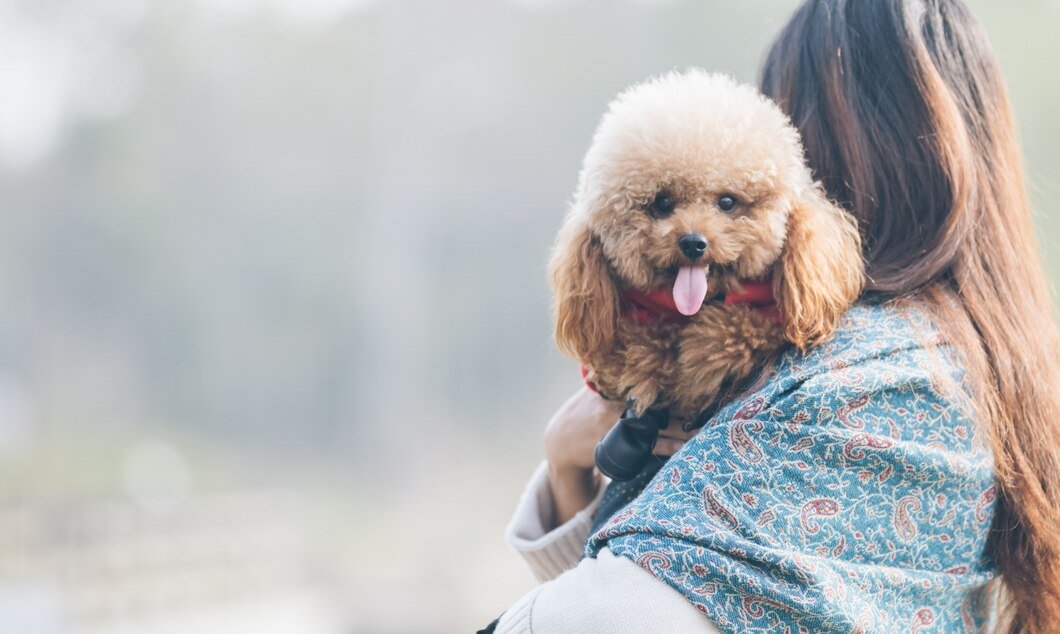
Socialisation is the method that one uses, in order to develop a puppy into a sociable dog without behavioural issues. As mentioned, the socialisation process should begin by the time the pet is about seven to eight weeks old and should continue for the rest of their life. Here are some tips for socialising a puppy:-
Puppy Classes
There are a number of organisations in the UK that offer puppy socialisation classes. Even if you do not have a puppy and would like to attend a class to learn more about socialising, do it. There is much to learn. A well run puppy class will involve minimum exposure to any health risks and the environment is set up to be one that is conducive to puppy socialisation.
These classes will:
-Increase the responsiveness of the dog to commands.
-Teach a dog when it is appropriate to use their teeth - and when it isn't.
-Teach a dog how to properly interact with people and other animals, including strangers.
-Help owners to develop realistic expectations of their dog.
-Strengthen the bond between the dog and owner.
-Give tips on housebreaking and preventing hyperactivity.
-Help an owner learn how to correctly discipline a dog.
Many studies show that owners who take their dogs to puppy classes have dogs that are much better behaved and easier to handle, than dogs that do not attend puppy classes.
Interact With People and Other Animals
Owners of a new dog should invite friends and family over to meet with and interact with the dog. It is best to include people of different ethnicities and ages, along with people who have children of varying ages. Both men and women should be introduced to the dog. One should ask friends and family to bring gentle, well behaved dogs, puppies and cats to the home too, or one can take the new dog to the homes of others. When introducing a new dog to other animals, it is imperative that those animals are vaccinated. It is also important to take the puppy to public areas, where there are people and other animals. This way, the dog gets used to a crowd.
Expose the Dogs to Unfamiliar Sounds and Sights
Owners should also expose a new dog to unfamiliar sounds and sights, even those in the home. This is to ensure that the dog is not fearful of any changes in their environment, such as the rearranging of furniture, dropping of pots or pans, or even loud voices. Owners of dogs should also get their pet accustomed to loud sounds, such as the vacuum cleaner, lawnmower, hair dryer - and even the sound of the television.
Owners should not attempt to scare or frighten their dog. Instead, it is best to expose the dog to the sound from a distance and then gradually bring the sound, or the dog, closer. Take things slowly and eventually, the dog will learn that it has nothing to fear.
Grooming, Bathing and Handling
From a young age, it is important to get a dog used to being brushed and bathed. It is also important that the dog is handled by a number of different people and that these people handle the paws, the mouth, the ears and tail. This will allow the dog to be more comfortable when handled, which ultimately helps to make grooming and vet visits easier on everyone.
Make Socialising a Positive Experience
Most people who get a new dog are excited to show the dog off and often want to do it from day one. Though this is fine, new owners should keep in mind that they should take things slowly and allow the dog to meet people and animals, at their own pace. If not, the puppy could become overwhelmed, scared, or harmed.
Young dogs tire quickly and forcing or hurrying their progress, will make them tire even faster. These quick training sessions for socialising must also always remain positive. When a puppy shows fear or hesitance to do something, owners must not reward this behaviour with attention or affection. Instead, owners should reassure the dog that it is safe, but then back off. Doing more than this might seem like a reward to the puppy, which will encourage his fearfulness. Socialising should be an activity that is enjoyable and safe, for both the dog and its owner.
FACT
About 80% of dogs in the UK have at least one fear - and most of these fears are due to poor socialisation.
2.4 How do Dogs “Speak' to Each Other?

Thus far in the course, we have put a lot of focus on the basics of how dogs speak and communicate with humans. However, we have not had a lot of focus on how dogs “speak' with other dogs. Communication is the foundation of a dog's social behaviour - and a dog communicates by using its facial expression, body language and sounds. There are various components, in fact, which create the unique language of a dog. By learning more about how dogs communicate with each other, we can better understand how to communicate with them.
Eye Gaze
One way that dogs communicate is with their eyes. When they want to threaten or warn another dog, they will engage in a direct eye-to-eye stare. On the opposite end of the spectrum, a dog will turn their eyes away from another dog, or avoid direct eye contact, by breaking off the eye contact. Blinking is another way of communicating to other dogs that they are not a threat.
Body Language
Though most people might consider growling or barking to be the main way that dogs communicate with each other, it is actually with their body language that they mainly communicate. One of the foremost researchers of dog body language, Turid Rugaas, defines more than 30 signals that dogs give each other to show “calming signals'.
Some of these include:
-Licking
-Turning the head away from the other dog
-Walking slowly
-Play bowing
-Yawning
-Sitting down
-Wagging the tail
-Urinating
-Lying down
The position of the ears is also a way for dogs to communicate with each other.
Here are some examples of ear position and their meaning:
-Ears erect or positioned forward - the dog is on alert.
-Ears flat against the head, with teeth showing - the dog is ready to defend itself.
-Ears flat against the head, without teeth showing - the dog is stressed or anxious.
-Ears back and splayed - the dog is unsure/fearful.
-Ears that are flickering - as above, the dog is unsure/fearful.
As mentioned previously in this course, in order to truly read a dog's body language, you must look at the dog as a whole. That is, you must look at the entire body, in order to read exactly what the dog is trying to say.
-A dog who is relaxed and approachable, for example, will have his or her ears up and mouth open, with the tongue slightly appearing. The head will be high. The tail will look relaxed or wag playfully and the dog's weight will be positioned equally, on all feet.
-A dog that is alert will have a slightly different stance, however. In this case, the dog's ears will be forward and if he or she is trying to listen, they might begin to wiggle. The eyes will be wide and alert and the mouth closed. The skin on the face will be smooth, as the dog will not be snarling or baring its teeth. The dog will lean forward and the tail will move slowly, from side to side. A dog might take this stance, if he or she has detected something of interest, or something unknown. It is trying to determine if there is a threat.
-An aggressive dog will also take a different stance. In this case, the ears will lean forward, the forehead and nose might look wrinkled and the lips will curl into a snarl. One will see the dog's teeth and it might begin to growl. The legs will be stiff and the weight of the dog will be primarily on the front feet. The tail will remain in an upward position and the hackles, the hair on the back of the dog's neck, will be raised. This is a dog that will not hesitate to attack, if it is challenged. One might also see a dog that is aggressive, yet frightened. This too, will force the dog to take a different stance. In this case, the dog's ears will lay back on the head and its body will lower. The dog will often put its tail between its legs and have the mouth open slightly.
Facial Expressions
You will also see a number of facial expressions that dogs use, in order to communicate. For example, a dog might yawn to speak to another, or even to a human. Just like us, a dog yawns when it is tired, but it will also yawn when feeling stressed, or when faced with a dog that is more aggressive. A dog also will diffuse a stressful situation, by turning its head away and yawning. This is basically telling other dogs that this dog is done.
The shape of the mouth is also a way in which the dog uses facial expressions to communicate. A relaxed dog will have a mouth that is slightly open, or have the tongue draped over the lower teeth. A dog that is showing interest in something will have a closed mouth, with no tongue or teeth visible. Snarling, which is pulling or curling the lips to expose the teeth, is a warning sign that the other dog, or human, should back down. A dog that has a 'smile' with the lips pulled over the gums and teeth, is showing a calming signal.
Verbal Communication
Dogs also use vocalisation, in order to communicate with other dogs and with humans. By four weeks old, the dog knows most of the vocalisations that it will utilise throughout its life. Though the basic meanings of these vocalisations were discussed in Module 1, here are more details about how dogs communicate:-
There are many types of barks that a dog might use, including the following:-
-Barking in a rapid string of three to four barks - Dogs use this bark as an alert. He or she might sense something, but doesn't know if it is a threat.
-Rapid barking, without stopping - Dogs use this as an alarm bark.
-Barking continuously, with a low pitch - The dog is saying it is ready to defend and that it feels threatened.
-A string of barks, with a long interval in between - This dog is lonely and wants a friend.
-Sharp, short barks, with a high pitch - This is a greeting bark, which stops when the dog identifies the dog or human as friendly.
-Single, short, low range pitch bark - Dogs use this when they are annoyed. Mother dogs, especially, use this bark with their puppies.
-Single, short, high range barks - Dogs use this when startled or surprised.
-Stuttered bark - Used by dogs to initiate play.
-Bark that rises in pitch - Used by dogs to indicate a fun time, or when play-fighting.
Dogs also have a number of different growls.
Here are some of the growl sounds that one might hear a dog make:-
-Soft, low growl that sounds as if it is coming from the chest - Used to threaten.
-Soft, low growl that comes from the mouth - A warning to stay away.
-Low pitched growl-bark - A call for assistance.
-High pitched growl-bark - Frightened, but will defend, if necessary.
-Growl that changes pitch - The dog is afraid and will either defend itself, or run away.
-Noisy, loud growl, with teeth hidden - Usually used when playing, but one must look at the entire body, in order to be sure.
Howling is another way that a dog will verbally communicate with others.
Here are some of the most common howls and their meanings:-
-Yipping/Howling - The dog is lonely.
-General howling - The dog is showing a stranger that they are now in its territory.
-Bark-Howl - This is usually two or three barks, followed by a long, mournful howl. A dog that does this is calling for companionship and is lonely.
Dogs will also whine and whimper. Most people believe that this means a dog is sad, but it could mean a number of things:-
-Soft whining and whimpering - The dog is scared of getting hurt.
-Low moan or whine - The dog is showing that he or she is excited, or anticipating something, like a treat.
-Single yelp or high-pitched bark - This often means pain or fear. Several yelps means the pain or fear is severe.
Finally, a dog might sigh. This is an expression of the dog's emotions and usually occurs when the dog is lying down. If the eyes are half-closed and the body relaxed, this means the dog is content and happy. If the eyes are open and the body is rigid, it often means that the dog is displeased with something, such as not getting scraps from the dinner table.
2.5 Licking and Sniffing
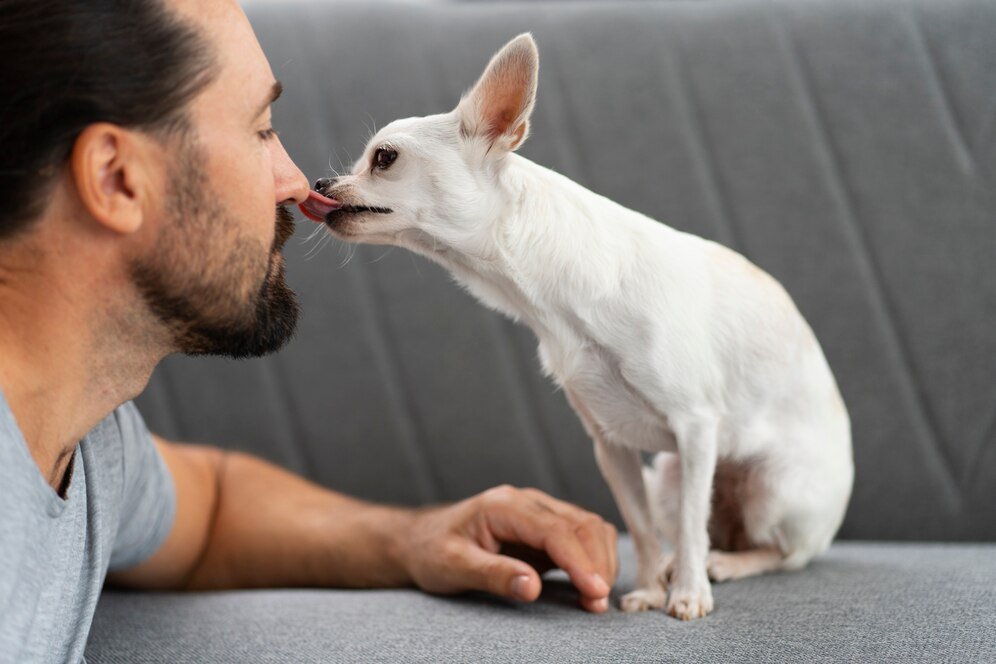
Dogs will also lick and sniff each other, as a form of communication. Some dogs will lick, to show affection, but they are also doing it for another reason - they want to taste and smell the odour of the other dog's face, or the human. Scent is one way that a dog recognises other dogs he or she knows. It is the same with humans.
There are several reasons why dogs lick each other and us:
1. Mothers lick their puppies to stimulate breathing and also to clean them
2. Our pets lick us out of affection and also because they're used to the taste and smell of our skin – it's comforting to them
3. Dog saliva contains enzymes that kill off bacteria, dirt and dead skin and they use licking as a way to groom themselves
4. Chronic licking could also signal boredom, anxiety or skin allergies
5. At times, your dog may lick you to remind you to fill the water bowl or open the dog door to the backyard
If you don't want your dog to lick you when you pet him, just leave the room when he or she licks you. This will teach them that constant licking is not acceptable.
Module Summary
Dogs are anything but silent, solitary creatures. In fact, a dog that is not allowed to socialise and vocalise would be similar to a human who is forced to do the same. Dogs have a language all of their own, but that doesn't mean that humans cannot communicate with them. A dog will use their socialisation and vocalisation skills, to share their emotions and intentions with those around them. Keep in mind, however, that sounds are only a small part of the way a dog socialises and speaks - they also express themselves by using body language, including facial expressions.
There are many reasons to socialise a dog - and this socialisation begins during puppyhood. The mother of the puppies will play a role in the socialisation, but it is also important that humans step in to socialise dogs too. Canines that are not socialised can become aggressive, difficult to handle and can even become dangerous to other animals, or people. This module showed you how to recognise the social behaviours of the dogs in your life - and how one can see a dog's intentions and possible future actions, by paying attention to their body language and vocalisation. This is a very important part of communicating with a canine.
.svg)



