
3.1 A General Overview of Breed and Communication
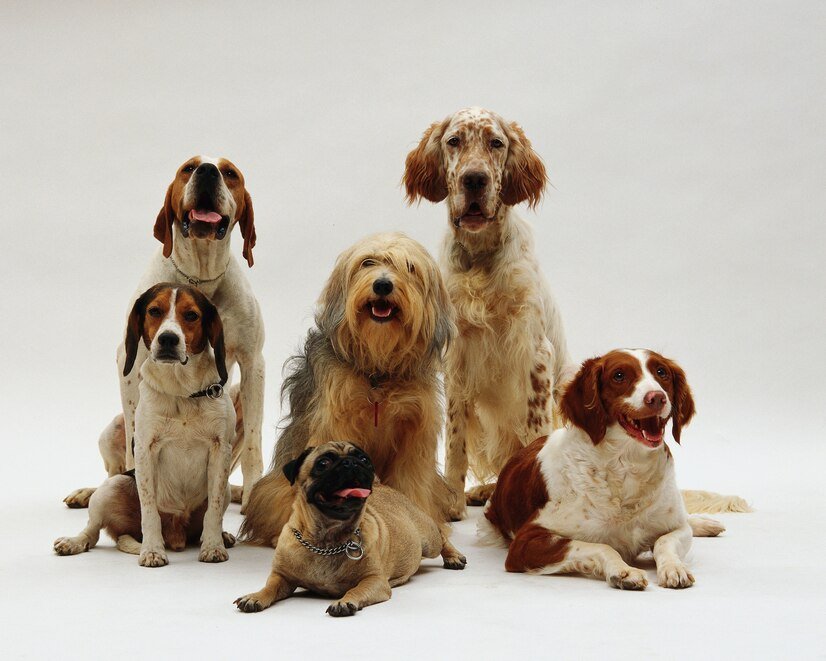
A dog's breed is determined by its genetics. As mentioned, all dogs have a basic way of communicating, but some breeds communicate in different ways than others. The genetics of the dog can influence communication through their physical attributes, for instance - and all of their behavioural communication fully depends on the capabilities of the physical structure of the animal.
For example A dog that has eyes that are set far apart will not be able to show other dogs, or even humans for that matter, a direct stare, which is a method of communication. Other dog breeds, such as Cocker Spaniels, have eyes that are close together, which not only allows them to be better hunters, it also allows them to use eye contact. Yet, there are other dogs that have eyes perfectly aligned, but due to their
breed, they have hair that covers the eyes, such as Old English Sheepdogs.
You can also look at the mouth of the different breeds, in order to learn more about the way these animals communicate. We discussed the 'submissive grin', for instance, in Module 2, so some dogs that do not have prominent facial features cannot do this as well as others. Domestic dogs, as a species, fall into a huge range of structural differences in the face.
For example
A Shih Tzu is one of the smallest dog breeds, only weighing from 4-7kg. They have faces that look almost squashed in and, thus, it is difficult to see what their lips are doing, so you cannot rely on looking for the “submissive grin' with this particular breed. The largest dog breed (the Irish Wolfhound), and many other breeds, have a much more defined face and snout, which makes it easy to se their facial expressions. The type of coat may also come into play when it comes to communication.
Some breeds, such as the Poodle, have very curly coats. This means that one cannot see certain types of body language, such as the hackles, which will rise when the dog is on high alert. Other breeds, such as the Rhodesian Ridgeback, however, have permanently raised hackles, which often gives the impression to other breeds that this dog is not one that they should mess with. Even the colour of the coat can be significant when it comes to communication.
For instance, dogs with black coats can seem featureless to other dogs, which means they are very difficult to read. Remember, the attributes of each breed are closely tied to the original function of the breed. This means that their physical attributes can be used to communicate. Body posture, ear carriage, facial expression, eye contact and the movements of the tail are all things that dogs use to communicate with other dogs, but, as mentioned, there are breeds that have physical traits that impede or prevent them from doing these things. We talked about some breeds having hair that covers their eyes, such as an Old English Sheepdog. These dogs also often have hair that covers their mouths, which means other dogs - and humans - cannot see the display of teeth, which many dogs use as a warning.
Tails
We have discussed previously that dogs use their tails as a way to communicate. Some breeds, however, such as the Pug, have a curled tail. This means that they cannot and do not use their tail for communication, as well as other breeds. There are also dogs that have docked tails, such as certain breeds of working dogs. Since the tails of these dogs are so small and short, it is difficult to read what the dog is trying to communicate with its tail.
Features such as skin folds around the face, as in the Pug, English Bulldog and Shar-pei, make it more difficult for other dogs and humans to read their facial expressions. These dogs naturally look as if they are frowning, but might be quite happy and content. When dogs cannot understand each other, or when humans cannot understand dogs, there is potential for trouble. Dogs that look most like wolves, for instance, such as German Shepherds, are often known to have body language that is the clearest to other dogs and humans.
Breeds with anatomical features that are peculiar, do not have that 'wolverine' shape, which means they can easily be misunderstood.
Take, for instance, a Bulldog. These dogs have many wrinkles, an odd body shape, almost no tail, lean forward naturally and have a short muzzle, which permanently shows the teeth. As another dog looking at a bulldog, one can see how this breed might seem confusing.
Types of Different Dogs' Tails:
Docked Tails: This is somewhat like a bobbed tail and can be found on breeds like English pointers, Dobermans and Boxers.
Ringed tail: These dogs have tails that curl round like rings like the Siberian Husky, Norwegian Elkhound and the Basenji.
Otter Tails (or Swimmer Tails): These tails are shaped like a rudder and can commonly be found on breeds like the Labrador Retriever.
Tufted Tails: Poodles have typical tufted tails that sit high on their back, are well-furred and straight up.
Gay Tail: This is a slightly curved, thick and has a small, white tuft right at the top. Common breeds with gay tails include Border Collies and Beagles.
Tapered Tail: Terriers, Dalmatians and English Setters have tapered tails which are thick at the base and taper out straight up or slightly horizontally.
Generally, dogs never wag their tails when they're alone. They only wag their tails in the presence of people or other dogs/pets. Negative feelings pull a dog's tail to the left while positive feelings pull it to the right. Dogs chase their tails for curiosity's sake, play, fun or to check for fleas.
FACT
Research shows that dogs with short or absent tails are twice as likely to have aggressive encounters, than dogs with longer and, hence, more visible, tails.
Source: Psychology Today
3.2 Dog Breed Specific Communication Behaviour
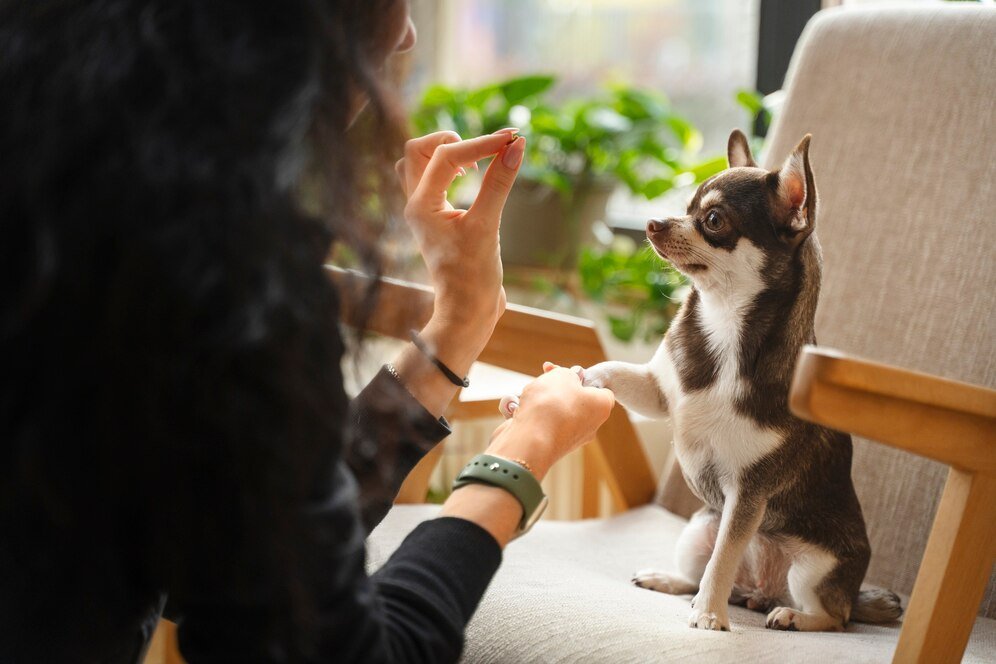
With more than 200 dog breeds recognised in the UK, it should not be a surprise that some dog breeds have built up a reputation for themselves, based upon some of their communication behaviours.
Barking and Howling
When you think of dog communication, you often think of the bark of a dog. You might be surprised to know that some dog breeds certainly bark more than others, thus, one could say that the breed has a specific influence on how 'talkative' a dog might be. Some breeds have been developed specifically for a certain purpose, such as hunting, companionship, herding, or even as watchdogs.
Those watchdogs and hunting dogs are generally the dogs that bark the most. Take for instance, the adorable Yorkshire Terrier. These are some of the smallest dogs around and though they are classified as a Toy breed, they are terriers at heart and, make no mistake, terriers of
all types, large and small, have been bred to communicate by using their bark. Therefore, even though one might think these small dogs should be quiet, they have not developed a reputation of being 'yappy', for no reason. Other dog breeds that are well known for their barks include German Shepherds, Miniature Schnauzers, Chihuahuas and Beagles.
As mentioned in the previous module, howling is another way in which dogs communicate. Some breeds can go their entire life and only howl a handful of times. Other dog breeds can go for a few hours and seem to have a need to howl. Some of the most prolific howling breeds include Basset Hounds, Bloodhounds and Siberian Huskies. One expects dogs to bark and howl, of course - but what if they do not? There are some breeds that are naturally quiet, which means they must communicate in other ways. Collies, Cavalier King Charles Spaniels and Mastiffs, are all breeds that are relatively quiet. However, some of them will get bored, if not given the proper enrichment and play. There is also a breed, the Basenji, which is known as the 'silent dog'. This dog does not bark at all, but that doesn't mean they are totally silent. Instead, they use a sound that resembles a yodel.
Eye Contact
You also learned in the previous module that dogs use eye contact to communicate and in this case, there are some breeds that use eye contact, more than others. Australian Shepherds, Border Collies and other dogs that herd, are usually the best with eye contact for communication. The act of direct eye contact with each other and with humans is thought to have developed throughout the thousands
of years of canine domestication. We have talked about dogs using eye contact to warn or threaten, but there is also research that shows that dogs use eye contact with humans, specifically, to learn about our emotional states, to get food, or to simply see what is happening in the world around them.
There is additional research from Japan, which has found that when dogs stare at humans, levels of oxytocin, a hormone, is released into their bloodstream. Oxytocin is also released, when a mother dog nurses her pups. In other words, it is a 'feel good' hormone and, in some way, staring at a human is like a reward for the dog.
Ear Shape and Position
If you have ever done any research into the breed standards that the Kennel Club has created, you will realise that each accepted breed has a certain look to its ears. We briefly presented information about ear shape and position in the previous module, but all dogs have ears of different size and shape.
According to the Kennel Club, a Cocker Spaniel, for instance, should have ears that are set low on the head, level with the dog's eyes and be covered with silky, long hair. However, with the ears low and covered with hair, it can be difficult for other dogs, or even humans, to know what a Cocker Spaniel is trying to say with its ears. Other dogs, such as German Shepherds, have ears that are easy to read, but even with ear shape and position, one can see how the breed ofthe dog can have an impact on the way they communicate.
Body Stance
The stance of a dog is always a way in which they communicate. As we have discussed, dogs that are attempting to communicate aggression will often lean forward, with their body weight in the front of the body. However, some dog breeds are naturally built in this way. English and French Bulldogs, for example, are dogs that have a naturally wide stance - and they lean forward a bit when walking. This stance alone can indicate to other dogs that this is an aggressive dog.
However, the personality of these breeds is far from aggressive. Fortunately, dogs know that they must look at the whole picture when trying to determine if another dog, such as a Bulldog, is being aggressive, or not. Even small dogs that don't seem too dangerous, such as a Chihuahua, have wide, broad chests, compared to their body size and tend to have a natural aggressive stance.
Facial Expressions
Dog facial expressions are also a way of communicating. However, as you have now likely come to expect, breed differences can come into play here too. Let's look at the 'submissive grin', a concept that has already been brought up several times during this course. This grin is often mistaken as a snarl. This expression is not common in interactions between dogs, but it is fairly common in dog- human interaction.
This is important, as researchers believe that dogs that use this expression, which looks similar to a smile, are saying that they are friendly and like the human they are smiling at. In fact, there is a well-known theory that dogs that use this expression are mimicking the smiles of humans. Some dog breeds, however, such as sheepdog breeds, have hair that covers their mouths, so it might not be easy to see this expression. If you do happen to see a 'submissive grin', take note of the rest of the dog's body language. If it seems relaxed, you can be sure that the dog is friendly. If this expression is indeed a snarl, the body language will support this too.
Dogs also express facial expressions, with their brows and mouths, but, again, some breeds are simply not made to utilise these expressions. For example, a dog that is calm will not have brow lines, unless, of course, the dog is a breed that is known to be wrinkly, such as a Pug or a Shar-pei. The same can also be said about the mouth. A dog that is afraid, aggressive or tense will have lines around its mouth. A dog that feels relaxed will have βlat lips, which are free of wrinkles.
FACT
The most popular dog breed in the UK is the Labrador Retriever. It is followed by mixed breeds, Jack Russels, Border Collies and German Shepherds.
3.3 A Dog's Breed and Its Behaviour
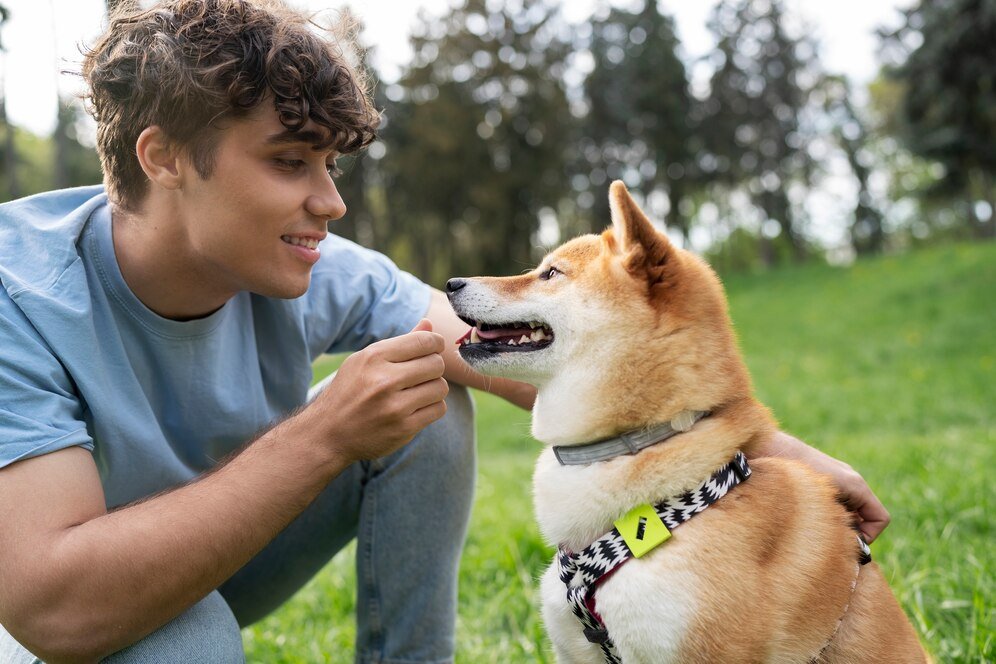
There are a number of stereotypes associated with a dog's breed. For instance, you might have heard that Border Collies are the smartest breed, or that a Beagle always will find its home, if it becomes lost. Though these might be true in some sense, not every Beagle that gets lost will come home, without help - and every single Border Collie in Britain is surely not smarter than every other dog. Despite these opinions, however, what is on the outside, or the appearance of the dog, might not have any bearing on its behaviour, intelligence, or even personality.
Understanding Where Breeds Came From
Imagine that you meet a person who has a dog. One of the first things that the person will tell you about their dog, or one of the βirst things you might ask, is what kind of dog it is. We are fairly breed-crazy, in fact - and though there are certainly dogs of mixed breeds, there is still an element of perfection, class, and even awe, when someone obtains a dog of a certain breed. We have the Victorians to thank for this, as during this period of history, is when the focus on breed became 'a thing'.
Before the Victorian era, the focus was on what a dog was able to do, not what the dog looked like. Thus, a dog that spent its days chasing hares was called a harrier and any dog that was large and intimidating was a Mastiff, etc. Over time, however, dogs began to take on certain appearances. In some cases, this was tragic or unthinkable, to most of us.
For example
In the 18th century, it was common for butchers to tie bulls out and use dogs to kill them before the butcher separated the meat. These dogs were low to the ground, had strong jaws, flared nostrils and a jaw that protruded - what we know of a modern Bulldog. As the Victorian era came into being, the middle class, for the first time, were upwardly mobile and they wanted to show off their social standing and wealth by what was on the end of a lead.
The easiest way to do so was to choose dogs that had a certain appearance. Today, we are still quite focused on looks over behaviour. For instance, you might have a Golden Retriever that does not retrieve. So, this raises the question of how closely a dog's breed relates to its behaviours, including communication. Are toy breeds really more attached to their owners? Are sporting dogs all very impulsive? There is a lot of research going on about this - and the findings are quite interesting.
3.4 The Studies and Results on Dog Breeds and Behaviours
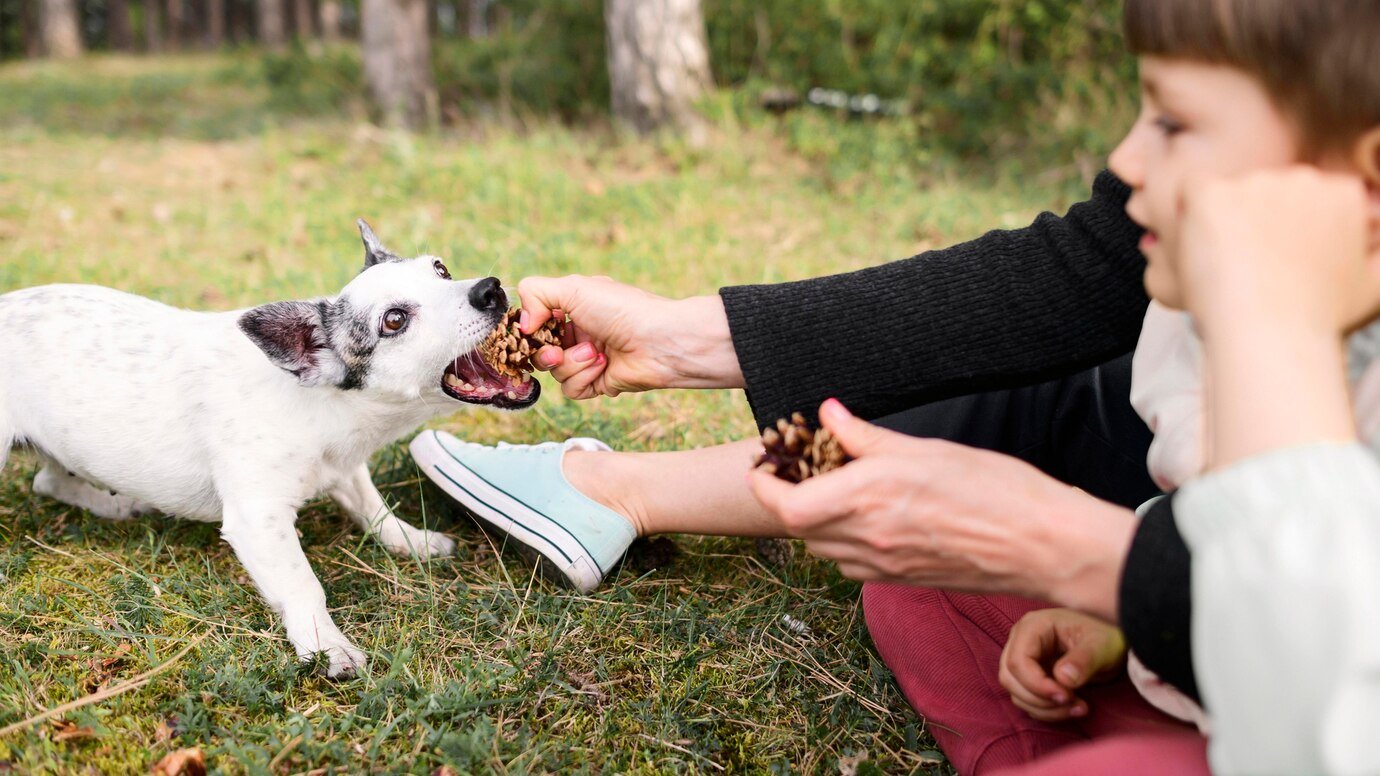
Thousands of dogs have been studied over the years and researchers have found that when it comes to communication, dogs that are purebred tend to be better with communication and dogs that are mixed breeds are better with memory. In order to test this, researchers
asked owners to point to food and then recorded if the dog followed the point. Though it might seem normal to dog owners, the fact that dogs can follow these points is truly extraordinary, as they are the only animal to do so. Even chimpanzees, which are closely related to humans, cannot outperform dogs, in this sense.
Both the mixed breed and the purebred dogs were able to follow the gestures of the owners, but the more consistent of the two were the purebred dogs. Memory was tested, by allowing the dogs to play a series of games, all of which measured the dog's ability to remember information and then manipulate it. In one game, the dog watched its owner put food under a cup, but then point to another cup. The purebred dogs were more likely to choose the cup that the owner was pointing at, whereas the mixed breed dogs were more likely to go to the cup with the food. One explanation as to why this is the case refers back to history.
Before the Victorians, remember, the emphasis for dogs was placed on the function, instead of the look. So, many dogs were bred to be working dogs, which relied on the act of reading gestures from humans. For instance A Labrador Retriever was originally meant to hunt and German Shepherds, to herd. Both of these 'jobs' required gestures from humans, in order to complete the tasks successfully. This does not mean, of course, that mixed-breed dogs cannot read gestures from humans, but many of the purebred dogs simply have this skill ingrained in them, thanks to domestication and evolution. Mixed breeds have the edge, however, as they can rely on their memory and other traits.
Module Summary
This module focused on the concept of breed and how the breed of a dog, or lack thereof, can influence the dog's behaviour and communication. A dog knows that it is communicating with another dog and even another breed, thanks to minor differences in the size, shape and sound of other dogs that it meets. Dogs cannot only recognise other dogs from a picture, but they can also distinguish dogs from other creatures, such as cats, small horses, foxes and other similar creatures.
Even though dogs come in a variety of sizes, from Chihuahuas to Mastiffs, they are also able to recognise different breeds, based on face shape, size, coat type and bark. This module introduced a number of concepts that might be new to you - and if you are going to work with dogs in the future, or even focus more on your own pet, this information will serve you well.
With so many dog breeds out there and many more mixed breeds, it is imperative to look at the way dogs communicate with their entire bodies and not just with one method. Dogs with long hair over their eyes might not be able to look others directly in the eyes and dogs that have docked tails might not be able to communicate by wagging or shaping their tails. These things, which are based on the breed, can limit the way the dog communicates.
.svg)



