
1.1 Course Introduction
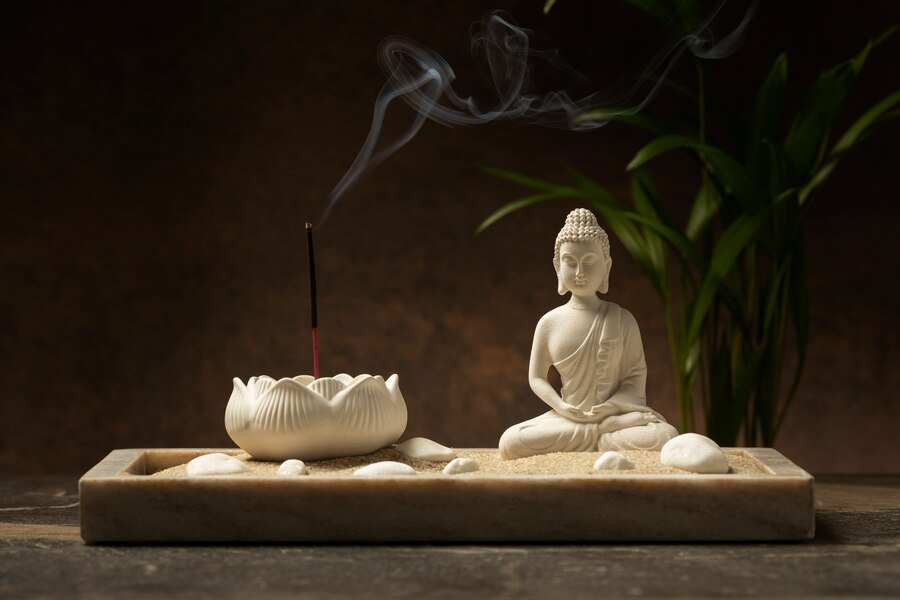
Dating back to the 14th century, priests of the Zen Buddhist faith began creating their own gardens for meditating and to be surrounded by beauty. These were the first Zen, or Japanese rock gardens, and were the precursors of the Zen gardens of today. These early gardens did not have water features, as you might find today. Instead, the priests created the feel of water with rocks and raking, which gave the ground a visual effect similar to the rippling of waves.
Today, Zen gardens come in a variety of forms, and those who create them are free to add their favoured elements and enchantments including bridges, ponds, lights, and even ornamental pieces. However, those Zen gardeners are much more personal than ever before, they are still rich in traditional Asian elements.
At first glance, you might believe that a Zen garden is simple, yet, in reality, they are far from it. Instead, they are quite complex and have a lot of depth. This course will teach you all you need to know about creating a Zen garden, as well as what the concept of Zen really means. This first module will focus on the history of the Zen garden, what makes a garden Zen, and how Zen gardens create order and harmony.
1.2 The History and Evolution of Zen Gardening
.jpg)
The first rock gardens that we can historically prove are those that existed in the Heian period of Japanese history (794-1185); however, it is likely that there were rock gardens before this.
We know of these gardens thanks to a manual called Sakuteiki, or the Records of Garden Keeping, which was written by author Tachibana no Toshitsuna, near the end of the 11th century.These first Zen gardens were based on the Chinese gardens created during the Song Dynasty, where the Chinese symbolically used rocks to create stylised versions of Mount Penglai. This is a legendary home of the Eight Immortals, which is a part of Chinese mythology.
In Japan, this mountain is called Horai. The Sakuteiki accurately described how rocks should be placed in these gardens, and the manual urged practitioners to do this on a dry landscape without any water features. This is called a kare-sansui. The first Zen gardens featured rocks, of course, and these rocks were placed in formations that resembled mountains, or they were placed in a way to create a miniature landscape. These included plants.
In the Sakuteiki, other styles also were described, including those that included plans to recreate ponds, streams, rivers, mountains, and marshes. One popular style at the time was the 'ocean style,' which utilised rocks that looked as if they have been eroded away by the waves and were surrounded by white sand, similar to a beach. This is important as we see how the concept of the Japanese Zen garden is intertwined in other types of Japanese culture, including religion.
For instance
In the Shinto religion, sand is seen as symbolic purity, so you often see white sand around temples, shrines, and palaces. In Zen gardens, the sand often symbolises water, which is also a reference to purity. Additionally, the sand represents distance or emptiness, which is how Japanese paintings represent the same: blank, white space.
The Flourish of Japanese Culture and Zen Gardens
By the Muromachi period (1336-1573), Zen gardens were quite popular. Like their European counterparts who were going through the Renaissance, Japanese culture was flourishing. Not only was the Zen garden becoming quite popular, so were other cultural advances, including the start of Noh theatre. Japanese architecture was also changing, and the shoin style came into play. This was a time of greatness in Japanese history, and Zen gardens were very popular among cultural leaders including war lords and the samurai. They appreciated this style of garden due to the self- discipline that it takes, something you will learn more about as you work through this course.
By the 14th and 15th century, rock gardens were beginning to appear around Zen temples in Kyoto, and these were expertly designed to promote meditation. Some of these gardens became quite well-known, which helped to spread the idea of Zen gardens.
For instance
Saihō -ji, which is also known as Koke-dera, was known as the 'Temple of the Perfumes of the West,' and was created by Musō Kokushi. Kokushi was a Zen master and Buddhist monk who transformed the temple from a Buddhist temple to a Zen monastery, and during that process, added the famed garden, still one of the most famous in Japan. Musō Kokushi is also known for creating the garden at Tenryū -ji, known as the 'Temple of the Celestial Dragon.' This particular garden was revolutionary because though it took inβluence from the Chinese Song Dynasty gardens, this garden featured a pond with real water. Tenryū -ji, as well as Saihō -ji, were seen as a transition from the Heian style of garden to the modern Zen garden.
Zen Gardens Go Through Major Changes
Muso Kokushi was not done yet. As you can plainly see, he was instrumental to the evolution of Zen gardens, and possibly the most well-known of anyone who has made Zen gardens. He also designed Ginkaku-ji, or the 'Silver Pavilion.' This garden was influential not only because it, too, featured real water, but because it featured 'ginshanada.'
What is ginshanada? It is an area of the garden that is created with raked white gravel. This gravel is shaped into a mountain shape, directly in the centre, which is meant to represent Mount Fuji. This feature, eventually known as 'kogetsudai,' appeared in Zen gardens for centuries after. Perhaps the most famous Zen garden is Ryō an-ji, and when it was built in the late 15th century, it was the first time that a Zen garden was truly abstract. Ryō an-ji is rectangle in shape and has an area of 240 square metres.
Within the garden, there are 15 different stones of different sizes, and they are placed in four different groups. Surrounding each group is white gravel, which is raked daily by the monks who care for the garden. There is no vegetation in the garden short of naturally growing moss around the stones. Yes, you can look upon this garden, but the garden was created to give the best view from the veranda of the monastery's abbot.
It is possible to write volumes of books on the history and evolution of Zen gardens. This is only a brief glimpse of the history of Zen gardens, but it will give you a good overview of how these gardens developed into what we see today. As you work through this course, keep this history in mind and reflect back as it will be referred to many times.
Fact
In a Japanese rock garden, large rocks often symbolise mountains, but might also represent a boat, carp, or turtle. When arranged in a group, they might symbolise a crane in βlight or a waterfall.
Source: Wikipedia.com
1.3 What is Zen?
.jpg)
You likely have an idea, at least on a basic level, of what a Zen garden is, but what is Zen?
Trying to define Zen is like trying to describe the taste of a certain food, such as sugar. You can describe the texture of sugar when placed on your tongue, you can try to compare it to other tastes, but until a person tastes sugar, they only have the illusion of what sugar is. Now, let's try to do the same with Zen. In order to truly understand what Zen is, it is a practice that must be experienced; it is not something that you can understand without knowing Zen intimately.
Japanese culture, including this type of gardening, embraces the concept of Zen, which is a type of Mahayana Buddhism. Zen is a practice that is passed from the master to the student and dates back approximately 2,500 years ago. A man named Siddhartha Guatama, or Shakyamuni Gotama as he is called in Japan, went through a spiritual awakening. His story is the premise of Zen, so it is important to hear it.
Fact
According to the latest census, there are 151,816 Buddhists in Britain. This, however, does not account for those who consider themselves Buddhists as well as Jewish, Christian, or any other religion.
Source: BBC.co.uk.
Siddhartha Guatama
Siddhartha Guatama was a real man, born in India, and began his search for enlightenment at the age of 29. Eventually, Guatama chose to leave his wealth, family, and power, and settled in a town near Gaya, where he and five followers began meditating 10 hours a day and sleeping and eating very little. However, he did not find enlightenment, referred to as satori, in Japanese.
By the time Siddhartha Guatama was 35, he found himself sitting at the base of a tree, still not enlightened. So, he decided that he would meditate until he found it, and 49 days later, he did. At the moment he found enlightenment, he became known as Buddha, 'The Awakened One.' From then on, it is said that Buddha had an intuitive understanding of all existence, and he not only understood the cause for all of our earthly suffering, but also how our suffering could be eradicated.
These observations became known to his followers as the Four Noble Truths.
These truths are:
To Live Means to Suffer - We, as humans, are not perfect, and we live in an imperfect world. We must go through suffering in order to appreciate joy and pleasure.
The Origin of Suffering is Attachment - The root of all suffering is attachment, thus, in order to stop suffering, one must break the attachments. These are our desires to 'have,' our cravings, and to 'not to have,' our aversions. To deny pleasure is to deny life, but giving into desire leads to lust, which causes a vicious cycle.
The Cessation of Suffering is Attainable - To stop suffering, we much stop our attachments. Though this is difβicult, it can be achieved with dedication and practice. When we learn to do this, we experience 'Nirvana,' or 'Satori,' in Japanese.
The Path to the Cessation of Suffering - Buddha taught that the path to nirvana, or satori, is attained by living a life of balance. To live a life of balance, one must follow the Noble Eightfold Path.
1.4 The Noble Eightfold Path
You might be wondering why we are getting deep into these Buddhist concepts, but the Four Noble Truths and the Noble Eightfold Path are at the centre of Zen, and the only way to achieve the state of Nirvana, or Satori. How does this relate to a Zen garden? We will get to that. First, you must understand the Noble Eightfold Path. This path was taught by Buddha to help a person attain the state of Nirvana by letting go of delusions and attachments, and helping the individual understand the truth of everything. The path is designed to help a person ethically and mentally grow and develop.
Here is the path:
The Right View - The right view means that you must see things as they are without illusion or pretence. Buddha taught that when we understand this, we can attain salvation.
The Right Thought - Buddha also taught that we are the person we are because of our thoughts. In other words, what we think, we do, so having the right thoughts lead us to the right actions. The Buddha's teachings help us to do this.
The Right Speech - To βind enlightenment, it is also important to speak the truth and to avoid gossip, slander, and abusive language. Words that offend or distress others should be avoided, as should mindless chatter, as it does not lend to growth.
The Right Action - Buddha taught his followers to behave harmoniously and peacefully. Followers of Buddhism should strive to remain in harmony with fellow humans, and stealing, killing, sexual misconduct, and overindulgence in anything should be avoided.
The Right Livelihood - Buddha also taught his followers to make a living honestly and righteously without resorting to anything nefarious or illegal. You should not exploit others nor animals. His followers were also advised to stay away from drugs, alcohol, and weapons.
The Right Effort - Buddha believes that our human nature causes us to automatically harbour bad thoughts. So, we must make an effort to train our minds to stop doing that. When we do this, we will become better people.
The Right Mindfulness - The right mindfulness, along with the eighth part of the path, The Right Concentration, come together to form the idea of Buddhist meditation. Buddha suggested that through meditation his followers could mentally focus on their capabilities, emotions, and mental faculties instead of becoming distracted by desires. The Right Mindfulness refers to the mind's ability to see things just as they are without losing sight thanks to anger, greed, or ignorance.
The Right Concentration - The βinal principle is essential to proper meditation, which is called Zazen. This is how to reach Zen. Without practising proper meditation, a person cannot move on to well-being.
1.5 Zazen

As you can see, following the Noble Eightfold Path leads to Zazen, or Zen meditation. This is the core of Zen Buddhism, and without mediation, there is no Zen. Those who practice Zazen do so while sitting on a meditation cushion, and they focus on living in the here and now. It is believed that it was through Zazen that Siddhartha Guatama found enlightenment and became the Buddha.
Zazen, or spiritual awakening, affects all aspects of daily life including sleeping, eating, talking, breathing, walking, thinking, etc. It is important that you do not think of Zen Buddhism as an idea, theory, or type of knowledge. It is also not a religion, belief, or dogma. Instead, see Zen Buddhism as an experience.
We are unable to fully and intellectually grasp Zen because our wisdom and intelligence is limited. Unlike religion, Zen is not about morals. There are no rituals nor theories. It does not have dogma, and it does not require that followers believe in anything or anyone. Why? Because a true spiritual path does not force people to believe in any particular ideals. Instead, a true spiritual path teaches people how to think, or what not to think.
Zen Buddhism is entirely focused on the mindful practice of Zazen. It is that simple. In fact, Zen is so simple that we have great difβiculty grasping it. In silence, when you quietly sit still and allow your thoughts to fall away, focus instead on breathing and posture. Become one with the universe. This is Zen.
Activity 1
Estimated time: 10 to 15 minutes
Understanding Zen, or Zazen, is important in correctly cultivating and creating a Zen garden. So, it is time to meditate.
Find a silent area, a soft cushion, and place it on the floor. Sit upon the cushion, keep your eyes open, face a wall to avoid distraction, and start breathing deeply. Free your mind from thoughts and focus entirely on keeping your posture and breathing deeply and calmly.
If you cannot sit due to a physical ailment, or similar, you can also sit in a chair.
Allow the thoughts to come in, and do not try to escape them. If you notice your mind wandering, bring your thoughts back to breathing.
Try to do this for 10 to 15 minutes.
1.6 What Makes a Garden Zen?
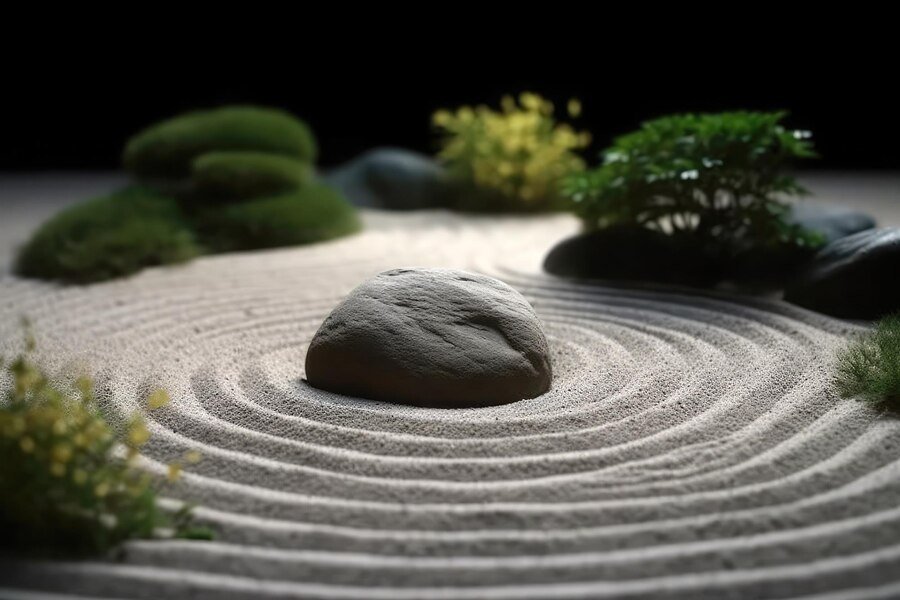
So, at this point in the module, you have a full, yet brief, history of Zen gardens as well as an overview of the concept of Zen Buddhism and Zazen. Now, of course, it is time to bring them together. A Japanese Zen garden is a garden that is created from the meditative thoughts of a gardener. In turn, it should promote meditation for the viewer. When you create a Zen garden it creates an opportunity for meditation, which, as you know from the previous section, is the basis of Zen Buddhism. We will get into this concept more as we move throughout this course, but when you create a garden, even though it is simple to construct, you must maintain it each day. This opens up the opportunity for daily meditation as you do this. When you view a Zen garden that is well- constructed, you should be drawn into a state of great contemplation.
As you learn more about the symbolism associated with a Zen garden, this will become easier. The greatest Zen gardens in the world are known for their elusive meanings, which helps viewers to clear their minds and eventually the brain becomes empty. As you now know, this is the goal of Zen meditation.
Activity 2
Estimated time: 30 Minutes, plus travel time
There are several public Japanese gardens located throughout the UK. Take some time to look up which garden is closest to your home. If there is one close to your location, plan a visit to the garden.
During the visit, observe the elements you encounter and try to empty your mind. Soon, you will create your own Zen garden, so looking at local gardens can be a great inspiration.
If you have no access to a Zen garden near your home, use the internet to find information on some of the most famous Zen gardens in Japan, such as Ryoan-ji and Jisso-in.
1.7 Creating Order and Harmony in a Japanese Zen Garden

You likely remember the concepts of order and harmony from the Noble Eightfold Path, and these concepts are produced by those who create a Japanese garden. The design principles and simplicity of those designs help to make the Zen garden a unique and peaceful place. Unlike a European garden, which is often filled with bold colours, symmetry, layers, and textures, the Zen garden is very different. Remember, the point is to create a meditative, calm, and quiet space, so having too many colours, plants, elements, or layers can confuse or overwhelm the mind.
Using the Natural Landscape to Create Harmony
We will soon get into the design of a Japanese Zen garden, but first you should understand how those who create Japanese gardens use the natural landscape. These gardens are always harmonious with nature, which is referred to as 'Shizen.' This means that there is no fabrication, invention, or pretence when creating a Japanese garden. In other words, you should not attempt to add to or alter the natural landscape.
Though small changes are obviously necessary, these should be minimal. Those who create Japanese gardens should never try to force an idea or design into their garden. Instead, you work with what nature brings to you. In fact, those who are Japanese garden purists never add plants nor other features.
Kanso and Simplicity
Another principle that you will come in contact with as you learn about Zen gardens is 'Kanso,' which means 'simplicity.' The concept of Kanso brings a sense of order to a Japanese Zen garden through a lack of chaos and clutter. The order that Kanso brings in a garden promotes a sense of calm to the garden, as well as peace and silence. This, of course, also promotes harmony. This is why you usually only see a couple of man-made features in a garden; too many can cause clutter and confusion. You will notice a lot of empty space in a Japanese garden, which gives viewers the ideal environment for thought and reflection.
Depth, Tranquillity, and Contrast
If you continue along with the idea that a Zen garden is a garden that is 'one with nature,' you will generally never βind great symmetry or an even number of items. Instead, things might appear 'thrown together' at βirst, but remember, these gardens are based on the patterns of nature. The design of a Zen garden follows the natural order of the Earth, which practitioners believe creates energy and movement in the garden.
This brings even more harmony. You might be wondering how depth is created in a Zen garden since it is so simple, but it is achieved through colours, textures, and composition. To create tranquillity and contrast, there is not a central focal point like you might find in other
gardens. Instead, this is created with several simple objects and the relationship between them. Order and harmony is further created in a Zen garden by creating a metaphorical impression of the world. Every part of the Zen garden is symbolic, which you will learn as you work through this course.
For instance
A large, single boulder might represent a majestic mountain and the white, raked gravel or sand might represent the ocean or a river.
Most Zen gardens are silent and water is represented through the garden's elements. However, there certainly are Zen gardens that utilise water features, especially if the water is naturally occurring in the chosen area for the garden. Remember, the goal of creating a Zen garden is to use the natural landscape.
Activity 3
Estimated time: 10 to 15 minutes
Using the existing landscape is very important when creating a Zen garden, but to fully understand this, it is important that you take a close look at nature. So, set aside some time and take a walk. It is best to find a forest trail or other area where you will be around the flowers, trees, grasses, and shrubs.
Look closely at what you see, and you will likely find that nature is wildly inconsistent and random, devoid of a lot of order. This is what you want to reflect in your Zen garden. Take photos and take notes, as we will refer to these later in the course.
1.8 Famous Japanese Zen Gardens

Before closing this first module, you are likely itching to learn more about what Japanese Zen gardens look like. The best way to do this is to look closely at some of the most famous Japanese Zen gardens in the world. Keep these gardens in mind, as you might want to refer back to them as we continue to work through this course.
Kongobu-ji - Koyasan, Japan
Kongobu-ji is located at Mt. Koya, and is called the Temple of the Diamond Mountain. This temple is the home to the largest Zen garden in the whole of Japan, which covers almost 2,400 square metres. The arrangement of the garden was created in 1984, and there are 140 stones contained within. Each stone symbolises two dragons coming down from the clouds to protect the garden.
Kennin-ji - Kyoto, Japan
Kennin-ji was created in the 13th century, and it is one of the oldest Zen temples and gardens in Kyoto, Japan. The garden is in the shape of a square, and it incorporates three large boulders. The garden is covered in moss, and the garden is surrounded with maple trees. As the seasons turn and the summer becomes autumn, these trees bring a new energy and look, which makes it feel alive. The garden at Kennin-ji is unusual because it is filled with lush, green plants, not gravel or sand.
Anyo-in Taisan-ji - Kobe, Japan
The garden at Taisan-ji is known for having a large number of large boulders and rocks. Some interpret these rocks to symbolise a grand mountain range, while others believe they are symbolic of a riverbed. Both easily promote meditation, which as you know is the main point of a Zen garden.
Jisso-in, Kyoto, Japan
Another unique Zen garden is the Jisso-in, which is located in Kyoto. Why is this garden unusual? It's because of the modern features that it contains.
For instance
Instead of featuring gravel in the garden, there are several large stones in the shape of the moon. However, these stones are partially submerged underground, which gives the illusion of rolling ocean waves.
MODULE SUMMARY
You have come to the end of the First module in this Zen gardening course. Now that you have an understanding of the concept of Zen and what Zen means, you should remember this information as we move forward through the course. We gave you a full overview of the history of Zen gardens, and a basic overview of what Zen means. We also explained some of the basics of the teachings of Buddha and explained how these teachings and ideals are translated within Zen gardens.
Finally, we shared some of the most famous Zen gardens in Japan for your reference as we move forward. In the next module, we will help you to start to create Zen garden of your own and will introduce all of the important elements of these gardens.
.svg)



