
How does mental health affect relationships?
We explained in lesson 2 that relationship difficulties can cause mental health problems.
This also applies if someone you are close to has mental ill health. It can be very difficult to watch them struggle. The mental wellbeing of everyone involved is likely to suffer as a result.

It is believed that 8 out of 10 people with mental ill health feel that their condition has a detrimental effect on their family.
Stress can be damaging to relationships.
It can make people feel low. They may isolate themselves or hide their feelings. It can make people argue with their partner which has an impact on their mood and temper. This could then affect the partner’s mental health and wellbeing. Having strong, healthy relationships can help people if they feel low or depressed, however, being in a troubled relationship can actually trigger mental health problems.

Depression can make it difficult for a person to communicate. This can be upsetting for the people who care about them.
People who suffer with depression may also start to feel guilty that they are making life difficult for the people around them. This can lead to deeper depression.
People who live with a person experiencing a mental illness may feel extra pressure to make things better. They may try taking on more responsibility than they are used to, while at the same time giving their loved one the support they need. Doing too much can lead to people feeling exhausted and burned out. Loved ones may not understand what the illness is or how the individual feels. Not being able to fix the situation and put things right can cause stress.
Anxiety can affect relationships.
It can make people feel tense. This may make it hard for someone to relax with their partner, friends or family.

People may worry constantly that the relationship will end. They may need endless reassurance that their partner is not going to leave them.
If someone you love or care for is living with anxiety, it can be difficult to watch them battle with these issues. Some people may even start to worry that they are the cause of anxiety which puts more pressure on the relationship.

Conditions such as bipolar disorder, schizophrenia, PTSD and eating disorders can all affect relationships due to changes in mood and behaviour.
It is important that everyone in the partnership or family is supported when someone is suffering from mental illness.
How does mental health affect people’s ability to work?
Mental health issues, such as anxiety, can cause someone to lose concentration.
This can make it difficult for them to carry out their normal day-to-day work activities. Someone with anxiety or depression may experience paranoia, meaning they might begin to doubt themselves and their work. A person with mental ill health may struggle to interact with others at work and could begin to isolate themselves. This can cause challenges with teamwork and communication.

People with a long-term mental health condition lose their jobs every year at around double the rate of those without a mental health condition. This equates to 300,000 people. This is the equivalent of the population of Newcastle or Belfast!
Work-related stress can aggravate an existing mental health problem, making it worse.
The stigma surrounding mental illness, and lack of understanding from colleagues, can cause people to become more withdrawn and isolated. Sometimes the symptoms associated with mental ill health can be so severe that people are unable to go to work. For example, in cases of severe depression, people may not be able to carry out the basic activities of daily living such as getting up and getting ready for work.

What are the social and economic affects of mental ill health?
The effect of mental ill health on people’s ability to work can lead to stress, unemployment and financial hardship.
The impact can result in a poorer quality of life and sometimes even poverty. Relationships can become difficult, they can even break down, then social isolation can occur. People can lose their their family life, their friendships and jobs. This reduces their support network causing more stress. Have a look at the diagram below….
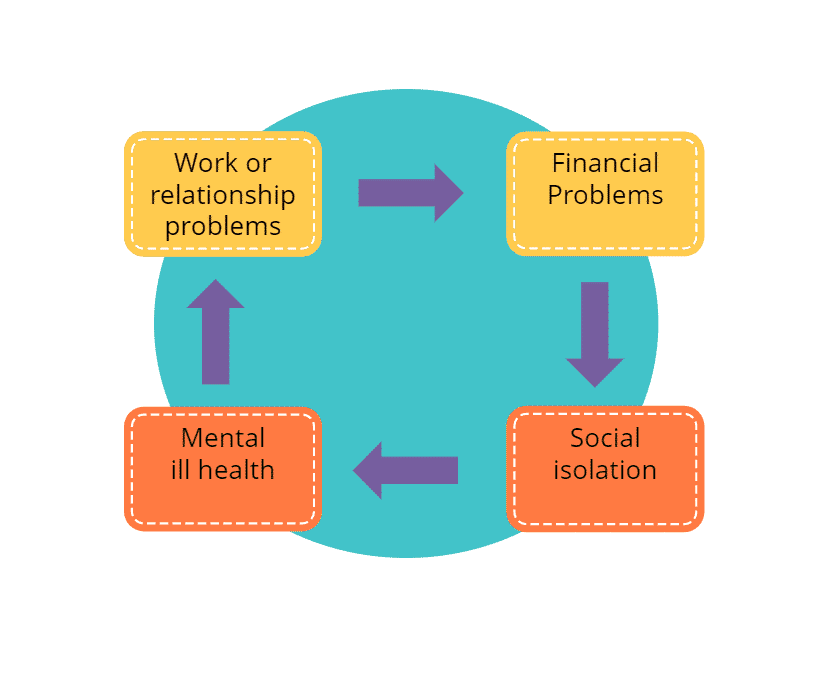
Thinking back to some of the causes of mental health problems, these are sometimes the same as the effects.
Many people live their lives in this cycle. The longer it lasts, the worse the mental health problems can get and it is harder to stop and reverse it.
Continued
How can mental health affect physical health?
Research shows that people with a mental health problem are more likely to have a preventable physical health condition, for example, heart disease.
See below some of the reasons why…
Mental health problems can also come with physical symptoms, for example:
- Depression can come with headaches, fatigue and digestive problems.
- Anxiety can create an upset stomach.
Medication used to treat mental health conditions can affect people’s physical health, for example, through weight gain.
Flip the cards below to see some of the reasons people with physical illnesses can suffer from mental ill health…
.svg)



