
2.1 Introduction
As explored in Module 1, digital marketing is an ever-expanding marketing technique. The realm of digital marketing encompasses many different platforms. This module will look at how search engine optimization and marketing can be used as effective platforms for digital marketing. But in order to do this, it is important to first provide a working knowledge of search engines, more generally, as well as how they work. This will be followed by defining search engine optimization and its pros and cons, before doing the same for search engine marketing. The module will conclude with an overview of the pay-per-click marketing strategy.
 2.2 What is a search engine?
In today's age of technology, the use of a search engine is most likely something that is second nature to many. The term “Google it" has increased dramatically in recent years, as the solution to finding any unknown or forgotten piece of trivia or information. But what, exactly, is a search engine?
 A Search Engine is nothing more than a database for information found on the internet. It's a collection of websites, documents, images, and videos that are available for public viewing, kind of like a library, but online. These databases can be accessed from almost anywhere in the world.
Public search engines were first introduced in the early 1990s. Since their inception, there have been a number of them introduced, although the majority of which are no longer active. Google is the most widely used and recognized search engine, with other active search engines on the web, including Ask.com, Baidu, Bing, Lycos, and Yahoo! However, the first search engines were actually created in the early 1980s and cataloged by hand.
Search engines function by using a series of keywords - as indicated by a user - to search for articles, websites, or other media that are related to these words. This process of retrieving content online is done by web crawling and indexing the search terms submitted.
Web crawling works by sending out signals to capture any and all search results with the keywords identified. It is called web crawling because these programmatic actions used to capture such results are referred to as spiders. When a search is underway, the search engine, or database, crawls the web searching for relevant results. The process of indexing places the results in order of relevance as quickly as possible.
There are a number of different kinds of searches, aside from the simple generic type.
These include:
-Academic
-Image
-Industry-specific
-Local
-News
-Video
Aside from just the regular search processes, there are other factors that can sometimes be at play. These factors use past information about either the user or the search terms to produce the list of results. This is sometimes referred to as search engine bias, because it tailors the results to either a user's previous history or a specific region's preferences. This results in the exclusion of some potential listings because of political, regional or other views.
Examples of search engine bias include focusing results on a particular geographical region. This means when the search terms are generically entered, such as “the news" there is a greater likelihood to receive results from one's own region, rather than the most relevant, in a general sense. In other words, using “the news" as the keywords for the search, will most likely receive results that are UK-based if the user is in London, than receiving news stories from the US, other parts of Europe, or the Middle East, for example.
However, if the terms were more specific, such as “the news Uganda", then the result would be targeted to βit that criteria. Another search phenomenon is the increased probability of turning up results aligning with previous search attempts, rather than providing all possible search results that are relevant to the keywords. For example, if the user is an environmentalist and they search “climate change" they are likely to receive results that relate to previous searches or beliefs, with less potential for a listing to be about the non-existence of this climatic manifestation.
The same is true if the user holds a particular political view, and is searching for a specific topic, but looking for an alternative view. It is likely that the user's listings will turn up search results that back the previously searched opinions. This can easily be tested by typing the same search words into a search engine on someone else's computer.
FACT
Google processes approximately 99,000 search queries every second. This translates to 8.5 billion searches per day and approximately 2 trillion global searches per year. The average person conducts between three and four searches each day.
Source: Google
2.3 What is Search Engine Optimization?
 Now that the basics of search engines have been reviewed, it is possible to look at how companies can use these databases as a means of gaining traffic that can lead to sales or other desired actions.
The first of three topics to be discussed in this module related to search engine digital marketing is search engine optimization (SEO).
SEO is a means of obtaining increased traffic, or viewership, of a website without the transfer of money. It works by adjusting and rewriting the content in an effort to achieve higher-ranking search listings and ultimately increase visibility. While there are similar methods, such as search engine marketing and pay-per-click (both of which will be discussed later in this module), it is important to stress that SEO draws attention to a particular site using unpaid, or organic, methods.
The term SEO was coined in 1997 by Danny Sullivan, an industry analyst. However, they were first put to use, like many other things in the digital marketing industry, in the mid-1990s. This was the result of website owners recognizing the value of having their sites more readily visible in these internet searches. By having their website fall within the top results, the search engine user perceived these sites to be more trustworthy or relevant to their inquiry. This led to a higher rate of visitors turning into customers. Implementing SEO can be handled by the company or individual running the website or by hired advertising specialists who deal specifically in this type of search engine tactic.
Activity 1
Estimated Time: 10 minutes
Testing the relevance of search engine results
As a means of understanding how a search engine works, it is important to be able to identify how keywords play into the relevance of the results listings.
Go to your preferred search engine. Type in a few search terms and scan the first page of results.
After each search, spend a few minutes scanning the results. Once you have completed this, spend a few minutes considering each of the questions below. (Bonus activity: try using someone else's computer or account to see how the result listings change.)
How many are paid listings versus organic ones? How can you tell?
Of those that were paid, how relevant were the listings to your search terms? Did you notice any discrepancies? How about for the unpaid listings?
If you opted to do the bonus activity, were there any significant differences? How does this change your opinion, one way or another, about how search engines function to provide results?
By completing this exercise, you will have a better knowledge of how search engines create result listings by using relevant keywords. It will also enable you to identify paid listings from organic ones, which should further your understanding of the differences between SEO and SEM strategies.
2.4 How does it work?

The purpose of SEO is to generate a positive user experience. This is done by the user indicating, within the search engine, their intention, or desired outcomes, in order for it to locate relevant results. This process is done through a series of algorithms, which are dictated by the search engine owners.
As noted in the previous section on search engines, these algorithms work by finding relevant websites and other media (such as video or images, for example) to the keywords used as the search terms. The algorithm then uses web crawlers and indexing to produce the listings in order of relevance to both the keywords used, as well as the user themselves.
Throughout these pursuits, search engines tend to look for a number of things, including website content, performance, consistency, and user experience in order to determine the results. However, at the same time, the web crawler is searching for relevant material, it is equally deterred from selecting websites that are heavy-laden in keywords, or that indicate a previous history of poor user experience.
To put this process more simply, SEO functions as a digital marketing strategy by selecting a search engine that is best suited for targeting the demographic the campaign is aiming to capture. This includes identifying what the targeted demographic might search for and what keywords are used within the search engine in order to locate their anticipated results. To optimize this, the owner of the website might consider editing its content or coding it to enable the site to be more easily accessed by the web crawler. In doing so, the website can increase its relevance to the most appropriate keywords while at the same time decreasing any potential barriers that may be found within the indexing process.
2.5 Why are SEOs beneficial as a marketing campaign ?
It should come as no surprise that the use of SEOs comes with a number of benefits to an organization.
Here are just a few of the positive aspects of SEO.
To start, it's extremely cost-effective because it's essentially free. Since an advertiser or company does not need to pay anyone to be included within the search results, there is no cost to be among the top results; but it takes a lot of time to make it happen. However, if the SEO plan is well thought out, and a niche market is identified, then this marketing strategy becomes even more effective overall. The increased exposure leads to increased traffic over time, as the more a result is selected, the higher its rank, meaning that it will naturally draw users to the site.
Because they are unpaid results, SEOs also tend to be more trustworthy - or at least they are perceived to be so. This is because users are inclined to trust organic results more than those that have been sponsored or paid for. As a result, users are more likely to click on the unpaid listing. This sense of trustworthiness also plays into a site's ability to convert users. When a potential customer is looking for a particular product or service, they are already interested in what the search listings will provide them. When an unpaid listing meets the user's search criteria, it becomes more attractive to them. Met with the perception of being trustworthy, there is a much higher likelihood of converting, or closing, the traffic that is generated through the SEO.But that's not all; it also helps to build the brand or company name. It is common knowledge that users who search for a particular item are looking to solve a problem or find an answer. SEOs provide exposure to these users who are hoping to find a solution, without the company needing to pay for placement or advertisement space.
2.6 What are the risks of using SEOs?
In contrast to the above-listed benefits, there are also a number of aspects surrounding SEOs that can be potentially problematic.
In order to avoid unsuccessful efforts, consider the following:

Time is without a doubt the single biggest challenge behind SEO strategies because they are time-heavy, even before they are put into action. Although it is a means of bringing in new business, it should not solely be relied upon to gain profit. This is because the algorithms used to produce the search engine results are ever-changing, meaning there is no guarantee that a particular website will end up in the top results for an extended period of time. This is equally true when looking at a much wider market, such as the global one. In this case, not only are the algorithms constantly changing in general, but they also tend to vary from market to market or region to region.
There is also a considerable lack of control when relying on SEOs. In order to make the top results, a number of factors need to be included. Some of the factors that play a role in achieving higher rankings include the company's past user history, the current competition (who they are and how great the competition is); plus there are a lot of unknowns, in general. Without having considered these in the strategy's development plan, it can significantly impact the potential for success.
The bottom line is that there is no guarantee that the SEO strategy will work.
The time and energy alone that are required to create an SEO plan are quite taxing - especially if it doesn't work. Plus, the time it takes for that intended traffic to increase makes measuring results extremely difficult, creating a lot of uncertainty throughout the entire process.
2.6 What is search engine marketing?

Building off of SEO, the next level of search engine strategy is search engine marketing (SEM).
SEM, simply put, is increasing website traffic by paying for search listings. It is a form of digital marketing that involves the promotion of a website in order to increase visibility, done predominantly through paid advertising. This is considered to be the primary form of profit gain for a search engine.
However, SEM is a bit confusing, as it has become more of an umbrella term, rather than a single entity in and of itself. Some place SEO into SEM, but this is not really the case, as SEO is different from SEM - although they can, and often do, complement each other.
Furthermore, SEM is often confused as meaning pay-per-click (which will be discussed later in this module), exclusively. But SEM is not just about search engine advertising, in any of its forms, but instead includes other aspects, such as branding, customer service, distribution, sales, etc.
Like SEO, SEM can be implemented through self-service or by using an advertising agency that is experienced with this type of digital marketing.
SEMs were first used in the mid-to-late 90s, just like many other internet-related innovations. By incorporating business models into search engine strategies, the use of such marketing tactics began to grow - especially in the 2000s. Danny Sullivan, who coined the term 'search engine optimization' was also the same person to do so for SEM. This took place in 2001 - four years after SEO was first popularized.
2.7 How it works
Using a business model, SEM works similarly to its counterpart, SEO.
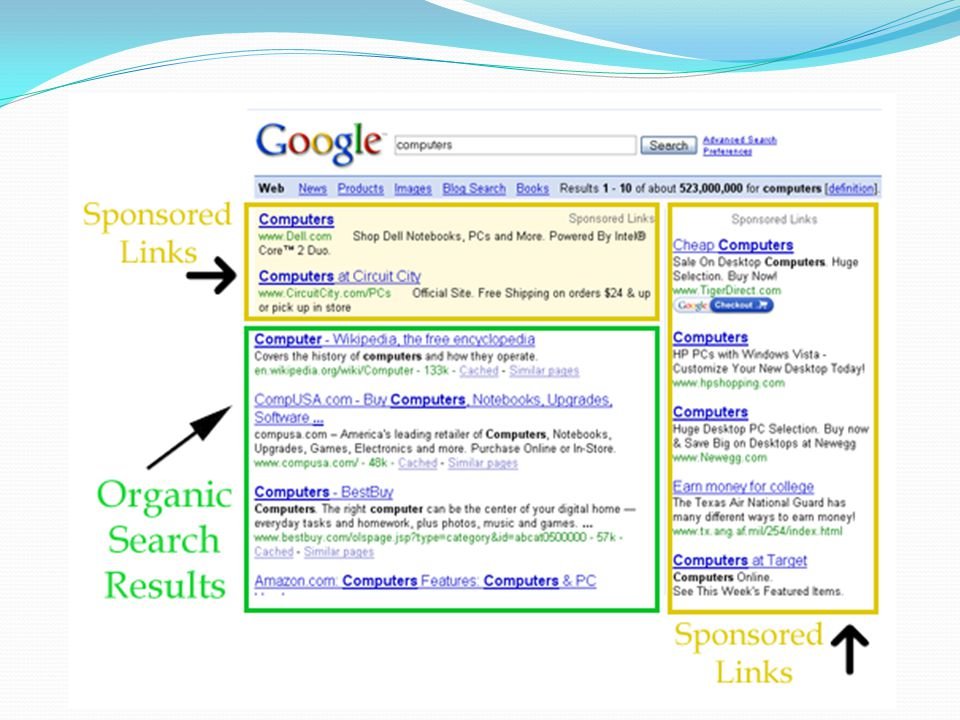
SEM initiatives involve paying a search engine for inclusion within its results pages, known as sponsored listings. Unlike SEO, which relies on optimizing website content to attract organic traffic, SEM operates on a pay-per-click model, where advertisers bid on keywords relevant to their campaigns. Keywords play a crucial role in SEM, as they determine when and where an ad appears in search results.
By identifying and purchasing permissions for relevant keywords, companies aim to match their ads with user search queries, potentially converting them into customers. This targeted approach enhances visibility and increases the likelihood of attracting interested users, making SEM a valuable strategy for businesses looking to drive traffic and generate leads.This is known as search intent.
Search intent alludes to the likelihood of a potential customer following through with the desired action of the search terms. In other words, when a user types in a specific set of keywords into the search bar, they are aiming to find results related to the criteria set in the initial query. What the user is trying to identify is the search intent, which enables them to select one of the paid advertisements, leading to increased traffic to a particular website.
Additionally, there are such things as high commercial intent, which are keywords that aim to give a greater likelihood of action by the user. These include catchy wording like 'buy', 'discount', or 'free shipping'. These high commercial intents are meant to entice the customer further into following through with the action because they perceive a deal is being given to them. These words can also help to convert potential customers that are on the fence about making a decision one way or another.
Relevant keywords

The process of identifying relevant keywords for a potential SEM campaign is also a good method for identifying negative keywords. Negative keywords are those that should not be included in an SEM campaign. This does not mean these keywords are always negative in the sense that they are bad, but have more to do with not being relevant to the target group or search that the company is trying to capture.
Ad auction

But it's not as simple as having a business identifying which keywords will suit them best. In order to obtain a keyword for an SEM campaign, the organization must first go through what is referred to as an ad auction. This is the process by which the company gains the right to use a specific search term.
The ad auction process works by having an advertiser or business indicate which search terms they want to use and how much they are willing to pay to use them. How much a company is willing to pay is usually done so on a per-click basis. From there, they are placed into the auction if deemed they are within a user's search terms.
It is important to note that the highest bidder is not always the one to be awarded the search term, although money does play a role. Additionally, not all advertisements will appear when those specific search terms are used. Determining when certain ads are used is based on maximum bid and a quality score. A maximum bid is the amount the company has indicated as the per-click rate.
The quality score, on the other hand, is the overall quality of the advertisement in question. The higher the quality score, the better the ad ranks. Quality is based on the website's ease of use, as well as functionality, such as how well it loads. If the ad auction is successful, the company's advertisement will appear within the search results, and it is then in the hands of the user to select that particular listing or not.
2.8 The benefits of using SEM
The use of SEM in digital marketing strategies is of significant benefit to an organization when employed properly.
The following are only a few of the perceived benefits of SEM.
Of all the positive outcomes of using SEM, its ability to control many aspects is by far one of the greatest benefits. The first way that control is maintained is through targeting the recipient audience. SEM allows an advertiser or business to control who is viewing the ads and where they might be located, making this a financially effective way of marketing. But it also brings about quite a bit of traffic almost immediately, if planned correctly. This is because the targeting of the ad placement should reflect the desired demographic to be captured within the campaign. If done successfully, this will lead to increased traffic both initially and over time.
Cost control

Another means of control that is considered to be a benefit of using SEM is cost control. Because the business is in direct control over how the SEM is allocated, it can easily be managed. This can be maintained by setting budgets related to paid advertisements in order to determine exactly how much should be spent per day, while capitalizing on specific websites, times, and demographics.
Managing keywords can also be done quite easily, which will determine how few or many hits a website will receive throughout the campaign. As a direct result of this management, and the fact that paid listings provide ample data about the users, this can provide a direct link between the amount of money spent on the campaign and its return on investment.
Through the increased traffic provided by these paid listings, SEM can actually help to improve any SEOs that a company or advertiser may have as well. This is because paid advertisements generate increased traffic to the specified website. Since keywords are a critical aspect of both paid and unpaid listings, the SEM results will eventually boost the results of the SEO over time.
The final benefit to be outlined is that effective SEM strategies can lead to increased name or brand recognition. Even if a user opts not to click on the sponsored link, the name generally tends to stick in their mind. When an SEM is viewed repeatedly by the same user, the brand or company name will become familiar, leading to the perception of trustworthiness in the future.
2.9 What to watch out for when using SEM
Like most things that come with numerous advantages, SEM also holds a number of risks. Some of these challenges include the following considerations:

Ensuring that an SEM strategy is well executed involves a lot of steps. The complexity involved in managing these campaigns requires a lot of time and experience to ensure they are rolled out successfully. To make this happen, there are a number of factors that need to be considered, such as selecting the right search engine, keywords, demographic, etc. Without these considerations during the planning stages, the SEM strategy is likely to fail before it has even been launched.
Next, the amount of competition one needs to break through is almost exhaustive, with no chance of it slowing down anytime soon. Aside from the increased pressure to be at the top of the list, with higher competition, comes higher costs. This is because when the competition expands, the budgets also need to increase in order to keep up with and secure the most effective placements. And with no end in sight, this is likely to continue to be an ever-advancing challenge.
Finally, the use of ad blockers is on the rise, producing an added challenge to SEM managers. Ad blockers work to prevent pop-up ads and other types of unwanted advertisements from appearing on a user's browser. But, as they become more popular, it makes SEM initiatives more ineffective, leading to a higher cost for little return to the business or advertiser.
2.10 What is Pay-Per-Click Marketing?
Even within the strategy itself, there are various ways to implement an SEM initiative. One of these processes is called pay-per-click (PPC) marketing.
PPC is the process of bidding on keywords used in searches. It is also known as paid search marketing. It relies on search engine advertising as a means of generating increased clicks to a website, instead of using more organic methods, such as SEO.
The difference between PPC and the other varieties of digital marketing discussed in this module is that with the latter, a user may end up at any part of a company's website, without its control, whereas PPC is directed to a specific section of a website, leading customers to a specific article, product, etc. In other words, PPC is not exclusive to search engines as such, although it does serve as a function of SEM. PPC can also be found within a website as a means of transferring a user to a landing page on another website.
There are several PPC platforms available.
These include Google Ads, which is keyword-driven and places PPC ads within Google search results and any of its partnering networks; Bing Ads, which place advertisements on its search engine and also use keyword matching; Yahoo! Search also functions in this same way; and LinkedIn and Facebook, which are both demographic-driven, using personal information and interests, as opposed to solely relying on keywords.
Activity 2
Estimated Time: 20 minutes
Assessing the relevance of pay-per-click advertisements
In order to understand how pay-per-click advertisements work, it is important to be able to identify them, as well as comprehend how they are used to draw traffic. Building on from the previous activity, you will now need to type in a product or service into the search engine. Take notice of the sponsored ads that come up. Click on a few of them and make note of what you see. Now, try to find similar advertisements within other websites. Note: these websites can be randomly selected, or something more specific, such as Facebook.
Upon completion of the task, answer the questions below after giving each one some thought:
How did the pay-per-click ads relate to your search terms? Were they for the exact product or service, or something similar?
How did they appear? Did it change depending on the platform that the ad was found? (Meaning were they different when using a search engine, compared to one found on a website?)
When you arrived at the landing site of the advertisement, how did it compare to your search result? Was it what you were expecting? Did any of them take you to sites that seemed irrelevant?
This exercise provides an opportunity to critically look at how SEM and PPC strategies are employed. By taking the time to really view and consider the outcomes of these advertisements, you should have a better understanding of how these marketing strategies work, and how they can benefit a paying organization.
2.11 How does it work?
Like SEO and SEM, PPC works through keyword matching (which will be described in further detail in the next section).
They work best for a variety of campaigns, including:
-Business-to-business awareness
-Direct-response business
-Issue-based efforts
-Niche terms
-Product listings
-Remarketing
But the process of being awarded the space is achieved through two different methods: flat rate and bid rate.
Flat rate PPCs are fairly straightforward. They occur when there is a fixed, or predetermined amount set for each click that a website receives when the advertisement is selected.
Bid rate, on the other hand, is usually done through an advertising agency. This process occurs when a company provides the advertising agency with the information and the amount they are allowed to bid. From there, the advertising agency enters auctions for PPC placements. If the agency PPC is the process of bidding on keywords used in searches. It is also known as paid search marketing. It relies on search engine advertising as a means of generating increased clicks to a website, instead of using more organic methods, such as SEO.
The difference between PPC and the other varieties of digital marketing discussed in this module is that with the latter, a user may end up at any part of a company's website, without its control, whereas PPC is directed to a specific section of a website, leading customers to a specific article, product, etc. In other words, PPC is not exclusive to search engines as such, although it does serve as a function of SEM. PPC can also be found within a website as a means of transferring a user to a landing page on another website.
There are several PPC platforms available. These include Google Ads, which is keyword-driven and places PPC ads within Google search results and any of its partnering networks; Bing Ads, which place advertisements on its search engine and also use keyword matching; Yahoo! Search also functions in this same way; and LinkedIn and Facebook, which are both demographic-driven, using personal information and interests, as opposed to solely relying on keywords.
2.12 Keyword Matching

The use of keyword matching is the main function behind a successful PPC campaign.
This is because search engine results are derived from specific words as determined by the user. But it's not just as simple as matching one word to another - there is an actual process that takes place, and it is determined by one of several types of keyword matching. These include broad match, phrase match, exact match, and negative keywords, all of which will be discussed below.
Broad Match
A broad match is referred to as the default match. It uses words that are similar to those searched, rather than using the algorithms of a specific program, such as those determined by Google. While this may seem like a better option, the downside is that a lot of the control is lost within the search. This means that while the search result may be receiving a larger number of clicks, or visitors, they aren't necessarily quality views. A quality view or click would be from a user that a company targets to visit the site, rather than just anyone.
Phrase Matching
Phrase matching works by identifying a specific set of words to be searched, rather than opting for a list of results related to the keywords submitted by the user. This usually occurs when the user places quotations around the search terms. An example of this is searching “phrase matching," instead of just typing phrase matching into the search bar of the search engine.
Exact Match
Similar to phrase matching is exact match. This is when a user searches for something requiring an exact wording match. The difference between an exact match and a phrase match is that exact match tends to locate results that have used specific keywords, rather than a phrase or other series of words. To identify an exact match search, the keywords must be in square brackets. For example, searching [exact match] rather than exact match.
Negative Keywords
The final type of keyword matching to be discussed is the use of negative keywords. By using this type of search function, it prevents an ad from showing up next to an undesirable search result. By placing a “-" before the search term, it removes all results including that word from the list. So, to use the example from earlier in the module, when searching for “the news" but not wanting to find results for Canada, the keyword search would look like this: the news -Canada.
Using PPC to bring higher traffic volumes to a website comes with several benefits.
Several of these advantages will be considered below.
One of the greatest benefits of using PPC advertising comes down to the results. This is for two reasons - they tend to be instant and easily measurable. The results are instant because they target specific demographics, and therefore tend to lead to increased traffic. It is believed that PPC is the quickest method of gaining high-quality traffic to a website. The measurability of the results stems from something called web analytics (which will be covered in Module 8 of this course).
But, by receiving data from the users who click on the PPC advertisement, the company placing the ad can identify a variety of information, which is used to measure the success of a campaign. These measurements can be taken as they happen or over a duration of time, depending on what has been dictated by the campaign itself.
Another benefit to using PPC is that the company only has to pay when someone clicks on the advertisement.
This means there is no cost to the advertiser if no one opts to view the landing page that the ad directs the user to. This also makes this a relatively low-cost marketing option, even if the ad is on a fixed rate plan. By having final payment being based on the number of people who selected the advertisement from the originating site, it makes for an excellent way to experiment with this type of marketing without the burden of a high financial cost.
The final benefit to be discussed is that the advertiser has complete control over the marketing efforts. What this means is that they can target customers using a variety of criteria, such as location, time, keywords, date, etc. in order to gain increased traffic. In using these specified criteria, the customer base grows by attracting those already seeking a product or service on offer. And, since the ads are usually placed on similar sites, it increases the probability of a user to click on the PPC campaign advertisement.
2.14 The downside of using PPC
The previous section determined a number of ways in which PPC can be beneficial to a company's digital marketing strategy. However, there are also several aspects of PPC that can lead to negative outcomes. While not all of the potential negatives have been identified, the following are some of the most frequently occurring.
The first consequence of using PPC is that it can often lead to empty, or junk, traffic. As noted in a previous section, if the search criteria is not in alignment with the advertisement shown, the likelihood of a user selecting it is quite low. This is also the case for broader keyword matches. If the PPC is not executed properly and with careful consideration in the planning stages, it can lead to a higher volume of traffic, but from individuals who aren't likely to follow through with whatever the desired outcome or action of the advertiser may be.
Ego-based bidding
It was indicated within the list of benefits that PPC is fairly low cost. However, it can be quite expensive if not managed properly. One of the risks of PPC comes from something called ego-based bidding. This is when a company or advertiser places multiple bids, or engages in several contracts not because they will benefit the overall goal of the marketing campaign, but because they know they will be awarded the spot. If this happens to take place, it will only be costly if users click on the advertisements, as is the basis of pay-per-click.
However, if the marketing plan is weak, leading to this scenario, then it could lead to high levels of junk traffic. It is for this reason that it is best to avoid ego-based bidding at all costs. In relation to costs, PPC has another downside - it usually does not scale. This means that regardless of the number of visitors achieved through the PPC campaign, the rate per click will remain the same. In other words, if an advertiser receives 10 visits from a particular campaign, the rate per click will be the same as if it gains 10,000 visits. This is an important consideration to make prior to entering contracts - especially for higher traffic websites, where the click-rate is likely to be higher.
Module Summary
This module sought to explain how useful search engines can be to a digital marketing campaign, in terms of building increased traffic, as well as profitability. It began by first giving a basic overview of search engines and how they function. Next, it outlined search engine optimisation, or SEO. This included a discussion on how SEO works, as well as looking at some of the pros and cons of this strategy.
Following this, the module examined search engine marketing (SEM). Providing an understanding of the processes behind this strategy and the beneβits and consequences of SEM were then outlined. Finally, pay-per-click (PPC) marketing was introduced, as a means of furthering the discussion on SEM, by detailing one of its many functions.
The related sections within this module focused on a variety of aspects including how it works, keyword matching, and like the other two main topics, the positives and negatives of using PPC campaigns as a digital marketing strategy. Each of these sections should have provided a clear understanding of how they can fit into a successful marketing campaign, while noting several aspects to consider in order to reduce the potential for ill-fated attempts, or ending up with undesirable traffic.
.svg)



