
7.1 Introduction

Stress, burnout and anxiety are common problems in the 21st century. In this module, you will learn how CBT interventions can help clients adopt a more balanced lifestyle and overcome the psychological and physical damage caused by stress. CBT is also useful in the treatment of anxiety disorders, including PTSD, which is addressed in this module. Finally, you will also gain insight into how CBT can be used in the treatment of insomnia.
What is stress?
When someone is stressed, they feel as though they are under an excessive amount of pressure and mare having problems coping. A degree of stress is normal and even beneficial.
For example
Work pressure encourages employees to finish their projects on time or improve their performance in the hope of securing a higher salary or promotion. Everyone has their own level of stress tolerance. A situation that triggers a lot of stress in one individual may merely be exciting or motivating for another.
Unfortunately, pressure can quickly build up and cause significant problems. It can come from a range of sources, including family relationships, friendships, health problems, romantic relationships and problems at work. When multiple sources of stress (stressors) build on top of one another, the result can be a perceived inability to cope. Problems that would otherwise have been easily resolved
can be blown out of proportion.
Stress is not an illness, but it can contribute to both mental and physical conditions if left untreated. Fortunately, CBT offers clients several tools they can use to help manage the inevitable pressures of everyday life.
What is burnout?
Burnout occurs when someone has been under so much stress that they are no longer able to cope with the demands of everyday life. Burnout can be thought of as a state of complete mental, emotional and physical exhaustion. In colloquial terms, it is sometimes known as 'having a breakdown'. It can take weeks or months to recover from burnout. Those in high-pressure roles such as nurses, firefighters and senior managers are at elevated risk of burnout.
Difference between stress and burnout
Although the terms are used interchangeably, there are distinct differences between stress and burnout. Burnout occurs due to unchecked and prolonged but both conditions are characterised by different symptoms:
1. Stress is associated with over engagement while burnout results in disengagement
2. Stress triggers hyperactivity and urgency while burnout is associated with hopelessness and emptiness
3. Stress is often the reason behind anxiety disorders while burnout results in depression and detachment
4. Stress leads to low energy or loss of energy. Burnout, on the other hand, leads to loss of motivation and interest
7.2 The Symptoms of Stress and Burnout

There are several dimensions of stress.
Cognitive symptoms
Finding it hard to think clearly, worrying more than usual, negative thoughts, difficulty concentrating, racing thoughts, difficulty in making decisions, assuming that a negative outcome or event is just around the corner.
Psychological symptoms
A sense of being overwhelmed, irritable, anxious, afraid, a feeling of being 'on edge', and a lack of self-esteem.
Physical symptoms
Dizziness, sleep problems, eating too much or too little, headaches, muscle tension, muscle pain, and fatigue. As you learned earlier in the course, feelings of stress are accompanied by changes in body chemistry that give rise to physical symptoms, some of which may be disturbing to the client.
Behavioural symptoms
Drinking more, smoking more often, arguing with others, withdrawing from social situations, performing less well than usual at work or college.
7.3 A CBT Perspective on Stress
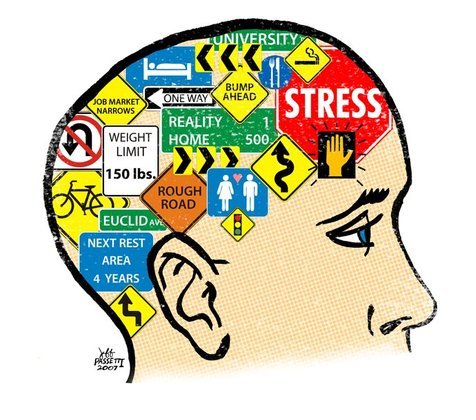
In the CBT paradigm, stress is conceptualised as a vicious cycle. The symptoms above interact with one another to perpetuate a client's feeling of stress. Someone who worries more than usual because they are under stress might start experiencing muscle tension and headaches as the stress takes its toll on their body. This might make them worry even more, because they now have a potential health problem to add to their list of concerns.
Their health concerns may make them feel irritable and on edge, which will have an adverse effect on their relationships. Arguing with a partner or family members will further compound their stress, which may cause more physical symptoms and so on. As they begin to disengage from social situations, they might turn to alcohol or binge eating to help them cope with their negative emotions. Of course, the feelings of guilt, shame, or being out of control will then worsen, increasing their overall stress levels.
7.4 CBT Interventions for Stress Alleviation
CBT practitioners believe that in order to break the cycle of stress,mit is necessary to understand how the various dimensions of stress interact with one another. They can then be addressed using a mixture of interventions.
For instance
Someone who binge eats because they feel stressed and in turn feels even worse afterwards needs to find another way of dealing with their negative emotions and to limit their use of thinking styles and interpretations that cause these emotions to arise in the first place. The initial part of CBT intervention involves a detailed assessment of the client's thoughts, actions and feelings in order to identify those that are maintaining the cycle. This is because CBT works on the premise that we have to modify our response to events rather than change the event itself.
For instance
You may have a client who is stressed with rush-hour traffic every day. He or she hates driving bumper to bumper and invariably ends up exhausted, angry and drained due to stress. CBT seeks to change his or her perception about the traffic as you cannot alter the physical event. In this case, the practitioner may suggest playing soothing music or listening to motivating audiotapes while being stuck in traffic.
CBT interventions for stress and anxiety usually involve meditation, mindfulness and yoga to help the client engage in the present moment. Specifically, a therapist will typically use the following strategies to help a client reduce the amount of stress in their life.
Identifying stress triggers
The experience of stress consists of a stressor, plus the individual's reaction. A stressor is not objective - even events that would be considered stressful by most people do not necessarily result in stress. The outcome depends on the individual's thinking style and response.
For example
Moving house is commonly recognised as a source of stress. However, someone who thinks of the move as an opportunity for a fresh start and a chance to make improvements to their lifestyle will be less stressed than someone who thinks that they can't handle such a big
change.
When clients understand why they are feeling stressed and come to realise that their feelings are not a sign that they are going crazy, they are in a strong position to take a more realistic view of the situation and assess how their thoughts and behaviours keep the cycle going.
Challenging negative self-schemas
If a client believes that they are an inadequate person who cannot cope with major life events, they are unlikely to be confident in their ability to conquer stress. This can result in a defeatist attitude, refusal to engage with the situation and feelings of depression.
In order to bring about meaningful change, a therapist needs to help the client unpick their negative core beliefs and replace them with a more realistic, constructive approach. This can be done by gathering evidence against the thoughts, using positive self-talk and other techniques that lessen their power.
For example
Someone who was bullied as a child and adolescent might start to believe that they are a weak, ineffectual person who deserves to be used by others. As an adult, this individual will struggle to stand up for themselves, take on too much work and become stressed. They will also believe that they are stressed because they are weak. These thoughts are likely to cause the client repeated problems over time, unless they are challenged.
To help this client, their therapist could ask them to keep a record in which they note when and where they engage in this kind of thinking, how it made them feel and what happened to their mood and stress levels. With the therapist's help, the client will notice that their core beliefs are holding them back and keeping their stress levels high. They could then substitute them for more helpful beliefs such as “I can help people, but I don't have to”, “I have the right to decide for myself what I'd like to do” and “Although I am stressed, I am a strong person who can cope with it”.
Gathering evidence in favour of these new beliefs will help. For example, the client in the above example could think about previous occasions on which they proved themselves capable of handling stressful situations.
Challenging catastrophic thinking
Catastrophising keeps the cycle of stress going. When a person assumes that something bad will happen, or that an event is of far greater magnitude than it really is, their emotional and physical symptoms will worsen. If a client can learn how to identify their own catastrophic thinking patterns, they will have taken the first step towards overcoming this tendency. Their therapist could ask them to experiment withadopting a more positive outlook, or simply to practise recognising their catastrophic thoughts and labelling them as such. Awareness is a valuable first step in changing thought patterns.
Sleep management
Sleep deprivation is both a cause and effect of stress and burnout. Later in the module, you will learn how CBT is used to promote healthy sleep patterns in clients. When someone feels rested and suitably energised, they usually find it easier to make changes to their lifestyle, thinking patterns and behaviours.
Assertive communication skills and roleplay
A common source of stress is the inability to say “No”. Stressed clients may have worn themselves out by agreeing to help family, friends and colleagues whenever they are asked to lend a hand. If someone believes that their worth is contingent on helping other people, or that they are a bad friend or partner if they say “No”, then they are vulnerable to overloading themselves and becoming burned out as a result.
A therapist can help a client overcome this difficulty by examining their beliefs around assertive communication - for instance, whether they think it is 'wrong' to stand up for one's own beliefs and needs - and by helping them implement new relationship skills. Just knowing that they do not have to comply with everyone else's wishes can be a great relief.
Relaxation techniques
Relaxation techniques can help with the physical symptoms of stress, such as muscle tension. This in turn reduces negative feelings about bodily symptoms (e.g. “My body hurts, so there must be something wrong with me!), which then reduces the client's overall stress levels.
Amongst the most popular relaxation techniques are breathing exercises and Progressive Muscle Relaxation (PMR). Breathing exercises can be as simple as counting to five with every inhalation, then counting to five on the exhalation.
Visualisation
When someone imagines themselves successfully handling a stressful situation, their confidence improves. Our everyday experiences show that there is a close link between mind and body.
For example
If you are afraid of public speaking, you will experience physical symptoms of fear when you imagine getting up on stage and addressing an audience. Imagining this scene repeatedly will not fill you with confidence if you have to give a speech! On the other hand, if you can picture yourself remaining calm and confident whilst giving the talk, it is more likely that you will be successful. If a client is stressed or anxious because they fear that they will not be able to fulfil an obligation, even if their rational minds know that they are capable, visualisation is an effective tool.
Teaching the client time management skills
Having an insufficient amount of time in which to complete necessary tasks (whether at work or at home) is a key source of stress. When someone feels as though they are fighting against an overwhelming amount of work, they can quickly move from feeling pressured through to feeling defeated. Failing to complete important tasks leads to feelings of failure and low self-esteem, which then promotes further stress and so the cycle continues.
Assuming the client has a realistic workload, learning how to prioritise their tasks greatly decreases stress levels. A therapist can supply worksheets that teach clients how to rank the tasks in order of importance and urgency before estimating how long the tasks will take and scheduling them accordingly.
7.5 What is Anxiety?

In everyday parlance, anxiety simply refers to a sensation of worry or apprehension. It is perfectly normal to feel a degree of anxiety from time to time. Unfortunately, some people become chronically anxious to such a degree that their quality of life is reduced. There are several
anxiety disorders, but there is considerable symptom overlap.
Psychological symptoms of an anxiety disorder include difficulty concentrating, feeling on edge, feeling tearful and feeling in extra need of reassurance from others. Physical signs include gastrointestinal distress, feeling sick, headaches, palpitations and feeling faint.
Panic attacks
One of the most challenging manifestations of anxiety is a panic attack. These can form the basis of panic disorder (PD), but they can occur in isolation or in other disorders such as Generalised Anxiety Disorder (GAD). A panic attack is a rush of intense anxiety which is accompanied by physical symptoms.
Symptoms of a panic attack include sweating, trembling, palpitations, nausea, dizziness, a choking sensation, tingling fingers and tinnitus (ringing in the ears). Some people feel as though they are 'going crazy' or that they are about to die. Panic attacks usually last between five and 20 minutes, although they can last longer. In some cases, symptoms can persist for an hour or more.
Someone with PD has ongoing panic attacks that seem to have no discernible trigger. However, patients often start avoiding situations in which they have previously had a panic attack because they wish to avoid another. Unfortunately, they start living 'in fear of fear'. This can increase anxiety levels, which can in turn increase the likelihood of a further panic attack.
Activity: What's It Like To Have A Panic Attack?
Estimated time: 5-10 minutes
Have you ever experienced a panic attack? If so, what was it like?
Ask a few of your friends and family about their experiences. You may be surprised to discover that they affect a lot of people! Although they feel slightly different for everyone, there are particular symptoms that occur in most sufferers.
Based on your informal research, what do you think these might be?
7.6 Phobias

A phobia is an overwhelming fear of an object, situation, feeling, animal, or place. Some people do not experience any symptoms of anxiety until they come into contact with their feared stimulus, but the majority will feel uncomfortable merely thinking about it. A phobia may not
affect someone's life much, if at all - for example, someone who has a flying phobia might be content just to avoid taking plane trips - but phobias such as agoraphobia can be debilitating.
There are two types of phobias.
Simple phobias
Simple phobias involve a particular animal, situation, object, or activity. They often go away with time.
Complex phobias
Complex phobias, the most common of which are social phobia and agoraphobia, involve a deep- seated fear or anxiety about relatively common situations.
For instance
Someone with agoraphobia will become anxious if they find themselves in a place where they cannot escape in the event that they have a panic attack. A person with agoraphobia may avoid crowded places, refuse to travel on public transport, or feel anxious at the thought of being alone without a 'safe person'.
Social phobia is rooted in a fear of being humiliated or being proven worthless in social situations. Someone with severe social anxiety may avoid socialising with people beyond their family or immediate friendship group. They might even avoid strangers and service workers such as shop assistants, because they have such a strong fear of being judged.
7.7 PTSD

Post-traumatic Stress Disorder (PTSD) is an anxiety disorder caused by very frightening or distressing events. Common causes of PTSD include near-fatal accidents, abuse, or experience in combat situations. Terrorist attacks, natural disasters and being held hostage may also cause PTSD.
A person with PTSD often relives their experiences via flashbacks and nightmares. Their memories may become all-consuming and result in social isolation, guilt and a lack of engagement with the outside world. PTSD usually results in insomnia or other sleeping difficulties. Therefore, there is a clear distinction between the cognitive, psychological and behavioural components of the disorder.
Complex PTSD (C-PTSD) is a disorder that develops in children or adults who have been the victim of repeated neglect, violence, abuse, or other form of traumatic event. The symptoms are the same as those seen in classic PTSD, but the condition often develops some time after the trauma.
Complex PTSD is likely to be more severe if the trauma was caused by a parent or carer, if it occurred early in a person's life, if the person experienced the trauma for a long period of time and the person responsible for the trauma is still present in the person's life.
Fact
Around one in three people who have experienced trauma develop PTSD.
Source: www.nhs.uk
7.8 How CBT Can Be Used To Help Lower Anxiety Levels

CBT is one of the most effective treatments for anxiety and panicmattacks. Interventions include the following.
Interoceptive exposure
A therapist can help the client induce feelings associated with panic (for instance, hyperventilation will trigger the sensation of feeling faint) and then help the client challenge the thoughts they have about panic attacks. Thoughts such as “I'm having a heart attack”, “This will never end” and “I'm going crazy” can make the attacks worse. Deliberately inducing the symptoms and gathering first- hand evidence that they are not harmful can help clients cope with further attacks.
For example
Suppose a therapist asks their client what symptoms bother them the most during a panic attack and the client says that they feel as though the sensations of dizziness they get during an attack are especially bothersome. The client says that they tend to think, “I can't cope with this, I'm going to be sick”.
The therapist may suggest that the client deliberately induces a state of dizziness during the therapy session, for example by spinning on an office chair at a moderate speed for half a minute. They can then challenge these thoughts directly. The client will notice that although the dizziness is unpleasant, they can cope with it.
Graded exposure
Gradually exposing the client to increasingly intimidating scenarios and stimuli, whilst teaching them how to remain calm, will increase their tolerance and gradually erode their fear.
Relaxation exercises
Relaxation exercises can restore a client's perceived level of control over their own body and can lower overall stress levels if done on a regular basis.
Trauma-Focused Cognitive Behavioural Therapy (TF-CBT)
There are CBT programmes specially designed for people diagnosed with PTSD. Using this approach, the therapist will teach the client how to ground and stabilise themselves, using techniques such as paying attention to the environment and deep breathing. Working with memories is also a key component of the therapy.
CBT practitioners believe that if a client is to resolve their memories and make peace with their experiences once and for all, they need to be processed during therapy. This may entail talking about what happened, deliberately re- imagining them, or expressing them via writing or drawing. Trauma can change someone's entire outlook on life.
For example
They may come to believe that no one can be trusted, or that they are destined to be anxious or “on edge” forever. Challenging these thoughts is a key step in recovery. People suffering trauma often report that they have become more reluctant to engage with other people and life in general and a key aim of TF- CBT is to help the client re-discover what they enjoy doing.
7.9 Using CBT To Overcome Insomnia

To have insomnia is to regularly experience problems getting a normal night of sleep. It manifests in various ways. Some people find it hard to go to sleep and lie awake all night instead of getting a normal amount of rest. Others can go to sleep, but wake up several times during the night. Insomniacs feel tired and irritable during the day, but typically find it hard to take a nap despite feelings of physical exhaustion.
Insomnia has many causes, including stress, anxiety, depression and poor sleep hygiene. Sleeping pills can offer short-term relief, but they can have unpleasant side effects and may become less effective over time. Some are also addictive, so cannot be prescribed for long-term use. CBT is a safe, effective treatment for insomnia that works over the long term. It tackles the maladaptive thoughts that are often seen in insomnia and it also assists the client in adopting good sleep hygiene.
CBT practitioners use the following interventions with insomniac clients:
Challenging unhelpful thoughts
Clients who lie awake worrying about a lack of sleep will affect their health or general level of functioning and are unlikely to enjoy a good night's rest. Their anxiety triggers a state of alertness, which makes the problem worse. Changing these thoughts can lower a client's anxiety levels.
For instance
“If I don't get to sleep soon, I won't be able to work tomorrow!” can be replaced with “If I don't sleep soon, then I'll be tired tomorrow, but I'll still be able to do my work”.
Stimulus control
To promote good sleep, the client needs to condition their mind to associate bed only with intimacy and sleep. This means that the client might be advised to go to bed at the same time each evening, to get up and undertake a boring task if they have been lying awake in bed for some time and to avoid napping or sleeping anywhere other than their bed.
Sleep restriction
It may be necessary to deliberately reduce the time a client spends in bed. This will trigger feelings of tiredness, which, after a couple of nights, should make it more likely that they will fall asleep at a reasonable hour.
General stress management
If a client's insomnia is triggered or maintained by stress, treatment will not be successful unless the underlying problem is addressed. A therapist should take time to learn about the client's general lifestyle and recommend that they make appropriate changes.
Paradoxical intention
This approach consists of trying to actively avoid sleep. Insomniacs frequently find themselves making conscious attempts to go to sleep, which only results in feelings of wakefulness! A client may discover that when they stop putting themselves under pressure to fall asleep, they are more likely to drift off.
Relaxation techniques
PMR, meditation and guided imagery can all promote sleep. The client will be taught how to use a sleep diary to record their progress and identify potential areas for improvement.
Activity: Insomnia In An Office Worker
Estimated time 5-10 minutes
Imagine that you are treating a client who cannot fall asleep until the early hours of the morning, but has to get up just a few hours later to go to work. Their job performance has been declining and they have started to feel as though they "can't be bothered” to go out and see their friends. They mention that there have been "big changes at work".
What questions would you ask this client?
What interventions might you consider using to help them get back into a healthy sleep pattern?
Fact
Around 30-50% of the general population have trouble sleeping from time to time and 10% report chronic insomnia.
Source: www.sleepmanagement.md
Module Summary
Stress and burnout respond well to CBT interventions that tackle a client's cognitions, emotions and behaviours. Stress is caused by a feeling of heightened pressure that puts too many demands on a person's resources. Left unchecked, prolonged stress can result in burnout, a state of complete physical and emotional exhaustion. CBT treatment for stress consists of lifestyle changes (such as time management and relaxation), along with evaluating thoughts and assumptions.
Anxiety disorders, including panic disorder and phobias, vary in their manifestations, but feature a common set of psychological and physical symptoms. Depending on the nature of the fear or anxiety, a CBT practitioner will use a range of interventions, including graded exposure, interoceptive exposure and relaxation exercises.
Taking a realistic perspective on anxiety - for instance, acknowledging that panic attacks are not fatal, just uncomfortable - can help alleviate a client's distress. Those with PTSD and C-PTSD benefit from TF-CBT, a set of techniques designed to help clients overcome the psychological effects of trauma. For instance, based on the assumption that trauma must be confronted before it can be processed, TF-CBT practitioners help clients make sense of what has happened to them by exploring and expressing their feelings.
CBT is also an effective intervention for insomnia. Techniques such as stimulus control, paradoxical intention, relaxation techniques and keeping a sleep diary can all bring symptoms under control.
.svg)



