
7.1 : Introduction

Back pain is one of the leading causes of employee
absenteeism.
For example about 8 in every 10 people in the UK report experiencing back problems that last for 24 hours or more. Back pain or strain may feel uncomfortable but is not serious. Recurring
back pain may disrupt your daily life and interfere
with your ability
to function normally.
Back pain is often caused by disharmony
between the muscles, bones, ligaments and discs that work together. Triggers for back pain could
include poor posture, heavy physical work done with incorrect movements.
Other causes could include stress,
anxiety, depression, obesity
and a sedentary lifestyle. In addition, strained
muscles, discs, tendons or ligaments
can also trigger back ache – even if the actual point of strain is localised
elsewhere in the body. You can even develop back pain by incorrectly bending
down to tie your shoe laces!
Massage is a gentle, non-invasive and drug-free treatment for persistent back pain. Medical
experts are now beginning to accept massage as an effective therapy that is recommended in tandem with medical treatment.
According to a news report published by the Independent, a recent study on back pain indicates
that consistent massage provided more therapeutic benefits
for the back compared to consuming medication alone.
Although it's common knowledge that a relaxing
massage is great for back strain, the modern research
studies are backing up this information with some clinical
factors.
If you are one of the millions
who suffer from back pain, you may wish to read on for some important facts about the therapeutic effects of back massage.
The therapist uses either his hands or specialised tools to perform
a back massage.
He uses kneading, stroking or rubbing movements
to stimulate blood circulation to the muscles which in turn helps them heal. The strokes
also help eliminate
waste products and toxins that may result in pain or stiffness. Accumulation of waste products like lactic acid cause muscular
spasms. This is why touching
certain muscles feel painful when stroked.
This is why it's extremely
important to communicate with your client about how he feels. Find out if the pressure is too much or too little; ideal pressure should produce 'good pain'. The back muscles
should relax in response to the pressure
applied by the therapist and the spasms should ease.
FACT
The
spine contains over 120 muscles,
220 ligaments and over 100 joints
Source: trucomfort.com
7.2 : Techniques for giving a Good Back Massage
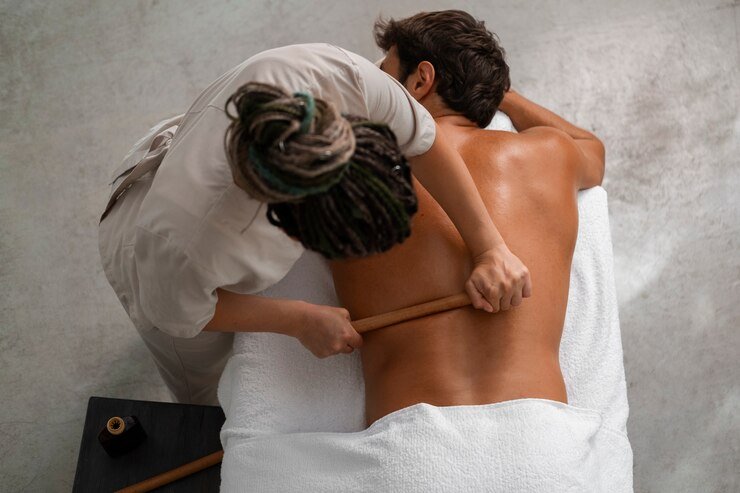
Raking:
Spread your fingers
apart and start at the shoulders and work your way down the back. Use a raking movement
with your hands and avoid touching the spine. You can also try altering
the movement by working one hand upwards and the other downwards.
The Fan Stroke:
This is a popular massage stroke. Request your client to lie face down and kneel down on one side of her. Place your palms in the middle of the back and fan your fingers outward from the spine. Using a fan-shaped stroke, work your hand upwards toward the shoulders and then work your way back down towards the edge of the body. Remember to avoid keeping your palms on the spine itself.
Circular massage:
Start the massage from the lower back region. Place your hands flat with palms facing downwards and use a gentle, anti-clockwise movement. Remember to keep your fingers pointing away from the spine. Use your right hand on the right hand side of the spine and the left hand on the left side of the spine. You can work your hands alternately and repeat as often as required.
Back Petrissage:
This is the relaxing kneading
of back muscles to loosen up tight and stiff muscles. The back muscles
are compressed and released in a rhythmic manner. You can use the one-handed
or two-handed kneading
massage to work on groups of back muscles. Using an essential
and carrier oil decreases the friction and pinching sensation
on the skin.
Hot Stone Massage
Hot stone massage
is also used effectively ease back strain and ache. Heated, smooth,
black stones are placed on strategic points on the back (the stone is usually made of basalt rock). The stone are first immersed
in water and heated until a specific temperature (usually between 120 to 125 degrees).
The heat from the stone helps ease muscular tension and stimulates
blood circulation in the back muscles. Some therapists may give you a light oil massage before placing the stones. They may use the stones to massage your back and then place them on various 'chakras'
in your back. They may also use different sizes of stone for different
muscles – the big ones for larger muscles and so on.
Experts believe that the heated stones posses a charge and re-energise our body energy and aid healing.
7.3 : Ice Massage
for Back Pain:
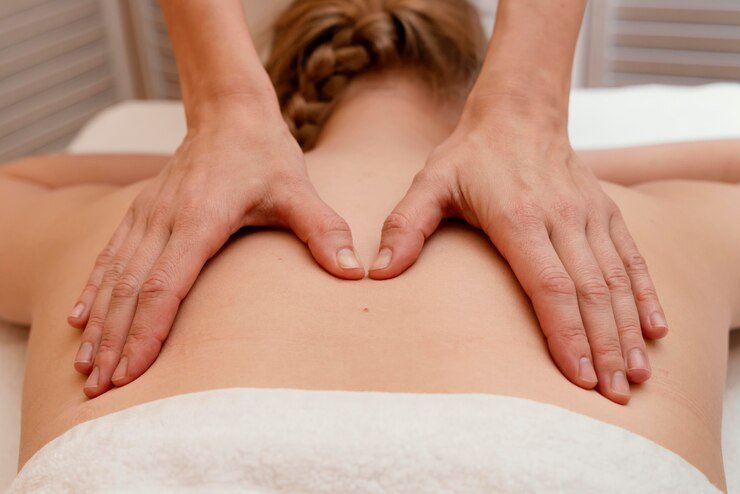
A simple ice massage is still one of the most effective ways to ease lower back stiffness or pain.
Ice
massages are known to provide back pain alleviation in a number of ways:
*Ice reduces
inflammation and swelling
of muscular injuries.
Most back pain problems are cause due to inflammation or swelling of muscles that result in pain.
*Ice has the potential
to soothe sore muscle tissues
and has a similar effect to an analgesic
*The application of ice slows down nerve impulses and disrupts pain-spasm
reactions. In other words, the nerves take longer to transmit pain messages to the brain
*Ice helps reduce muscle tissue damage and shrinks veins, thus reducing circulation to the injured area. When the ice is removed,
the veins overcompensate and there is a rush of blood to the area, thus promoting internal healing of tendons, ligaments
and tissues.
How to Perform Ice Massage for the Back
As far as possible, use a larger piece of ice although
regular pieces can also be used (you can try using a Styrofoam cup to freeze water).
Request the client to lie face down on his stomach. Try and place a towel under the hips for added comfort.
Apply the ice pack gently and in a circular
motion on the lower back region. Focus the treatment
on the area where the client experiences the most pain. Avoid placing the ice on the bony portion
of the spine. Limit the ice massage
to roughly 5 minutes at a time; exceeding this could increase
the likelihood of ice burn.
The key to a successful ice massage is to induce numbness in the pain zone without
causing ice burn. Ice massage for lower back pain is most effective within 24 to 48 hours after an injury.
7.4 : Additional Tips for a Good Back Massage
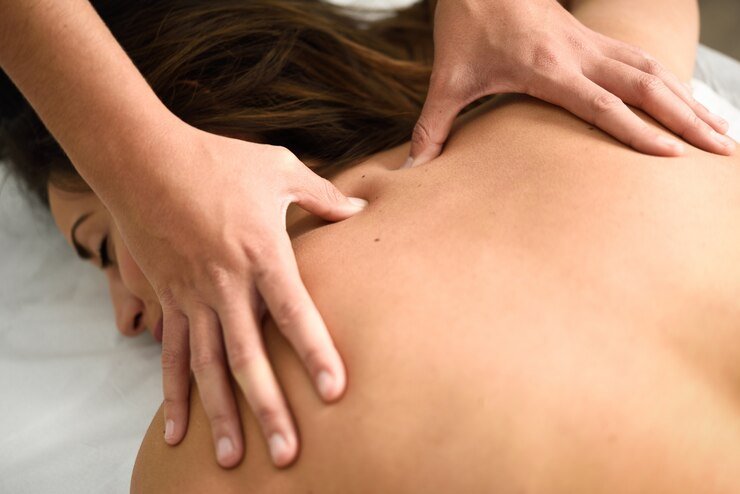
*When you perform the massage, you should feel the muscles move but your client should not grimace or squirm; this indicates that the pressure is excessive
*Avoid rubbing fast and hard (this will only irritate the muscles and skin); use your fingers,
finger pads and thumbs for gentle, firm, even strokes
instead.
*Never push directly on the spine – always work on the muscles
around the spine. Excess pressure
can bruise thin muscle tissue.
*Place
your hands on your client's hips. The firm columns that you are able to feel
under your thumbs hold us upright.
They tend to become stiff and tight at times. Relaxing them can help relive lower back pain
*Place one hand on the lower back with fingers pointing
away from the spine. Now place one hand on top of the other and gently push down on the muscle. Now repeat on the other side of the spine using the heel of your hand every time.
7.5 : Neck Massage

The bones, ligaments and tendons of the neck support the head and allow movement.
Any misalignment, disharmony or malfunction causes neck stiffness, soreness or pain. Most people have experienced neck pain at one time or the other in their lives. Neck stiffness
can also be caused by falls, accidents, poor posture, stress or whiplash.
Other causes could include sleeping
in an uncomfortable position or a poorly designed pillow.
can cause damage to the spine. The top 7 cervical bones of the spinal column form the neck region.
Neck pain may also be caused by degenerative disease
or arthritis.
Neck pain may also be experienced as
deferred pain in the shoulder blades or upper chest region. Tension neck pains can be felt as strain
in the rear of the head. The most type of neck pain is non- specific
neck pain that does not seem to have any obvious cause.
The good news is that whether chronic or mild, neck massages
can help relieve neck pain and can ease muscular
misalignment or stiffness. According to Elaine Calenda, Boulder
College of Massage
Therapy, gentle massage
of the shoulder, back, face,
neck and jaws may all help to ease neck pain.
In addition to providing relaxation, regular neck massages
can keep your entire body free of stress pain. Regular neck massage also helps improve
flexibility, posture and help increase
the range of motion.
7.6 : Neck Massage
Techniques

For massaging the neck area, place one hand on the client's
neck and the other hand on his forehead.
(this part of the vertebrae
is delicate) while extending your thumb slightly
away from the rest of the fingers.
Glide your fingers towards the hairline. Now, let your hand support the head` while slowly tilting the head backwards
within a comfortable range of motion. Lift the head back to its original position and repeat three to four times.
Neck massages help boost blood circulation to the brain.
Simple Compression Massage
Request your client to sit upright in a chair. Stand behind the client and rest your forearms
on their shoulders. Keep your arms as close to the neck as possible and see that the fleshy part of the forearm is placed on the shoulders
and not the bony part.
Gently push down with your body weight on their shoulder. After 2 to 3 minutes,
relax the pressure and move your forearms one inch further away from each other. Now repeat the same process again. When you feel the hard, bony part of their shoulder,
come back to your starting position again.
The Thumb Touch Compression
Request the client to sit upright in a comfortable chair. Now use your fingertips to feel the bony part of the shoulder. Move close to the neck until you are able to feel the fleshy part. Now place one thumb on this portion
(this is also called the 'trapezius muscle')
and place the other thumb on top of the first one. Now push gently, hold the pressure and release after 30 to 40 seconds. Keep moving your thumbs by one thumb width closer to the neck.
Ideally you should be able to complete
3 to 4 compressions before you reach the neck. When you have completed
one set of compressions, return to the starting point and repeat again. After completing 3 to 4 sets of compressions on one shoulder,
move over to the other side of the neck and repeat.
Finger Compression
Stand behind your client and drape your arms over his shoulder,
as close to the neck as possible.
Gently squeeze the trapezius muscle (on the shoulder) between the fingertips
and heel of the hand. Keep your thumbs tucked inside your index finger.
Squeeze the soft muscle for a few
seconds and release (be careful not to pinch the skin). Keep moving your fingertips about inch towards
the bony part of the shoulder. Keep your squeezing movement gentle, steady and firm.
Extensor Muscle
C-Scoop Massage
The extensor muscles located at the rear of the neck are responsible for holding the head upright and can be extremely
tender or stiff due to poor posture or stress.
Cup your hand in a C-shape and gently position
it just behind the rear of the head. Now using your fingers on one side and the thumb on the other, gently massage both sides of the neck in a circular
movement. Now move your fingers
either up or down the length of the neck using a kneading movement
and repeat. Use your fingers
to massage the skin without
rubbing the skin.
Module Summary
In this module you have learned how to give a proper back or neck massage.
You know that back pain is the most common problem for people being absent from work and a lot of your clients will need your help in treating these problems. One must be careful of the spine when massaging
a person's back and neck. You can use firm
techniques on the
back and surrounding
areas.
We have discussed how to give an ice massage and other techniques that you can try with clients.
 |
.svg)



