
2.1 Introduction

What would you do, as a minute taker, if an assertive and outspoken person at the meeting insists that you edit something in the approved minutes?
What would you do if a new supervisor thought the format you have been using to share minutes should be changed to their preferred layout?
To avoid these issues and protect both the organisation and individuals involved, it is critical to have pre-approved standards and a process for approving the minutes.Minutes are not a free-for-all. The minute taker should not be subjected to demands from individuals insisting on different ways of recording or altering the minutes.
But a minute taker might find they are confronted by people asking for amendments. Approved standards can be a safety net when dealing with people that have clout in the organisation. Minute standards provide an objective tool that can help you to deal with confrontations on the structure and content of the minutes with meeting members or management.
If you are working in an organisation that is yet to agree on minute taking standards, you can take the initiative and offer to prepare them for the team or entire company. Their lack is often anoversight rather than an active decision to not have a methodical and agreed upon way of capturing vital notes.
The aim is to have minute taking standards that have been unanimously approved by the relevant team, board or management and have been designed for maximum effectiveness and relevance. This creates security and leverage if someone challenges you to add something that goes against the standards - you can politely remind them that you have heard them but you are adhering to the policy regarding the taking of minutes. It can be an invaluable conflict resolution tool. The minutes are a definitive reminder of what happened even if people do not remember it that way.
Fact
6% UK workers admit to taking naps in meetings!
Source: Arvato
2.2 Taking Detailed Minutes

Choosing the depth of information to be captured is critical to setting the tone of the minutes. As a general rule, each item recorded should be related to one of the agenda items and a numbering system should be adopted for each entry. Even the most detailed minutes should never be verbatim transcripts of the meeting.
On average, minutes should have three sections, the beginning, the middle and the end:
Beginning: this is where the agenda item is explained
Middle: this is where the main points discussed are summarised
End: this is where the outcome of the discussion is recorded
Listening attentively is one of the most important skills in writing minutes. Once you have heard what the participants have said, you also need the ability to mentally sort through the information to decide what to include in the notes and what to leave out. Sometimes, recording the entire meeting can help you to have more time to sort through the discussions when the meeting is over. If you do not want to listen to a recorded audio transcript of the meeting, you might have to write out everything using shorthand or abbreviated notes and work on the minutes after the meeting.
As you listen to the proceedings, take note of the main points. If you take time to prepare well for the meeting, you can even find this process easy and interesting. Whenever you are not sure, just record the point anyway and then revisit it after the meeting to know whether or not you should include it in the minutes.
Recording attendance
Before the meeting commences, make a record of all the invited members that have sent in their apologies and then advise the Chair. Once the meeting commences, update the list to include any other people that did not make it to the meeting. You should also have an attendance sheet to record all the members that are present. There are two ways of doing this - you can have a form where all members manually sign their names to indicate their attendance or you can list all names of the invited members and then tick against the names of those present. Whichever method you chose, be very careful not to leave anyone out because people do not take it very well if their attendance or titles are not accurately recorded.
Recording votes
Depending on the nature of the meeting, you might be required to count and record the number of votes for and against a given motion. This will be important if there is clear disagreement during the discussions that led to the vote. Once the Chair calls a vote, count the hands and if possible, request the members to clearly raise their hands. If it's a big meeting, you can save time by having more than one person counting the votes. Once you have counted the votes, write them in brackets with an explanation before the brackets.
Style of minutes
Make your minutes as brief as possible, but applicable for their designated purpose. The purpose will tell you who the minutes are being written for.
For instance:
If you are writing minutes just for those at the meeting, then you can make the minutes briefer. However, if you are forwarding the minutes to another department or they are required to be a legal record then they need much more detail.
Ordering and numbering
It is advisable to stick to the order that was used in the agenda where possible. Minutes should ideally be numbered including sub-sections, using the legal numbering system, e.g. 1, 1.1, 1.1.1, 1.2, 1.3, etc. as this makes things much clearer. If you are writing minutes that need to be read by another team then it can be helpful to group the minutes under relevant headings, e.g.,“Discussions for the attention of the leading committee”. This makes it easier for the respective committees to easily locate the section that concerns them. Including other subheadings can also make it easier for readers to understand the notes they are consuming.
Picking up the Pace
You can use your own form of shorthand when taking the notes to reduce the amount of time spent on taking the notes.
For example:
Using standard or personal abbreviations for common words can really speed the process up.Examples of shorthand you can use include: initials instead of names, symbols to represent long words, abbreviations, and short form of words. However, be careful not to use symbols and shorthand you will not understand afterwards. Even just a few shorthand abbreviations can really speed up your writing and make it easier to keep up with the conversation check out some of these and see which might work for you:
Examples of Abbreviations used for Minute_Note Taking
When taking down notes, it is always advisable to indicate the initials of the speakers to help you know who said what. You may not need to name the names of the participants in the final copy of the minutes, but having the initials in the notes is important in case you want to consult with them to clarify something they said. It can also help in case any dispute arises concerning who said what. If you do not hear something well, do not panic because that can make you lose even more points. Instead, request for the speaker to repeat or clarify the point. If this is not possible, seek for the clarification after the meeting from the speaker or from the Chair if the speaker is unavailable.
Fact
We write at about 40 words per minute (wpm) but we speak at around 150-180wpm. A good speed for a minute taker is 80wpm, a journalist needs about 100wpm and using Teeline shorthand you can increase to 200 wpm, the world record is 350wpm!
Source: Pitman London
Activity 1: News Minutes
Estimated time: 20 minutes+
Find a news-like broadcast on TV or the internet which is reporting on a discussion, meeting or event. Look for something with multiple speakers and opinions like a panel debate or opinion event. Find something you can watch repeatedly so you can practise your shorthand, and choose something of about five minutes long.Based on your preconceptions of the piece, chose a few shorthand symbols that might be useful for you.
Watch the piece and take notes of the important facts and opinions, ensure you capture who said what
Pay attention to how often you used the symbols and which ones worked for you
How well did your notes come out?
Would you be able to produce a set of minutes based on them?
Working out the best method for you is important for both speed and accuracy; you might need a mixture of methods, mediums and devices to optimise your output.
2.3 Filing and Archiving Minutes
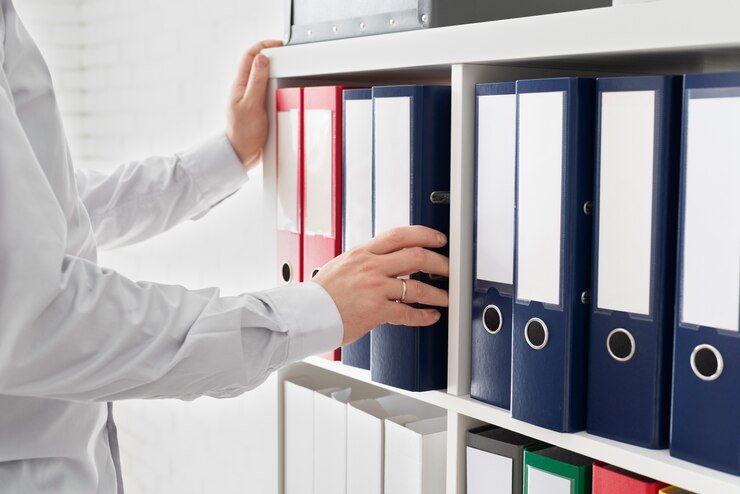
Some organisations are still required to save and archive physical copies of minutes. For legal or regulatory purposes volumes are printed and archived in bomb and fireproof storage. This is often achieved by binding printed minutes or collating in files and folders. Beware of rust or plastic folders which will deteriorate with time, thereby causing damage to the documents insidethem. If the minutes will not be bound in the near future, then a good springback binder can be used to store them. They are ideal because they hold the papers firmly in place and also because they do not have exposed metal clips which can erode or rust over time.
Even though hard copies are important, you should also archive an electronic copy of the minutes.Most organisations are moving away from paper and using shared storage networks or cloudarchiving. Keeping an easily accessible copy of current and historical minutes in the company's document management system ensures attendees can access relevant information in a timely way. For easier access of formal and ongoing meetings, create a folder for each Year and then create in it a subfolder for each Month. You could also have different subfolders for different types of meetings, e.g. departmental meetings, management meetings, board meetings, etc. In addition, name the file as descriptively as possible.
For example:
You can use the syntax - “NameOfMeeting_Date” e.g. BoardMeeting_28 Nov. 2017. Once the minutes have been approved, save them as read only files to avoid unauthorised personnel from making any updates or edits.
Activity 2: Archiving and Electronic Filing
Estimated time: 15 minutes+
What are the document requirements for meeting minutes in your organisation?
Investigate the current methods for creating physical and digital copies
Is this process working effectively or are there any gaps or redundancies?
How do people feel about the meeting minutes process, are archived versions easily accessible?
Are meeting minutes stored in a methodical manner?
Are legally required copies being kept and protected?
Are there any policies or standards in place?
Understanding the current situation will help you determine what changes may be required to elevate the process and its outputs and make them more effective.
2.4 Minutes Layout

Writing minutes is not like writing a novel where you come up with your own plot and structure - there is a predefined way of structuring minutes that needs to be adhered to. Minutes are official documents and they often create a trail of evidence for audits and disciplinary issues. This is why they have to be structured in a given way. Following a specific layout also helps the readers to know exactly where to find what they are interested in. The pre-defined structure makes writing minutes more simple - all you need to know is the structure and then just follow it. Let us look at some of the important parts that should be covered in minutes.
Title
The heading title should contain the name of the meeting (e.g. Meeting of the Departmental Heads), the date and time the meeting is taking place, and the venue of the meeting
Present
A list of all the people who made it to the meeting. To avoid confusion, you can list the names alphabetically, but remember to identify the Chair
Absent with apology
A list of all the members that notified the meeting in advance that they were not able to attend. It is also of value to include those who are absent without an apology. If the same people or group of people are frequently not attending their need to attend should be questioned.
Approval of previous minutes
The minutes are the full responsibility of the committee and they should always be given a chance to review and accept or propose amendments. This is done by asking the team to approve the minutes of the previous meeting before embarking on the new agenda.
Matters arising
This is the section where the action points from the previous meeting are looked into to see if they were followed through. If not well managed, this can turn out to be a very chaotic time. Reasons should be given for any matter yet to be actioned and an estimate given of when it should be done. This activity is often done 'offline' before the meeting and only problematic actions are brought up.
Topics and discussions
This is the section that outlines the discussions and decisions made from the agenda items and topics covered at the meeting; this is usually led by the agenda.
Confidentiality
Decisions on items of confidentiality should also be included in the minutes. The governing committee determines what is confidential so you should consult with the Chair on this.
Date of next meeting
The minutes should contain the dates of the next meeting clearly outlined.
Signature or approval
Once the minutes have been ratified by the Chair, they should be physically or digitally signed. Key items to include:
Minutes should always take the flow of the meeting - If an agenda is taken out of order, the minutes ought to reflect the agenda change
Decisions and the discussions that led to them must be recorded in the correct order
Motions should be properly laid out to make them stand out from the discussions and reports -
a motion must have the name of the person that made it, the seconder of the motion and whether or not the motion went through
The minutes should also identify the conversations that were tabled for later in the meeting or for a future meeting
Directions or action steps should be outlined in detail and with specific timelines
Any handouts that were used in the meeting should also be referenced in the minutes and then included as an attachment
2.5 Taking Notes

Accuracy is of utmost importance in the note taking exercise. To do this, you will need to listen attentively to the words that are spoken, evaluate and think about the point of view of the speaker, and then summarise the message that was being passed. Even if you do not agree with the speaker, you must be neutral and objective in your reporting. To ensure accuracy of motions, the minute taker should be allowed to politely interrupt the proceedings to seek clarification from the speaker. The words you use in the reporting will have an impact on the message you communicate.
For instance:
Most people make the mistake of using could, would and should interchangeably when writing minutes. But these three words have totally different connotations:
Should - it means that something ought to occur
Could - it means that something might occur
Would - it means that something will occur
Motions and resolutions
The two words “motion” and “resolution” are often used interchangeably but they actually mean two different things. A motion refers to a proposal that is put before a meeting for purposes of taking an action or making a decision. With this in mind, we can accurately state that a motion is a proposed resolution. When a member makes a motion, we say a motion has been proposed or moved.
On the flip side, a resolution refers to a motion that has already sailed through. A resolution is therefore the end result of a motion that has been approved. Motions that have been resolved are in some cases legally binding.
There are two broad categories of motions:
Substantive motions: are concerned with the opinion of the members on a given issue and the decision they make.
Subsidiary or procedural motions: are concerned with the conduct of the meeting itself and not the content of a proposal. An example of such a motion is moving that a meeting be adjourned.
The minute taker should record both motions and resolutions indiscriminately, whether substantive or subsidiary.
Motion drafting conventions
As you take minutes, you should also carefully keep track of all motions because you might be requested by the Chair to read the motion out to the members. If a member makes a motion that is too lengthy to record as is, request them to provide a written copy for purposes of inclusion in the minutes.Also keep track of any amendments to motions so that you have the correct version of the motion at the end of the meeting. Writing motions in capitals or highlighting them can help you to quickly locate them, especially if you have several pages of notes.
There is very little a minute taker can do to change the wording of a motion once a resolution has been made in a meeting. Nonetheless, you can still influence the wording and form before a resolution is made. If the motion was made verbally, you should write it down very carefully. Just to be sure you captured it right; ask for a chance to read it out aloud for everyone to hear. This should be done before it is voted on because after the vote, it is as good as sealed.
The following conventions should guide you when drafting motions:
Motions should start with the word “that” e.g. “that the recommendation for...be adopted” Use the verb “be” instead of the word “is” when phrasing motions, e.g. “that the recommendation be adopted” Express the motion using one positive sentence to avoid any confusion during voting Composite motions should be carefully worded to allow it to be broken down into segments so that each segment can be dealt with individually The motion must be in line with the objectives of the committee and be relevant to the organisation.
Activity 3: Minutes Structure and Layout
Estimated time: 15 minutes+
Minutes have a predefined structure that they should adhere to. Develop a template which you can use to take minutes:
The template should adhere to the minimum requirements It should also be consistent with what your company requirements are and should meet your needs For informal minutes you can customise colour and font to make it more visually appealing Test your template out with some dummy content, for example the news minutes from the previous exercise. If your organisation already uses a pre-defined template, then this exercise has already been done for you, simply get hold of a copy and ensure you are comfortable with using it!
Take a Quick Recap Test
[viralQuiz id=422]
2.6 Recording Minutes

Using an audio recorder for taking minutes is a great way of ensuring accuracy when compiling minutes. There are some guidelines that must be adhered to when using an audio recording device. You need to ensure compliance with data privacy and it is advisable to let people know you will be recording the meeting. The recording of minutes is commonly used in lengthy meetings and when the accuracy of the proceedings is very important. It can also come in handy for evidential purposes in legal meetings. However, recording does not replace the formal note taking. It should be looked at as a complimentary tool and not a supplementary one. The hard copy is always safe because technology can fail during or even after the meeting.
Notification of recording
Before you bring a recording device into a meeting, you must notify those attending of your intent to record the proceedings. This will help you avoid any privacy or confidentiality issues. If there is a member who objects to the recording, let the Chair of the meeting know and the Chair will rule on the matter. Upon reviewing the objections the Chair may find them to be genuine concerns and you will not be able to record the meeting. Before the meeting kicks off, the Chair must also remind the members that the minute taker will be recording the meeting. This notification should be done before the actual recording begins. Once the meeting formal closes, the recording should also stop. Meeting attendees who come in later must also be notified of the recording. Meeting attendees may talk privately after the recording has been
switched off at the end of the meeting. These private conversations should not be recorded as part of the formal meeting.
Device security
The devices to be used for the recording should be secure and only authorised people should record the meeting. If another person requests to make a recording, the Chair will consider the merits and demerits of the request and advise accordingly.
The following are some device security considerations which may be relevant depending on the level of security of information in your organisation:
The device must be running the latest operating system: security updates are typically only given for the latest versions
The device should use encryption; old devices that do not allow encryption should be replaced
Strong passwords and passcodes should be allocated to the accounts that are given access to the device
Devices should have screen saver passwords and auto-lock when inactive for a few minutes
Devices that are susceptible to malware must run an updated anti-virus software
Any loss of a device must be reported immediately
Retention and storage
The recorded files should always be stored in a secure folder with limited access. Only those authorised to access the file should be granted access privileges. The recordings must always be retained for a reasonable period of time, but there should also be a schedule for data destruction. It would make sense to have the recording saved up until the minutes have been signed and accepted in the next meeting. If the meeting was a hearing, it might be a good idea to retain the recordings until all proceedings are over.
The length of time that a recording is kept for must be determined by the regulatory and legal requirements of the business. Some businesses require a much more stringent level of data storage due to the possibility of future legal action against them, such as the pharmaceutical industry.
There is typically a period during which the data must be kept for and a period by which the data should be destroyed; in between there are often review periods to confirm the requirements have not changed. Staff must be made aware of that all recordings will be governed by the Data Protection Act and the Freedom of Information Act where applicable. For this reason, any information request should be passed through the information rights officer or their equivalent in the organisation.
Assignment
Standards for Minute Taking
Time: 30+ minutes
Hopefully, you took in as much of the information in this module as possible. To find out how well you have done, complete the following worksheet.
Module Summary
In this module we discussed minute taking standards. Standards are important because they define pre-agreed operating procedures that are beneficial both for the minute taker and the organisation at large. When standards are set and adhered to, they avoid conflict between the minute taker and other stakeholders and significantly improve efficiency and aid accurate communication. We looked at some key components of standardisation: the importance of sticking to the agenda items in the discussion as well as the meeting notes; using a specific numbering system; formal approval processes and storage requirements.
.svg)



