
5.1: Time Zones

When you're working in aviation, the time zones will be referred to using the 24-hour clock. This is done to avoid any confusion over AM and PM. Instead of 1 PM, it'll be referred to as 13:00 hours. The easy way to remember this is to add twelve to the PM time. Two PM becomes 2 + 12 , which is 1400 hours.
Another important element of this line of work is how your geographical location affects time. This is especially the case when you're flying to international destinations, as there are numerous time zones, which will take a bit of getting used to. In aviation, the universal time zone is displayed in UTC which utilizes both positives and negatives. It's used to synchronize time zones together into a universal time used internationally.
The abbreviation used is UTC, despite it representing “Coordinated Universal Time”, which would be CUT, but it's not. The reason for this is that international resemblances would bring about confusion. In aviation, the time term is Zulu Time, based on military time zones, when it represents UTC.
Now with the Coordinated Universal Time (UTC) there's no confusion over Zulu Time Zone whenDaylight Saving comes into effect. The UTC simply adds or subtracts 1 to bring into affect the civil time in the country the flight arrives at. All time zones are referred to as UTC+1 or UTC-1 and range in whole numbers from UTC-12 to UTC+14. There are international time zones that will use an additional fraction to establish the local time zone. Those will be displayed as (example) UTC+5.45 which is local time zone for Nepal.
UTC was officially formalized in 1960 by the International Radio Consultative Committee in Recommendation 374, having been initiated by several national time laboratories. The system was adjusted several times until leap seconds were adopted in 1972 to simplify future adjustments.
source: wikipedia
5.2: Currency Conversion

When you're working in cabin crew, you'll be responsible for the sale of duty-free products.
Those can include items such as:
1.Perfumes and Aftershaves
2.Cosmetics
3.Jewellery
4.Toys
5.Gifts
6.Gadgets such as earphones
7.Alcohol
One of the niceties about this part of the job is that airlines pay their cabin crew a commission on the total sales made. Therefore, it's in your best interest to have your trolley presented professionally and aesthetically pleasing to create the attention you need to drive the sales.
However, the most important thing you can do is get the basics down on currency conversion first. Prior to employment, airline recruitment will often include a maths test to ensure you have the numeracy skills needed to calculate your sales during a flight.
When you are doing a test, be sure that you read the questions carefully, as you have to know the rate of the currency to use in your answer. Are you changing a foreign currency into GBP, or from Pound Sterling, to Euro? Answer it appropriately, and it is really simple to do. Currency conversion is as simple as multiply or divide. Any maths test you do will stipulate the exchange rate to use. To keep things simple, the example below will use round numbers to illustrate currency conversion.
Example
Selling a set of earphones at £10, with an exchange rate of 1.5, would bring the price to 15 Euro. If it was the other way around and converting the Euro price to GBP, you'd divide the price by the exchange rate to bring it to the pound sterling price. 15 divided 1.5 brings you to £10. Just remember to divide or multiply to get the price due from customers. During a maths test, be sure to double check the rate of conversion you use is correct, and make sure you've multiplied or divided to get the total price in the correct currency. A common error is mistakenly dividing instead of multiplying or vice versa, and that will destroy your takings at the end of the flight.
5.3: Duty Free Selling
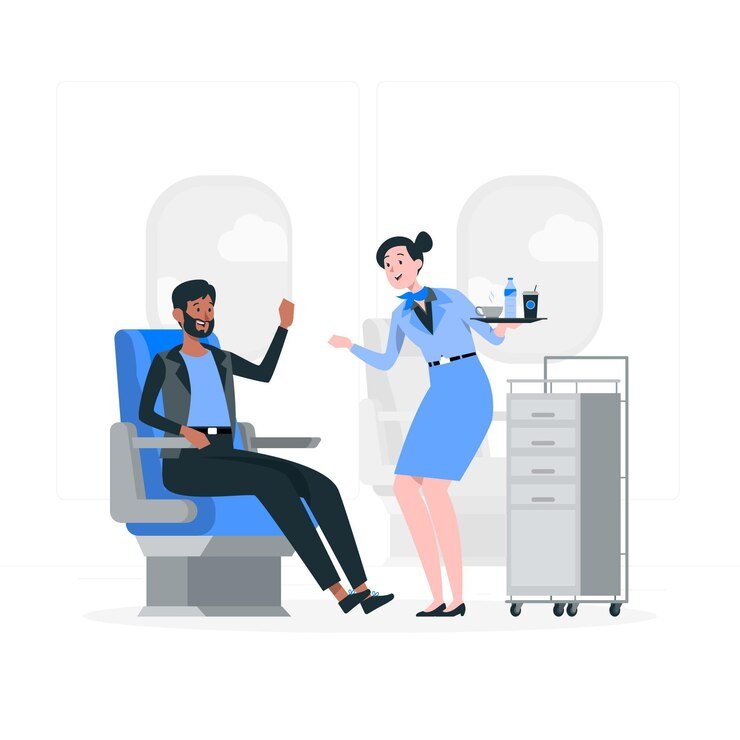
Nearly all airlines will pay a commission to cabin crew members based on their total sales volume. Therefore, the more sales you make, the more you can increase your salary beyond your basic pay. Typically, you can expect to earn between 1% and 2% of your total sales volume. If you're working with a budget airline, maximizing flight time in the air, you'll have even more selling opportunities, but never forget your primary role is always safety.
The more you're up and down the aisle with your trolley, the more engaged you'll be with the passengers on-board the flight, and this presents an excellent opportunity to observe the passengers' behaviour..
In terms of improving the sales you make, experience is what matters, as the more familiar you are with the products available, the more you can understand the benefits each product offers. It's those benefits that will allow you capitalise on the sales potential, and grow your sales volumes significantly.
The sales process used in the sales and marketing world uses a four step process known as A.I.D.A.
A – Attention
I – Interest
D – Desire
A – Action
The attention begins with your window display which will be your trolley. The better you can present it, the more attention you can draw to the products you want to sell. Aiming to highlight the pricier products is a great way to boost your commission, but you may also want to ensure customers' eyes are drawn towards the more useful products, as they are more likely to buy them. That could be ensuring that earplugs are within high visibility, with beverages being on the lower shelf. The better you can present the trolley will bring attention to your product inventory.
To create interest, people pay attention more to what's said at the beginning of your pitch and at the end. Everything in between is pretty much filler, but your body language will speak louder so pay attention to the way you present the products to the customer, always sounding upbeat, as you move into the part where you create the desire to buy the product. Once the customer desires a product, you are well on your way to securing that sale.
For those struggling with sales, it's usually down to the desire aspect. You need to create the desire and you do that by focusing on the benefits each product has for the consumer, which in this case is your passenger. This is where the sales become easier. With experience, you'll grow your knowledge on the benefits each product you have to offer to consumers.
A lipstick and brush applicator might be presented as being convenient, but a better way to promote it could be saying it contains both the lipstick, (choice of colours where applicable), a brush applicator. You may also want to focus on the ingredients, and how they can benefit the customer too. For example, if it contains aloe vera, you can highlight that it will soothe their lips after a long flight.
Doing this highlights the benefits in a manner someone can familiarise with right away, so that they know the product is beneficial for them, and not just another lipstick to make them look good. The more familiar you are with the products on offer, the better your presentation will be. The more you create the sense of desire, the more urge there will be on the consumer's part to take the action you need for them to buy the products. That's when you'll boost your salary through commission.
Module Summary
In this module you learned about the geography of the different regions you will visit, and how each destination affects your role. One of the primary ways geography affects your job is through the difference in time zones. Knowing how to calculate these time zones, how daylight saving affects them, and how to manage your sleep cycles within each one makes your job easier. Not adjusting your watch or phone to adapt to the time zone you land in is never an excuse for making it back to the plane late, so familiarising yourself with the basics now could save you your job. In addition, it helps to know a little about currencies. Many cabin crew interviews now employ the use of a maths test, have you ever wondered why this is? It is because part of your role in the air is to act as a sales person, which means you need to
make calculations, especially when customers hand you different currencies.
.svg)



