
1.1 Opening the Conversation
.jpg)
While many parts of society have become more open towards speaking about mental health, the topic still faces significant stigma within the construction industry. For many who work in this sector, it can feel like a conversation that's just too hard to have. If this is how you or perhaps a colleague/employee is feeling, you/they are not alone. As hard as it can feel, it's a conversation that really needs to be had; however, it must be done in a straightforward, down-to-earth and normalising manner because so many people are affected by it.
This course speaks about mental health as a completely normal part of life because this is a vital part of the destigmatisation that needs to take place. Just as we all experience physical health — and are always in a state or relatively better or worse physical health — so too do we all have mental health, and so too are we always in a state of relatively better or worse mental health. Mental health is simply a fact of life, and it is with this perspective that this course aims to open up dialogue and help you to find the language to express and understand your own mental health experience and the experiences of others around you in your sector.
1.2 The Construction Industry Picture
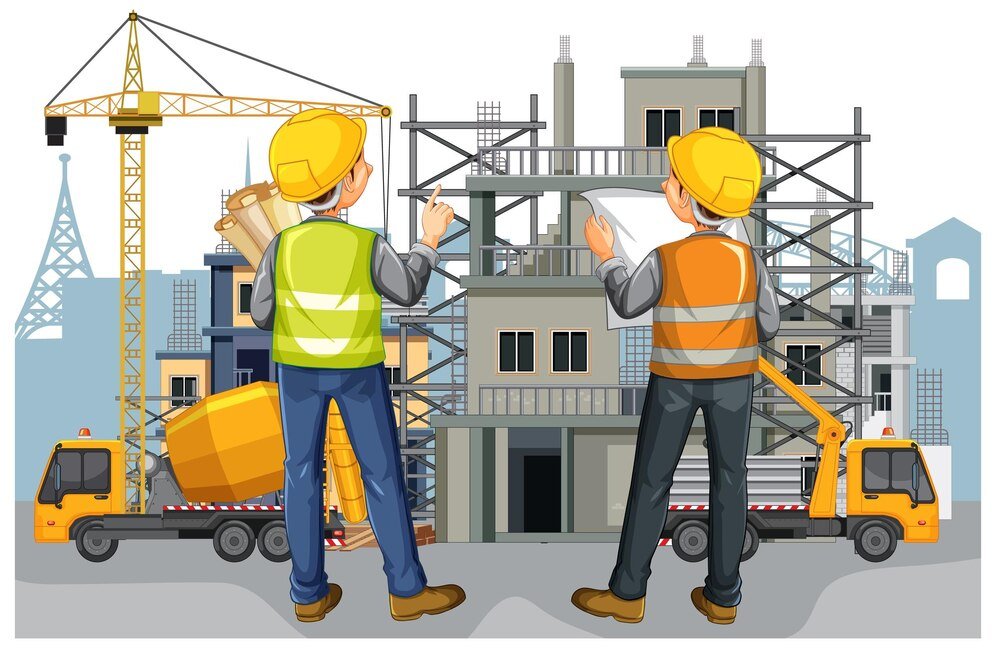
The construction industry in the UK employs 2.4 million people, who, every year, lose 400,000 working days to mental ill-health. The Office for National Statistics recorded that the risk of suicide among low-skilled male labourers, particularly construction workers, was three times the male national average between 2011 and 2015 (latest available figures).
Every working day, two construction workers in the UK commit suicide, according to The Lighthouse Club, a construction industry charity.
Why is it that these statistics reveal such elevated levels of mental ill-health in construction workers?
What is it about construction work that may be leading to these outcomes?
What do we need to specifically understand about ourselves as people and about the construction industry, in order to see what's going on here?
When we see and understand ourselves better, alternative options open up around our mental health, and we can experience an easing of part of the burden of bearing our mental health struggles alone and uninformed.
1.3 Factors

Just as there are numerous contributing factors to our physical health — for example, our nutrition, amount of exercise, provision of warmth, shelter and clean water — so too are there a host of factors that affect our mental health. Some of them are the very same factors that affect our physical wellbeing, such as diet and exercise, but others can be more subtle and less obvious, yet no less potent in contributing either to mental wellness or mental illness.
Human beings are remarkably sophisticated biologically, and the body's response to our environment is incredibly attuned and sensitive. If we are subjected to experiences that our mind and/or body find stressful or difficult, the whole system responds. This is not a choice; it is an automatic process and is hard-wired into us for optimal functioning. It's important to understand this as part of the mental health picture.
1.4 The Stress Response

When we are triggered by difficult situations — for example, dangers, threats or sudden surprises — our system goes into 'survival mode' and generates a stress response. Specific hormones, such as cortisol and adrenaline, are released, and the body goes into 'fight or flight' mode. For the body, there is no difference between our evolutionary response to a life-or- death threat from a predator and, nowadays, a remark from a colleague that leads us to feel at risk of rejection from the group.
Times have changed, but our biology has not, and we have evolved to experience a profound need to feel seen and heard and accepted by those around us. Togetherness and cohesion have always been essential to human survival, which is why peer pressure and cultural issues run so deeply through our feelings of wellbeing or otherwise. When we don't feel safe and welcomed by those around us, feelings of isolation and despair can accumulate and contribute to the development of mental illness if they are not addressed. When we understand this process and can observe this happening, as a natural response, it can help us to get some distance from some of the distressing thoughts and feelings that can often accompany experiences of stress, especially when we don't understand why we are having them and may feel that we shouldn't be having them.
As an example:
Feeling out of control financially, due to unpredictable working rotas, and struggling to maintain a routine can leave us overwhelmed and depleted, while feeling a constant need to prove yourself within a 'macho' culture, which derides and rejects any sense of perceived weakness, is another way in which the culture of the construction industry can be damaging to mental health in the long term.
All of these aspects of day-to-day life in the construction industry can prolong a stress response in the body, which, over time, can manifest both as physical and psychological suffering, both of which can predispose mental ill-health. Most people are able to withstand some stress for a certain length of time, and this is a healthy response which enables us to handle difficulties. Seen in this light, stress itself is not a mental health problem or something pathological.
However, long-term or chronic stress is a predisposing factor for other more serious mental health concerns, such as depression and anxiety, because it simply isn't healthy to live in a state of chronic stress. It can affect the way we think, our emotions, and our ability to cope, all of which are areas in which we may start to experience mental ill-health.
1.5 Chronic Work Stress as a Gateway to Mental Ill Health

While work stress isn't the only contributing factor towards depression, depression can be the outcome of living in a state of ongoing stress, as can anxiety, and many people working in construction experience a mixture of both. Both depression and anxiety are recognised, diagnosable mental health conditions and can both be caused by an original stressful stimulus, for example, working conditions, and are often experienced as part of a vicious cycle.
It's possible to feel anxious about feeling depressed and depressed about feeling anxious and to feel stressed about both, and it can be a very difficult cycle to break, without proper support. For further clarity, we will look in more detail at depression and anxiety in Module 2, as well as how to recognise them and what steps to take if you do, both for yourself and someone else.
1.6 Structural Stress Factors in the Construction Industry
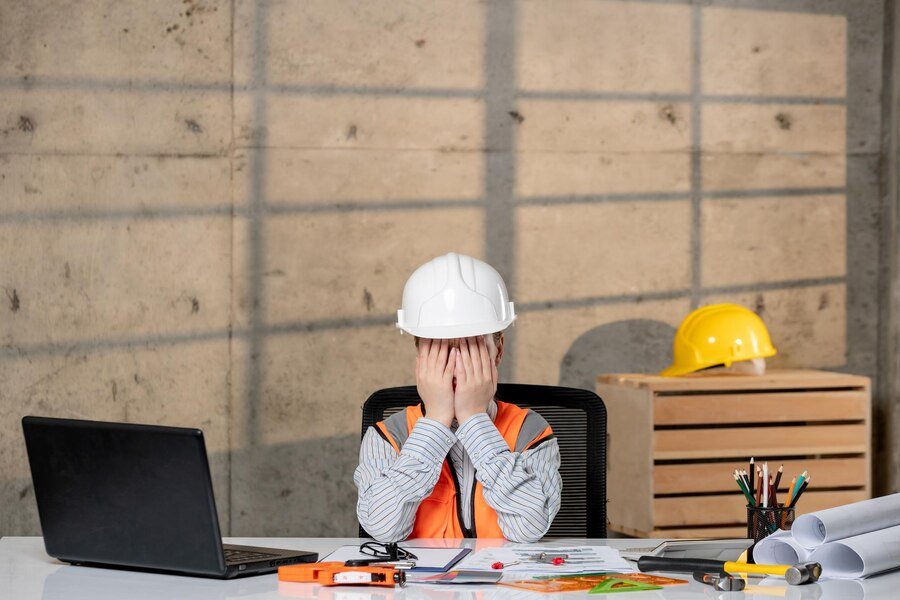
Many of the characteristics of working life in the construction industry are stressful. Here are just some of the factors specific to construction that workers commonly find most challenging:
1.Lack of job security and financial stability, as a result of labour being contract-based
2.Strain of continuous physical work; every year in the UK, 2000 construction workers are left unable to return to work, due to accidents, with many more experiencing less major, but, nonetheless, difficult injuries and ailments.
3.Lack of routine, which can make maintaining a healthy diet, and sleep and exercise pattern, very challenging, all of which are proven to be integral to good physical and mental health
4.Travel necessitating time spent away from loved ones
5.Work conducted in isolation
1.7 Social Stress Factors

Loneliness is another key contributing factor for many people's experiences of anxiety and depression; however, sometimes, the presence of other people can be as much of a trigger as isolation. The social and cultural conditions of the construction industry are important to consider — construction is a heavily male-dominated environment, and it embodies a strong 'macho' culture, in which it is not acceptable to speak openly about feelings or show signs of vulnerability. This can lead to individual fears of being perceived as weak or incapable by the group, which, in turn, frequently pushes people towards operating outside of their comfortable limitations, either risking their individual physical safety manually or while using machinery.
Meanwhile, the UK has over a million construction firms, and, in many instances, these can be small family-run businesses, whereby other specific social dynamics, expectations and pressures may apply, and this can lead to people feeling compromised in their ability to speak out. The flux of casual labourers throughout the industry can lead to feelings of constantly needing to prove yourself in the job, in order to retain work. This can lead to an internally and externally felt pressure to come across as more capable and confident with tasks than perhaps you may be.
Facing a perceived need or expectation to perform at a level that feels outside of your training or comfort zone is a stressful, sometimes even traumatic experience, and, therefore, for construction workers who live with this day in day out, the burden on mental health can be very high. The 'macho' culture can serve a compounding blow, by creating a feeling that it's not possible to talk about your struggles, which can push people significantly further into mental illness.
1.8 The Importance of Speaking Out

Talking to someone about your experience is one of the most important steps in taking ownership of your mental health struggles and pursuing recovery. Very often, the relief felt sharing your experience can, in itself, trigger a profound improvement in symptoms of conditions such as depression and anxiety.It is now vitally important for the construction industry to reflect on how it can build into its structures and processes ways for its workers to feel comfortable talking about how their work is affecting their mental health and how their mental health may be affecting their work.
Creating opportunities for open dialogue helps to render feelings of hope, instead of isolation, and opportunity, instead of entrapment. It offers the chance for symptoms to be alleviated by discussing workplace triggers and improving general awareness, which also goes a very long way towards helping people experience the mental health benefits of feeling understood and valued, as well as promoting a cultural shift.
Moving forwards, it will be important to look into how mental health discussions can be accommodated within screening procedures, for example, in the same way in which physical screening often routinely occurs to ensure that workers are physically capable of the work required. Confidentiality in these spaces is key to ensuring that people feel safe and supported, and if mental health consultation could be included in such processes, this could provide some important ground for the foundations of a new culture around vocalising mental health in the construction industry.
MODULE SUMMARY
We all experience mental health, just as we do physical health, and this must be normalised. Stress can be a big factor in predisposing construction workers to mental ill-health, based on the nature of the stressors they commonly experience within the workplace. The 'macho' culture of the construction industry compounds mental ill-health as long as it deters people from sharing their experiences of mental health. Work must be done to create safe spaces for speaking out within the construction industry, to broker individual changes and a cultural progression away from stigma.
In Module 2, we will discuss the common mental health problems of depression and anxiety.
.svg)



