
Module 1: Electrical Fundamentals
Basics of Electricity (Voltage, Current, Resistance)
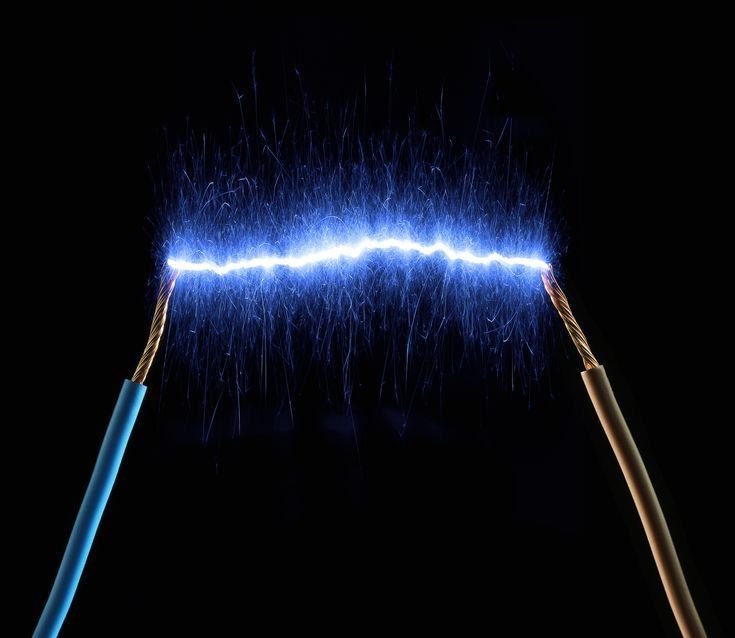
Electricity is the flow of electrons through a conductor, and its behavior is governed by three fundamental quantities: voltage, current, and resistance.
Voltage (V), measured in volts (V), represents the electrical potential difference between two points, acting as the driving force that pushes electrons through a circuit.
Current (I), measured in amperes (A), is the rate at which electrons flow past a given point in a circuit.
Resistance (R), measured in ohms (Ω), opposes the flow of current and is determined by the material, length, and cross-sectional area of the conductor. These three properties are interconnected, forming the basis of electrical theory and circuit analysis.
Ohm’s Law and Power Calculations
Ohm’s Law is a fundamental principle in electrical engineering, stating that the current through a conductor is directly proportional to the voltage and inversely proportional to the resistance. Mathematically, it is expressed as:
V=I×R
V=I×R
This relationship allows engineers to calculate any one of the three variables if the other two are known. Additionally, electrical power (P), measured in watts (W), represents the rate at which energy is consumed or produced in a circuit. Power can be calculated using:
P=V×I
P=V×I
Or, by substituting Ohm’s Law:
P=I2×R
P=I
P=V2R
P=
R
V
2
Understanding these equations is crucial for designing circuits, selecting appropriate components, and ensuring efficient energy use.
Electrical Safety (Lockout/Tagout, Arc Flash)

Working with electricity poses significant hazards, making safety protocols essential.
Lockout/Tagout (LOTO) is a critical procedure used to isolate energy sources during maintenance or repairs, preventing accidental energization. It involves physically locking switches or breakers and tagging them with warnings to alert personnel. Another major hazard is arc flash, a dangerous release of energy caused by an electrical fault, resulting in extreme heat, explosive pressure, and molten metal. Proper personal protective equipment (PPE), arc-rated clothing, and adherence to safety standards (such as NFPA 70E) are necessary to mitigate risks. Regular training, hazard assessments, and compliance with safety regulations help prevent injuries and fatalities in electrical work.
By mastering these fundamentals—electricity basics, Ohm’s Law, and safety practices—individuals can build a strong foundation for further study in electrical systems and ensure safe, efficient work environments.
Conclusion
By understanding electrical fundamentals is essential for working with any electrical system. Key concepts like voltage, current, resistance, and power form the basis of circuit analysis and design. Ohm’s Law and Kirchhoff’s Laws provide the foundation for solving electrical problems, while knowledge of components such as resistors, capacitors, and inductors helps in building and troubleshooting circuits. Mastering these principles ensures safe and efficient handling of electrical applications, whether in simple circuits or complex systems. Continuous learning and practical application of these fundamentals are crucial for success in electrical engineering and related fields.
.svg)



